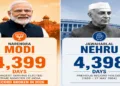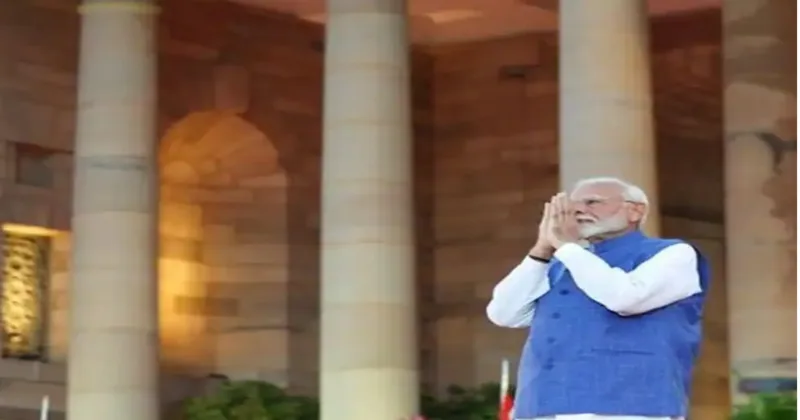
As PM Narendra Modi completes 4,399 days in office and becomes the longest-serving Prime Minister of India, a significant milestone in the nation’s democratic journey has been reached. While longevity in public office by itself does not guarantee greatness, history often judges leaders by the transformation they bring to their societies. In the case of Prime Minister Narendra Modi, his twelve-year tenure has fundamentally altered India’s political discourse, economic ambitions, global standing, and governance architecture.
For millions of Indians, Narendra Modi is not merely the head of government but a “Pradhan Sevak”—a public servant who has consistently emphasized service before power. His leadership has been characterized by a blend of welfare-driven governance, bold decision-making, cultural confidence, and an unwavering focus on national development. Whether one views his tenure through the lens of economics, foreign policy, social welfare, or national security, there is little doubt that his years in office have left an indelible mark on modern India.
Governance with Last-Mile Delivery
Perhaps the most transformative aspect of the Modi era has been the revolution in governance delivery. For decades, welfare schemes in India were often weakened by leakages, middlemen, and inefficiencies. The integration of Jan Dhan bank accounts, Aadhaar identification, and mobile connectivity created what came to be known as the “JAM Trinity.” This architecture enabled direct benefit transfers to reach beneficiaries with unprecedented efficiency.
From free LPG connections under Ujjwala Yojana to housing under PM Awas Yojana, from rural electrification to piped drinking water through the Jal Jeevan Mission, governance increasingly became measurable by outcomes rather than announcements. The idea that government benefits should reach the poorest citizen directly became a defining feature of the administration.
The scale of welfare initiatives undertaken during this period is unprecedented in India’s history. Yet what distinguishes them is not merely their size but their execution. The emphasis on transparency, technology, and accountability has redefined the relationship between the state and the citizen.
Reimagining India’s Economic Aspirations
When PM Modi assumed office in 2014, India was grappling with economic uncertainty and policy paralysis. His government sought to reposition India as a major global economic player through structural reforms and infrastructure expansion.
The introduction of the Goods and Services Tax (GST) created a unified national market. The Insolvency and Bankruptcy Code strengthened the financial ecosystem by addressing non-performing assets. Initiatives such as Make in India, Startup India, and Production Linked Incentive (PLI) schemes sought to boost manufacturing and entrepreneurship.
Equally significant has been the massive expansion of infrastructure. Highways, expressways, airports, ports, railways, and digital infrastructure have grown at a pace rarely witnessed before. Infrastructure has been viewed not merely as construction but as a catalyst for economic productivity and national integration.
India’s emergence as one of the world’s fastest-growing major economies despite global disruptions—including the COVID-19 pandemic, geopolitical conflicts, and economic uncertainties—has strengthened confidence in the country’s long-term trajectory.
India’s Rise on the Global Stage
One of the defining achievements of Narendra Modi’s leadership has been the elevation of India’s international stature.
India today occupies a position of greater influence in global affairs than at any point in recent decades. Whether through leadership in the G20, active participation in the Quad, strengthened relations with major powers, or advocacy for the Global South, India has become an increasingly important voice in shaping international discourse.
Prime Minister Modi’s diplomacy has combined strategic pragmatism with civilizational confidence. India has successfully maintained relations across competing geopolitical blocs while safeguarding its national interests. The country’s growing role in technology, supply chains, climate action, and global governance reflects this enhanced stature.
The successful presidency of the G20 and the admission of the African Union as a permanent member under India’s leadership symbolized a broader vision—one where India acts not merely as a participant in global affairs but as a shaper of global outcomes.
National Security and Strategic Confidence
A major pillar of the Modi legacy is the strengthening of India’s national security posture.
The government’s response to terrorism and cross-border threats demonstrated a willingness to move beyond traditional strategic restraint. The surgical strikes and the Balakot air strike signalled a new doctrine that emphasized proactive deterrence.
Simultaneously, efforts to modernize the armed forces, promote defence manufacturing, and strengthen border infrastructure have enhanced India’s strategic preparedness. The emphasis on self-reliance in defence production reflects a broader vision of strategic autonomy.
The abrogation of Article 370 in Jammu and Kashmir remains one of the most consequential political decisions of independent India. Supporters view it as the completion of national integration, while critics continue to debate its implications. Regardless of perspective, it represents a defining moment of the Modi era.
Cultural Renaissance and Civilizational Confidence
Beyond economics and governance, Narendra Modi’s tenure has been marked by a renewed emphasis on India’s civilizational identity.
For decades, discussions of development and cultural heritage were often treated as separate domains. The Modi years sought to bridge this divide by presenting India’s ancient traditions as assets rather than relics.
The construction of the Ram Mandir in Ayodhya, the restoration of the Kashi Vishwanath Corridor, the development of the Mahakal Lok project, and efforts to promote yoga and traditional knowledge globally have reinforced a sense of cultural pride among many Indians.
This cultural resurgence is not merely symbolic. It reflects a broader attempt to reconnect modern India with its civilizational roots while projecting that identity onto the global stage.
Empowering the Aspirational India
Perhaps the most enduring feature of Narendra Modi’s leadership has been his ability to connect with India’s aspirational classes.
His vision of a developed India—”Viksit Bharat”—extends beyond economic growth. It encompasses skilled youth, technological innovation, women-led development, entrepreneurship, and social mobility.
Initiatives focusing on digital transformation, financial inclusion, start-up ecosystems, and skill development have sought to unlock the potential of India’s demographic dividend. The rapid growth of digital payments, innovation ecosystems, and technology adoption demonstrates the emergence of a new India that is increasingly confident, connected, and ambitious.
The Legacy of 4,399 Days
History rarely delivers a final verdict in real time. The ultimate assessment of Narendra Modi’s tenure will continue to evolve as future generations evaluate its long-term consequences.
Yet certain conclusions are already evident. His leadership has transformed governance from entitlement to delivery, elevated India’s global profile, strengthened national security, accelerated infrastructure development, and rekindled civilizational confidence. He has reshaped political narratives and governance expectations in ways that will influence India for decades to come.
As Narendra Modi completes 4,399 days as Prime Minister, his legacy extends beyond electoral victories or policy achievements. It lies in the ambition he has instilled in a nation of over 1.4 billion people—the belief that India can simultaneously preserve its ancient values, empower its poorest citizens, harness the energy of its youth, and emerge as a leading power in the twenty-first century.
For supporters and critics alike, one fact remains undeniable: Narendra Modi’s twelve-year journey as India’s Pradhan Sevak has become one of the most consequential chapters in the story of modern India.