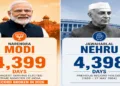

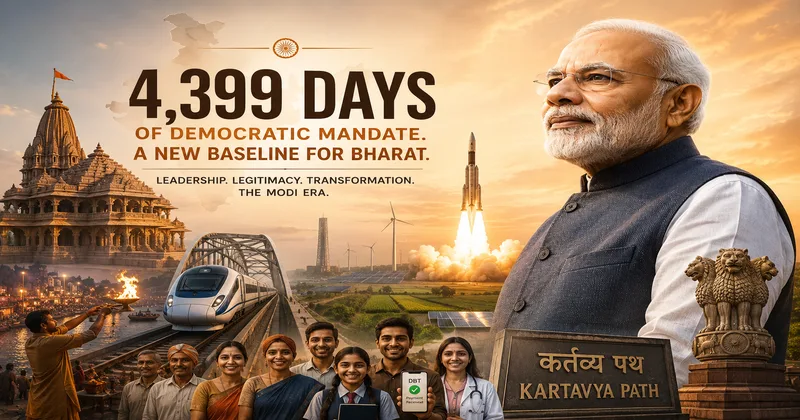
June 10, 2026 marks a significant milestone in Bharat’s political history. On this day, Prime Minister Narendra Modi surpasses Jawaharlal Nehru’s record of 4,398 consecutive days as an elected Prime Minister. While political milestones are often reduced to statistics, this moment deserves deeper reflection. It is not merely about the number of days spent in office; it is about the vastly different political environments, ideological frameworks, and visions of nationhood that shaped the tenures of Bharat’s first Prime Minister and its current one.
The comparison between Nehru and Modi is not simply a comparison between two leaders. It is, in many respects, a comparison between two competing ideas of Bharat.
The Meaning of the Record
Much of the public discussion surrounding this milestone has focused on tenure. Yet an important distinction must be made.
Jawaharlal Nehru served as Prime Minister from August 15, 1947 until his death in May 1964. However, for the first 1,732 days of that tenure, he was not an elected Prime Minister in the modern democratic sense. He assumed office through the political arrangements accompanying Independence and the decisions of the Congress leadership under the extraordinary circumstances of decolonisation. Bharat’s first general election took place only in 1951–52, after which Nehru became Prime Minister through a democratic mandate.
Narendra Modi’s tenure presents a different story. Every single day of his premiership, beginning on May 26, 2014, has been sustained through electoral legitimacy. Three national elections, three successive mandates, and an uninterrupted democratic endorsement from the people of Bharat have defined his journey.
This distinction matters because it underscores the maturity of Bharat’s democracy. Modi’s record is not merely one of longevity; it is a record earned entirely through repeated electoral validation in a highly competitive political environment.
Governing Versus Ruling
The contrast becomes even sharper when viewed through the lens of democratic politics.
Nehru governed a political system in which the Congress Party enjoyed overwhelming dominance. In the elections of 1952, 1957, and 1962, no opposition party emerged as a serious challenger. The Congress commanded parliamentary majorities of a scale difficult to imagine today. Bharat was effectively a one-party dominant state.
Modi, by contrast, operates in a far more contested democracy. Every state election carries national implications. Every parliamentary election is fought under intense scrutiny. Coalition arithmetic, regional aspirations, social media ecosystems, judicial oversight, and a relentless opposition create an environment in which political authority must constantly renew itself.
This is why Modi’s achievement resembles that of modern democratic leaders such as Angela Merkel more than it does the experience of post-independence Congress dominance. His longevity is not the product of political monopoly; it is the product of political adaptability and sustained public support.
The record, therefore, speaks not only of endurance but of democratic resilience.
From a Post-Colonial State to a Civilisational State
The deeper significance of the Modi era lies beyond electoral success.
The Nehruvian project sought to build a modern nation-state primarily through institutions derived from European political thought. Its emphasis was on planning, centralisation, secularism, and economic socialism. While these efforts helped stabilise a newly independent country, they also encouraged a view of Bharat that often appeared disconnected from its civilisational self-understanding.
For decades, expressions of civilisational confidence were treated with suspicion. Public articulation of Hindu civilisational consciousness was frequently viewed through the prism of communalism. Historical wounds caused by invasions and colonialism were often minimised in favour of a state-sponsored narrative of national integration.
The reconstruction of the Somnath Temple after Independence revealed this tension. While leaders such as K. M. Munshi and Sardar Vallabhbhai Patel saw the project as an act of civilisational restoration, Nehru expressed discomfort with overt state association with it.
The Modi era represents a significant departure from this framework.
The consecration of the Ram Mandir, the transformation of Rajpath into Kartavya Path, the recovery of stolen antiquities, the celebration of forgotten heroes such as Lachit Borphukan and Birsa Munda, and the renewed emphasis on India’s cultural heritage reflect a conscious attempt to reconnect governance with civilisational memory.
Critics may dismiss these as symbolic gestures. Yet symbols matter because nations are sustained not only by institutions but also by collective memory and cultural confidence.
Restoring the Citizen-State Relationship
Perhaps the most consequential transformation under Modi has been in the relationship between the state and the citizen.
For decades, welfare delivery in Bharat operated through intermediaries. Access to benefits often depended upon local power structures, bureaucratic discretion, and political patronage. The state appeared distant, and citizens frequently approached it as petitioners rather than stakeholders.
The Modi government sought to alter this dynamic through a combination of technology, financial inclusion, and administrative reform.
More than 55 crore Jan Dhan accounts, the expansion of Direct Benefit Transfer mechanisms, the rapid growth of digital public infrastructure, widespread sanitation coverage, Ayushman Bharat, and rural water connectivity have collectively sought to replace patronage with entitlement and discretion with transparency.
These measures are not merely welfare initiatives. They represent a philosophical shift—from a paternalistic state to a citizen-centric state.
The message is simple: governance should empower rather than patronise.
A New National Self-Perception
The most enduring legacy of the Modi era may ultimately be psychological rather than material.
Nations are shaped not only by what they possess but also by how they perceive themselves.
For much of the post-independence period, Bharat often viewed itself through external lenses. Validation from Western institutions, Western media, and Western intellectual frameworks carried disproportionate weight in shaping national discourse.
Under Modi, a different narrative has emerged.
Bharat increasingly presents itself as a civilisational state with an independent worldview, rooted in its own traditions while engaging confidently with the modern world. Whether through International Yoga Day, renewed Buddhist diplomacy, diaspora outreach, cultural diplomacy, or the articulation of Bharat’s interests in global forums, the country now projects confidence rather than insecurity.
This shift does not imply isolationism. Rather, it reflects a growing belief that Bharat need not apologise for its history, culture, or majority civilisational identity in order to participate meaningfully in global affairs.
The Limits and Lessons of Leadership
A serious assessment must also acknowledge that no government is without shortcomings. Economic challenges remain. Social tensions persist. Administrative inefficiencies continue to exist. Democratic politics inevitably involves compromises and imperfections.
Yet historical evaluation requires attention to larger trajectories.
The significance of Narendra Modi’s tenure lies not merely in the policies he has implemented but in the baseline he has altered. The abrogation of Article 370, the construction of the Ram Mandir, the institutionalisation of digital governance, the expansion of welfare delivery, and the revival of civilisational discourse have collectively reshaped the parameters within which future governments will operate.
Even political opponents increasingly function within frameworks that did not exist before 2014.
That itself is a measure of historical impact.
A Date Beyond Numbers
June 10, 2026 is therefore more than a personal milestone for Narendra Modi.
It symbolises the transition from one era of Bharat’s political evolution to another.
Nehru’s Bharat emerged from colonial rule seeking stability, institutions, and international legitimacy. Modi’s Bharat seeks confidence, continuity with its civilisational heritage, and a greater role in shaping the global order.
The debate between the two visions will continue, as all healthy democratic debates should. But one fact is undeniable: Narendra Modi’s record-breaking tenure reflects an extraordinary ability to maintain public trust in one of the world’s most complex and competitive democracies.
History will judge individual policies differently. It will debate successes and failures. Yet it may well conclude that the defining contribution of the Modi era was not merely economic, administrative, or electoral.
It was the restoration of civilisational self-confidence to a nation that had long been taught to view itself through someone else’s eyes.