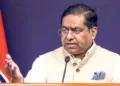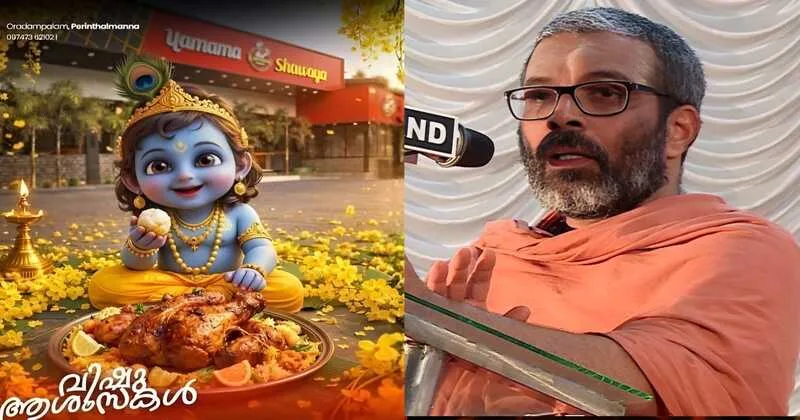
Kozhikode: Swami Chidananda Puri, the founder of Advaithashramam in Kolathur, Kozhikode, has issued a strong and detailed statement regarding the recent Vishu advertisement controversy, stating that the publication of similar greeting posters from multiple locations across Keralam on the same day cannot be dismissed as accidental or well-intentioned. He said the advertisements insulted “the Hindu spirit, our beliefs and the noble concept of Vishu Kani,” leading to what he described as “natural reactions from the offended community.”
He noted that the issue quickly became a matter of public discussion, with attempts made to justify the advertisements. “Many people came forward to justify and whitewash the insult by saying, ‘It was a mistake’, ‘well-intentioned’, ‘otherwise’,” he said. However, he rejected these explanations, adding, “In our society with limited freedom of expression, let that be. But only the truth will prevail.”
Questioning the pattern of incidents, the Swami stated, “No one with common sense can accept that similar advertisements were published from eight or nine places in Keralam at the same time as being accidental or well-intentioned.” He called for institutional action, saying, “If we want brotherhood and coexistence to flourish in our country, let the law enforcers conduct a fair and just investigation and further action.” He also urged public response, stating, “It is the urgent duty of patriotic common people to boycott such institutions that have committed such misdeeds in this matter.”
The Swami emphasised that respect for all religions must be upheld. “No one should feel the generosity to insult the idols of any religion here,” he said. He also criticised arguments that attempted to justify the depictions, particularly those referencing religious texts or traditions. “Many of those who have come out to justify the unscientific act of insulting Bhagwan Krishna are coming out with unfounded questions like ‘Didn’t Sri Rama eat meat?’, he said. He questioned the relevance of such comparisons, asking, “Is it appropriate to link the issue of Bhagwan Sri Rama, the great king, to Vishu Kani and Bhagwan Krishna?” He further elaborated, “Now, if the image of Rama and Lakshmana, who hunted and ate in the forest as was the right of the Kshatriyas of that time, is prepared today to humiliate them in front of a plate of meat, are you saying that Hindu society should tolerate it? That is not possible. In such a situation, the only answer is Rama’s arrow.”
Addressing the broader question of religious respect, he asked, “Will someone who insults other religious images out of ignorance like this be respected as freedom of expression?” He also responded to arguments invoking other divine narratives, stating, “Those who cite the story of Sri Rama when they say that Sri Krishna was insulted should also know that when the Bhagwan Himself came as the fierce Narasimha idol, He split the chest of Hiranyakashipu and drank his blood.”
He also highlighted differences in ritual traditions, stating, “It is unacceptable for those who do not know the differences in the worship rituals of Sattvic, Rajasic and Tamasika to associate Bhgawan Krishana with Bhadrakali, Muthappan, Gulika and so on. Our mind sees and respects all such worship rituals in their own divinity.” Rejecting claims that Bhagwan Krishna consumed meat, he said, “Can anyone point out any scientific evidence that Unnikrishnan, who was a resident of Vraja, or Balagopalakrishnan, who was a monk in Vrindavan, ate meat? Do not make bigger mistakes than the first one.” Concluding his statement, the Swami emphasised the need for societal response. “No one should be foolish enough to insult the venerated images of any religion or our cultural images. There needs to be a response in society to that,” he said, adding, “This is not a matter to be confused with any religion or religions, but rather with national separatism and religious extremism. Wake up, learn from history.”
Series of Vishu controversies across Keralam and beyond
The Swami’s statement comes amid a series of controversies linked to Vishu-themed advertisements across Keralam and outside the state, involving multiple establishments and police action.
The issue first gained prominence in Cherthala, Alappuzha district, where Meher Mandi & Grills, owned by Mohammed Shemir and associates, released a Vishu advertisement depicting Bhagwan Krishna alongside a non-vegetarian dish, including a biryani platter with fried chicken. The image circulated widely and triggered protests by Hindu organisations, including the Vishwa Hindu Parishad (VHP).
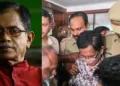
Following complaints, the Cherthala police registered a case under Section 192 of the Bharatiya Nyaya Sanhita (BNS). As part of the investigation, Arshad, identified as a co-owner, was taken into custody, and electronic devices were seized.
A similar incident was reported in Angadipuram in Malappuram district involving the Yamama Shawaya Hotel, located near Poradam Bridge. The establishment had shared a Vishu-themed image showing a child-like depiction of Bhagwan Krishna seated before a plate containing a meat dish. Though the post was deleted, it had already circulated widely. The Mankada police arrested three individuals, Mustafa of Pookottoor, Shahul Hameed, and Muhammed Shahil of Eramthode, and registered a case on charges of promoting communal disharmony. Devices used in creating and sharing the content were seized. In Ernakulam district, another image linked to a shop named ‘First Step’ on Kalathilparambil Cross Road showed slippers placed within a Vishu Kani-like arrangement. Vishu Kani, a central ritual of the festival, traditionally includes auspicious items such as rice, fruits, a mirror, gold ornaments, and images of deities, viewed at dawn as the first sight of the new year.
Beyond Kerala, a Vishu poster shared by Nadawi Mandi Restaurant in Bengaluru, depicted a child-like Krishna with a meat dish. The post was later removed following backlash. Additional visuals were also reported from establishments such as My Raydan Restaurant and Arabian Majlis, which have outlets across Kerala and in the Gulf regions.
With incidents reported from Alappuzha, Malappuram, Ernakulam, and beyond, the Vishu advertisement row has evolved into a broader and continuing controversy, drawing sustained public attention, protests, and police action in multiple locations.