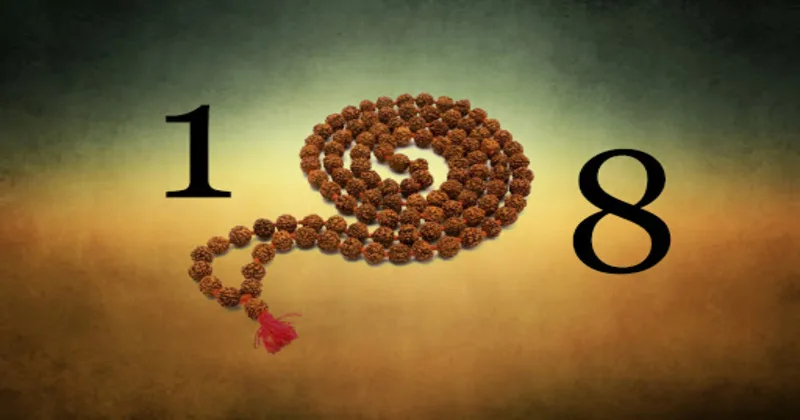
The number 108 occupies a position of exceptional importance in Indian intellectual traditions. While it is widely recognized for its spiritual and ritual significance, a deeper examination reveals that 108 also embodies mathematical structure, astronomical encoding, systemic modeling and knowledge organization. Rather than viewing it merely as a sacred numeral, it can be understood as an example of how ancient Indian thinkers integrated symbolic meaning with observational science and numerical elegance.
Astronomical encoding and observational insight
One of the most frequently cited scientific associations of 108 concerns astronomy. In traditional Jyotisha (astrology), the sky is divided into 27 nakshatras (lunar constellations). Each nakshatra is further divided into four padas (quarters), 27*4=108. This division represents the complete cycle of the Moon against the stellar background. Since the lunar cycle was central to ritual calendars, agricultural planning and timekeeping, 108 became a symbolic number representing the totality of the celestial cycle.
One of the most frequently discussed scientific associations of 108 relates to astronomical proportions. The apparent sizes of the Sun and the Moon in Earth’s sky are remarkably similar, which allows total solar eclipses to occur. When we examine the ratios more closely, we find that the average distance between the Earth and the Sun is roughly about 107-109 times the Sun’s diameter. Similarly, the average distance between the Earth and the Moon is about 110 times the Moon’s diameter. Though these values vary slightly due to elliptical orbits, they remain strikingly close to the ratio 1:108. This numerical proximity has often been cited as an example of how observational astronomy may have contributed to the symbolic importance of 108.
It is important, however, to interpret these ratios carefully. Modern astrophysics does not treat 108 as a fixed cosmic constant; the values are approximate and change over time due to orbital dynamics. Nevertheless, recognizing proportional relationships between celestial diameter and distance requires awareness of angular size, the principle that an object’s apparent size depends on both its physical size and its distance from the observer. The ability to conceptualize such proportionality reflects a sophisticated observational mindset, even if precise measurements were not available in ancient times. The recurrence of an approximate 1:108 relationship may therefore have reinforced the cultural and symbolic prestige of the number within cosmological frameworks.
Thus, the significance of 108 in this context lies not in exact scientific precision, but in proportional reasoning and systemic thinking. The convergence of solar and lunar angular dimensions would have been visually evident to sky observers, especially during eclipses, and may have inspired numerical abstraction. While we must avoid overstating historical claims, the presence of near 108 proportionality illustrates how empirical observation and symbolic interpretation can interact. In this sense, 108 emerges as a number situated at the intersection of geometry, astronomy and cosmological imagination.
Mathematical structure and numerical elegance
From a mathematical perspective, 108 possesses interesting structural properties. Its prime factorization is, 108=(2 to the power of 2 multiplied by 3 to the power of 3). This combination of squared and cubed prime factors gives it symmetrical elegance. The dominance of the number 3, itself symbolically significant in many traditions (three gunas, three worlds, three states of consciousness) adds to its structural appeal.
Additionally, 108 possesses interesting arithmetic properties that contribute to its numerical elegance. It is divisible by 9, and the sum of its digits (1 + 0 + 8) also equals 9. Since 108 divided by 9 equals 12, it qualifies as a Harshad number, a number that is exactly divisible by the sum of its digits. Such numbers exhibit internal numerical harmony, where digit structure and divisibility are interconnected. While this property does not imply mystical significance, it demonstrates arithmetic symmetry and structural neatness, characteristics that may have contributed to the aesthetic and mnemonic appeal of the number in mathematical traditions.
In geometry, the internal angle of a regular pentagon is 108°. The pentagon and pentagram appear in various traditional geometric motifs. Although there is no direct historical evidence linking this geometric fact to Indian symbolic systems, it demonstrates that 108 appears naturally in geometric constructions. Indian mathematics traditionally did not isolate numbers as purely abstract entities. Numbers often carried structural, mnemonic, and cosmological roles. The recurrence of 108 in combinatorics (e.g., 27 × 4) shows an interplay between counting systems and astronomical mapping.
Knowledge Organization
The traditional enumeration of 108 Upanishads (as seen in the Muktika canon) provides another example of systematic knowledge classification. While historical scholarship shows that the Upanishads were composed over many centuries and that the canonical grouping of 108 texts was formalized relatively late, the very act of organizing them into a fixed numerical corpus reflects deliberate intellectual systematization. Bringing diverse philosophical compositions under a structured numerical framework provides pedagogical coherence, enabling students to approach a vast body of thought in an ordered manner. It also enhances mnemonic efficiency, as fixed numerical sets are easier to remember, transmit, and reference within oral and scholastic traditions. Beyond utility, the number conveys symbolic completeness, suggesting that the corpus represents the totality of Vedantic wisdom.
In this context, 108 functions not merely as a sacred symbol but as a knowledge management device, an early form of taxonomical structuring. By assigning a definitive numerical boundary to an otherwise fluid textual tradition, scholars created a stable intellectual architecture for preservation and transmission. This reflects a broader pattern in Indian intellectual culture, where numerical frameworks were frequently employed to encode complexity into manageable conceptual units, facilitating both memorization and systematic study.
Cognitive and psychological dimensions
A japa mala traditionally consists of 108 beads, each representing one repetition of a mantra. While the number carries symbolic significance, it also has interesting implications when examined through the lens of cognitive science and physiology. Repetitive chanting, especially when synchronized with breath has been shown in modern research to produce measurable psychophysiological effects.
Modern cognitive science recognizes the benefits of repetitive rhythmic activity in inducing meditative states. Whether, or not the number 108 was chosen specifically for neurophysiological optimization, it effectively produces sustained engagement, which supports concentration and emotional regulation. Thus, the number plays a role in psychological entrainment and disciplined practice.
Systems thinking and cyclical modelling
Indian cosmology is fundamentally cyclical in structure, describing time not as linear progression but as recurring cycles – yugas, manvantaras, kalpas and cosmic dissolutions. Within this cyclical worldview, numerical groupings often serve as structural frameworks for modeling totality. The recurrence of 108 in several cosmological and astronomical enumerations suggests a systemic mode of organizing knowledge. For instance, the combination of 12 zodiac signs with 9 planetary influences yields 108, while the division of 27 nakshatras into 4 padas also results in 108. These are not arbitrary constructions but examples of combinatorial reasoning, where interacting subsystems are mathematically integrated into a coherent whole.
Temple architecture and spatial encoding
In temple architecture, the recurrence of the number 108 in structural and decorative elements, such as 108 steps, 108 subsidiary shrines, or 108 sculptural panels illustrates how numerical symbolism was often integrated into spatial design. From an architectural perspective, repeated numerical patterns create rhythm, proportional harmony, and visual continuity. Ascending 108 steps, for example, is not merely a physical act but a gradual experiential progression, reinforcing the psychological transition from the ordinary to the sacred. Structured repetition in space can guide movement, attention, and emotional tone, particularly in environments intended for contemplation and ritual engagement.
Traditional architectural treatises within the Shilpa Shastra corpus frequently combine geometric precision with cosmological symbolism. Proportions, alignments, and numerical counts were selected not only for structural feasibility, but also for symbolic resonance. Although the number 108 is not universally prescribed across all temple constructions, its recurrent use suggests that architects consciously incorporated meaningful numerical frameworks into design. In this context, 108 functions as a design parameter that harmonizes geometry, symbolic cosmology, and experiential psychology, illustrating how mathematical structure and spiritual meaning were often interwoven in sacred architecture.
Yoga, physiology and anatomical mapping
Yogic and Ayurvedic traditions refer to 108 marma points, understood as vital intersections where muscles, veins, ligaments, bones, and joints converge. Similarly, certain classical martial systems describe 108 pressure points associated with control, defense, or therapeutic stimulation. These classifications reflect a structured attempt to map the human body into organized nodal systems. Rather than viewing the body as a collection of isolated parts, these traditions conceptualized it as an interconnected network of functional points through which vitality, sensation, and movement are coordinated.
Scientific caution and responsible interpretation
It is essential to clearly distinguish between symbolic correlation and empirical causation when discussing the scientific dimensions of 108. Symbolic correlation refers to meaningful cultural or conceptual associations, whereas empirical causation requires measurable, reproducible, and experimentally validated relationships. The astronomical ratios often associated with 108 are approximate rather than exact constants. The enumeration of 108 marma points functions within a traditional anatomical framework rather than modern biomedical quantification. Similarly, the classification of 108 Upanishads reflects later canonical structuring rather than a historically simultaneous composition. These distinctions are crucial for maintaining intellectual integrity.
Therefore, 108 should not be interpreted as a universal physical constant or a hidden scientific code anticipating modern discoveries. Its value does not lie in mystical numerology or retroactive claims of predictive science. Rather, its significance emerges from the ways in which it demonstrates observational awareness, mathematical structuring, combinatorial reasoning, and system level thinking. The recurrence of 108 across domains suggests a cultural preference for numerical coherence and integrative modeling. Responsible scholarship acknowledges both the ingenuity embedded in these traditional frameworks and their historical and methodological limits, allowing appreciation without exaggeration.
Philosophically, 108 encodes the idea of completeness symbolizing the bridge between microcosm and macrocosm, the individual and the universal. Yet its significance should not be overstated as mystical prophecy or hidden scientific revelation. A balanced understanding recognizes it as a sophisticated cultural construct: a number that harmonizes symbolic meaning with structural reasoning. In this way, 108 illustrates how pre-modern intellectual traditions employed numerical abstraction not merely for counting or calculation, but as a powerful organizational principle for conceptualizing, transmitting, and structuring reality itself.