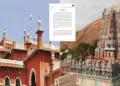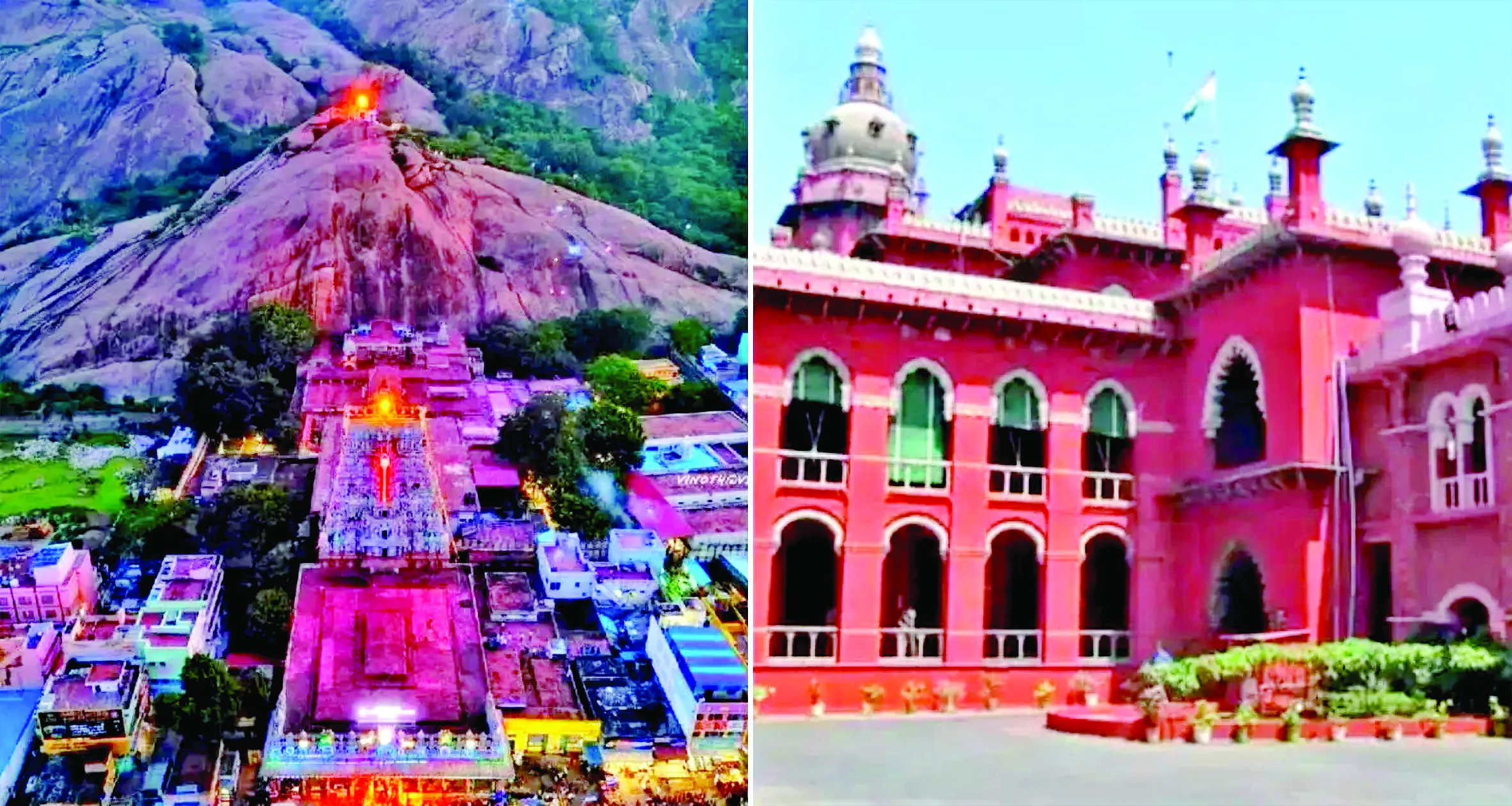
A Division Bench of Justice G Jayachandran and Justice K K R Ramakrishnan in the Madras High Court, while upholding the order passed by the single Judge (Justice G R Swaminathan, against whom the DMK and the I.N.D.I. Alliance had moved an impeachment motion), directed the Subramaniya Swamy Temple management to light Karthigai Deepam at the ancient Deepathoon (stone pillar) on one of the peaks of the Thiruparankundram hill, apart from the other usual places. The Bench, in its 170-page order, observed: “Apprehension of law and order was an imaginary ghost created by State authorities for their convenience to put one community against the other under suspicion. It is ridiculous and hard to believe the fear of the mighty State that by allowing representatives of the Devasthanam to light the lamp at the stone pillar near the top of the hill, located within the territory of Devasthanam land, on a particular day in a year, would cause disturbance to public peace. Of course, it may happen only if such disturbance is sponsored by the State itself. We pray that no State should stoop to that level to achieve their political agenda.”
Non Implementation of the Order
On December 1, 2025, Justice GR Swaminathan had directed lighting of Karthigai Deepam on a stone pillar near the dargah atop the Thiruparankundram hill, in addition to the usual places. However, the said order was not implemented, citing law-and-order problems. After hearing all stakeholders extensively, the Bench reserved its order on December 18. The contempt petition filed by the petitioners, Rama Ravikumar and S Paramasivam, over non-compliance with the December 1 verdict, is still pending before Justice Swaminathan and is expected to be heard on January 9. Disposing of a batch of appeals filed by the State and other stakeholders, the Bench, however, framed certain guidelines for lighting the lamp on the said pillar to ensure that both communities are able to celebrate their festivals on the hill without disturbing each other. The Bench said the Devasthanam should light the Deepam on the “Deepathoon”, but the public should not be permitted to accompany them during the lighting. The number of persons involved in the ritual should be decided by the Devasthanam in consultation with the Archaeological Survey of India (ASI) and the police, while the District Collector should coordinate and supervise the event. ASI should also impose conditions to preserve the monument. The judges expressed hope that by implementing the above directions, which can be suitably modified whenever festivals of the respective communities fall, there would be “only light and no fight”.
The judges said: “When there is a custom of lighting a lamp at an elevated place and such a place is available within the limits of Devasthanam property, there is no plausible reason for the Devasthanam to refuse to comply with the wishes of its devotees, when such a request is not against morality or public policy.”
Sikkandar Darga: Not a Notified Darga
The Court referred to the arguments of the petitioner’s counsel: “The ‘Sikkandar Darga’ is not a notified Darga or mosque under the Waqf Act. The entire Thiruparankundram hill is a monumental site and was declared so under the Act as early as 1905. Further, after the amendment to the Waqf Act, the Waqf has no role in this matter. However, the Waqf was impleaded as a respondent and allowed to participate in the proceedings. Shockingly, in the course of the arguments, the learned counsel, representing the Waqf, claimed that the ‘Deepathoon’ belongs to the Waqf. Even the Darga representatives, who claim rights over the entire top of the hill, had not claimed any right except over the top of the hill… This clearly discloses that the offer of the Waqf for mediation is not bona fide and cannot be relied upon or acted upon.”
The Bench observed: “No one can have even an iota of doubt about the fact that lighting a lamp on the hill on the full moon day of the Tamil month of Karthigai is a religious usage and part of Tamil culture. The said culture and usage are followed throughout the State and even in neighbouring States from time immemorial. Therefore, we hold that writ petitions seeking enforcement of a religious practice in protection of fundamental rights deserve to be entertained. … The dispute is not just about enforcement of a custom; it sufficiently concerns the enforcement of fundamental rights of worship and expression, as well as the protection of culture. In such circumstances, taking note of the silence consistently exhibited by the authorities, who ignored the pleas of worshippers for several years, warrants interference under Article 226 of the Constitution of India.” The Bench further said the issue, which has undergone judicial scrutiny in different forms for over 100 years, needs to be resolved to maintain comity instead of keeping the fire alive without lighting the lamp. Therefore, it held that the alternate remedy of resorting to the provisions of the Act is not efficacious. The Court noted: “The proceedings of the RDO indicated that a decision regarding the lighting of Deepam on the Deepathoon at the top of the hill would be taken from the forthcoming year by constituting a Committee within a month and communicating it to the Government through the District Collector. We note that even after a decade, nothing has happened and no decision has been taken by the Government regarding the lighting of Deepam during the Karthigai Deepam festival at the Deepathoon on the hilltop.” The Court further pointed out two vital facts that emerged from the case: first, the attempt by Darga representatives to change the physical features of the Darga area by shifting the flagstaff and tying it to a nearby tree; second, the Government’s refusal to measure and demarcate the area. This, the Court said, clearly indicated that the Government was not inclined to bring a quietus to the perennial problem.
The judges held that there was no material to substantiate the existence of any Agama Sastra that prohibits lighting the Mahadeepam anywhere other than the Uchipillai Temple, nor was it the case of the Devasthanam or the Government that lighting Deepam was not a prevailing custom at Thiruparankundram hill. The stone pillar, with provision to light the lamp—called ‘Deepathoon’ in Tamil—is located in the portion of the hill declared by a competent civil court as Devasthanam property. The Waqf Board, as on date, has no locus standi in the matter.