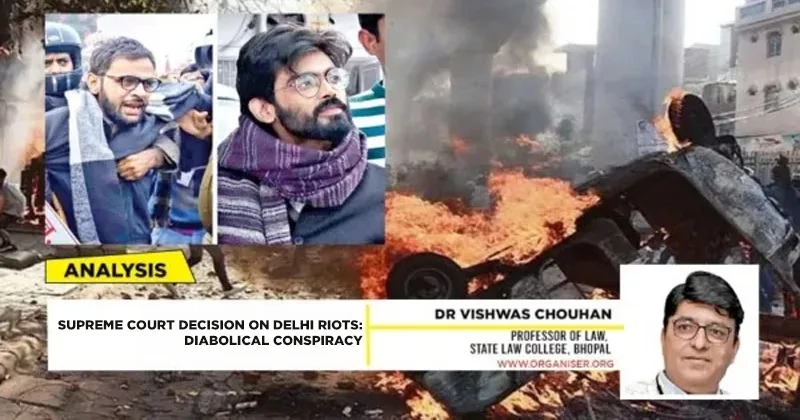
We all know that the alleged “larger conspiracy” case related to the February 2020 Delhi riots has remained at the centre of Indian judicial and public discourse for a long time. This case has not been confined merely to the criminal investigation of riots. Rather, it has raised fundamental questions concerning bail under the Unlawful Activities (Prevention) Act, 1967 (UAPA), personal liberty, national security, and the delicate balance of judicial discretion.
The Delhi riots resulted in the deaths of 53 people, and more than 200 were injured. These figures are drawn from reports of the National Human Rights Commission and other sources, though they often remain under-discussed. The riots erupted during prolonged protests against Citizenship (Amendment) Act (CAA) and the proposed National Register of Citizens (NRC), during which roads in Delhi were blocked for months. According to the prosecution, these protests, allegedly aided by certain jihadi elements, were part of an organised conspiracy that eventually turned violent. One lesser-discussed fact is that the Delhi Police filed a chargesheet exceeding 15,000 pages, relying on WhatsApp chats, speeches, and call records as evidence.
Rationale for Denying Bail
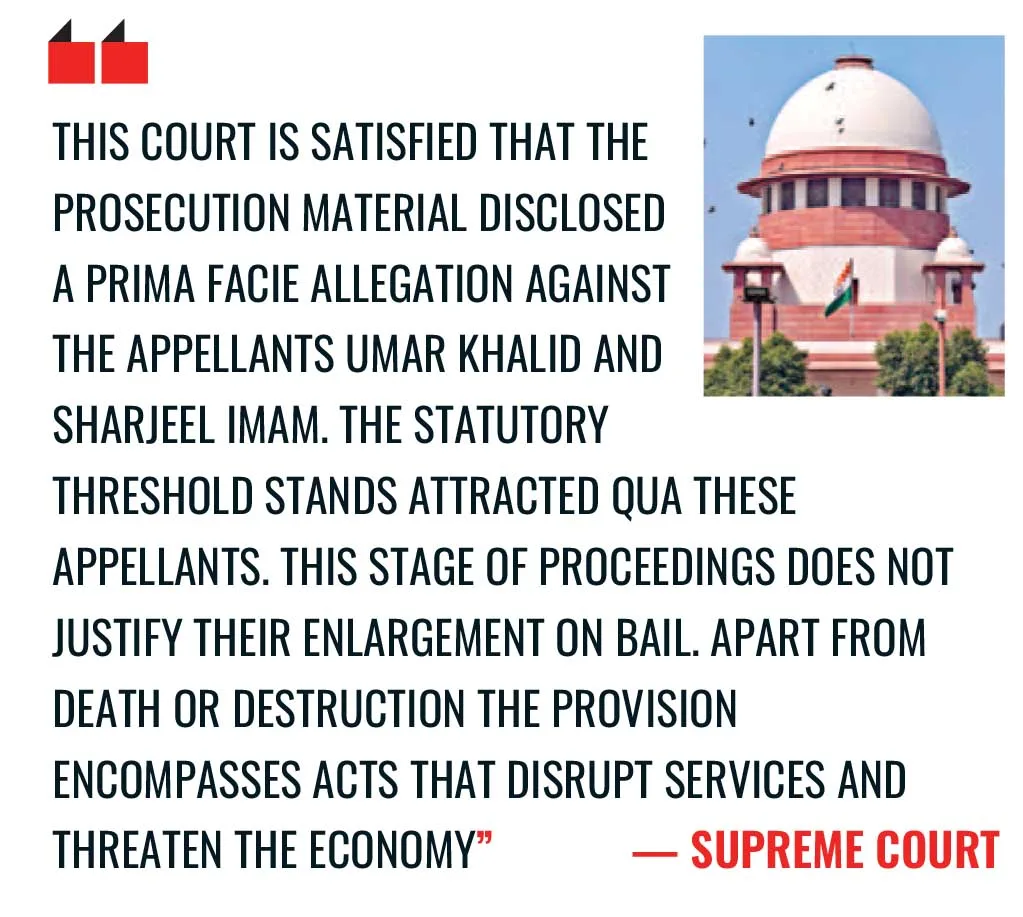
Against this background, the Supreme Court’s order dated January 5, 2026, assumes decisive importance. In this order, the Court granted bail to some accused persons while denying it to others, clearly articulating the reasons for such differentiation. The Supreme Court refused bail to Umar Khalid and Sharjeel Imam, observing that the prosecution material disclosed a prima facie case against them under the UAPA and that their roles appeared to be “central and decisive.” The SC said that “Prolonged incarceration of Khalid and Imam was not sufficient justification to grant them bail and that the pair had played a central role in the conspiracy.”
At the same time, the Court granted bail, subject to stringent conditions, to five other accused persons, including activists Devangana Kalita, Natasha Narwal, and Asif Iqbal Tanha. While granting bail to them, the Court emphasised that each accused’s role had been independently evaluated and that a collective or blanket approach had not been adopted. This reasoning constitutes the core of the judgement.
The order arises out of FIR No. 59/2020, which names a total of 18 accused. The trial is still incomplete, and all accused have remained in judicial custody.
In this case, the Supreme Court applied Section 43D(5) of the UAPA and clarified that at the stage of bail, the Court’s duty is not to conduct a detailed examination of evidence, but only to determine whether the prosecution material appears prima facie credible. This approach aligns with the Court’s earlier precedents and reinforces the principle that ordinary bail jurisprudence under general criminal law does not apply to UAPA cases.
The UAPA, enacted in 1967 to curb terrorism and unlawful activities, was amended in 2004 and again in 2019. These amendments further tightened the bail regime under the Act. As a result, data from the National Crime Records Bureau (NCRB) indicates that between 2020 and 2024, more than 80 per cent of those arrested for serious offences under the UAPA were not granted bail.
Delay in Trial
The Supreme Court observed that delay in trial, by itself, does not automatically justify bail in UAPA cases, although it directed the trial court to expedite proceedings. While this view is legally consistent, the question remains whether such directions are practically effective in cases involving protected witnesses and complex evidentiary processes.
Political Reactions
Following the judgement, certain opposition leaders described the grant of bail to five accused as a “victory for justice,” and international commentary on India’s internal processes resurfaced. Notably, eight Democratic members of the U.S. Congress, including Ilhan Omar, Rashida Tlaib, and Zohran Mamdani, wrote to the Indian Ambassador to the United States expressing support for accused persons such as Umar Khalid and Sharjeel Imam. They argued that detaining individuals for five years without trial amounted to a violation of human rights and urged India to ensure a fair trial in accordance with international law. From a judicial perspective, such reactions do not influence the Court’s decision. However, it is legitimately expected that Supreme Court judgments should be so clear in their reasoning that any apprehension of external pressure or influence is automatically dispelled. Unfortunately, in this case, the Court appears to have fallen short of that expectation.
National Security Dimension
The case has also been viewed alongside statements by Bangladesh-based extremist elements concerning sensitive geopolitical areas such as the “Chicken Neck” (Siliguri Corridor). In one of his speeches, Sharjeel Imam spoke of “cutting off” the Chicken Neck to separate the North East from the rest of India, a statement that reportedly found resonance among certain Bangladeshi jihadi leaders. Reports have cited instances where Bangladeshi extremists invoked China’s support and even urged political leadership in West Bengal to “liberate Bengal from Modi’s rule.”Legally, the Supreme Court cannot take cognisance of such statements unless the prosecution establishes a direct or indirect link between those elements and the accused. Nevertheless, in matters involving national security, judicial orders inevitably carry a broader symbolic and messaging impact. It is noteworthy that Sharjeel Imam’s statements contained a Chinese dimension, which is why security agencies viewed them as an attack on India’s territorial integrity. Orders passed under laws like the UAPA do not remain confined to the accused and the prosecution; they also convey a message to society and the nation. It is therefore natural to expect that courts will clearly state that their orders do not legitimise or endorse any separatist, extremist, or anti-national ideology.
Ultimately, the Supreme Court’s decision is neither wholly stringent nor excessively liberal. In cases of national significance, Supreme Court judgements do not merely resolve legal disputes; they also define the standards of justice in a democracy. The long-term evaluation of this decision will ultimately depend on the speed and fairness of the trial.