The discussion of youth is not new. From Swami Vivekananda to Shivaji, Savarkar, and Guru Gobind Singh, all believed in the power of youth, though their definition of youth was rooted not merely in age but in perspective. According to standard demography, people aged between 16 and 35 are considered youth, and on this basis, Bharat is called a ‘youth nation’ today, with our median age around 28-29 years, while developed nations like those in Europe have reached nearly 60. Demographic balance faces threats from economic class disparities and religious-community imbalances, requiring awareness and timely vigilance. But, this is just a demographic understanding of youth, which is also important and Bharat’s median age is below 30, which is great strength.
Defining Youth
But the real question is: who is truly young? Not just one with a young age, but one who speaks the language of the future—whose words brim with future tense—is truly young: “I will do this, it will happen, I dream of this.” One who keeps harking back to “In our times…” may be young in body, but is mentally quite old. Youth is one who dreams with open eyes and sacrifices sleep to fulfil those dreams. One who thinks within their capacity is a child; one who thinks below capacity is aged; but one who dreams
beyond limits, with the courage to break boundaries—that is true youth.
Pandit Satavalekar ji, the century-old scholar, exemplified this. At the age of 100, writing 100-125 pages daily, he planned a 21-volume Mahabharata commentary. Even at 100, his creative vision spanned 4-5 future years. Age 100, but gaze entirely futuristic —this is authentic youth.
Youth is also one who needs no reason to smile. When inner energy naturally manifests as facial joy, know that youthfulness lives. When calculation precedes laughter—”Why did he laugh, why should I?”—inner youthful energy begins to wane. One who finds joy in life’s simplicity without reels or stand-up comedy—that one is truly young.
Every generation has accused the next of “lacking patience”—this is not a new trend. The difference? Previously, one changed TV channels after five minutes; today, even 30-second reels feel long. Speed and media have changed, but youth’s restlessness remains the same—society and elders must channel this creative energy properly.
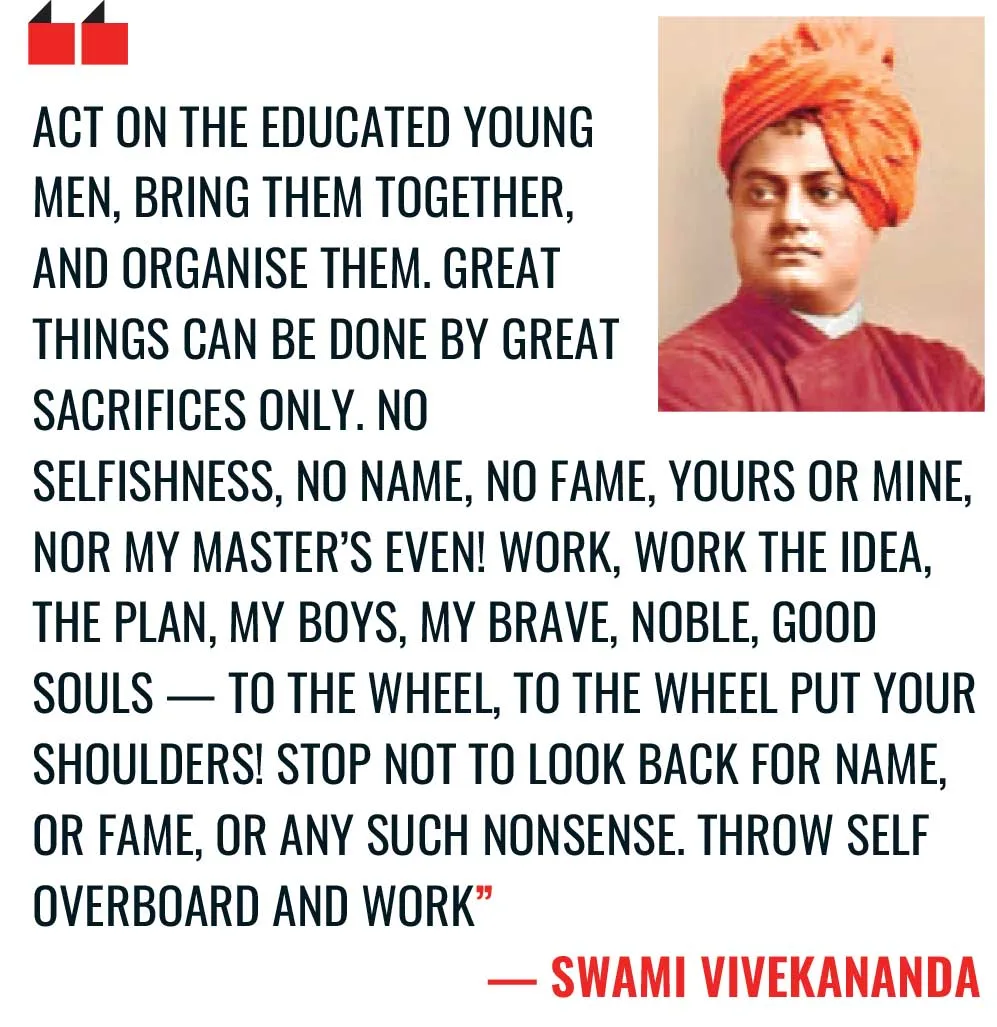
The essence of youth is energy, dreams, and noble purpose. When goals are high, hearts pure, and vision future-focused, any age becomes youth. That is why Swami Vivekananda wanted a team of youth, Chhatrapati Shivaji Maharaj wanted build army of youth and Guru Govind Singh ji gave a call for youth with pure heart.
Youth Energy: From Power to Valour
This restlessness isn’t a problem—it’s your power. Physics’ law: where energy abounds, speed increases. Water flows, needing containment. Freeze its energy into ice, it stays put without a container. Boil it, and the container bursts. Youth is restless because power surges within. Power has two qualities—motion and expansion. Energy resists contraction. We’ve forgotten expansion, so our power fuels destruction over valour.
Clinging to “I” brings impatience, stress, and boredom. Boredom has no place in a youth’s dictionary. Reduced creativity breeds tedium. Binding fierce power to narrow self-interest causes tension, despair, and depression. Shift from “I” to “we,” and this energy will fuel a spirit of national service.
Madan Lal Dhingra embodies this. A handsome youth from an affluent London family—gramophone, dance, revelry with English mems, he had everything. One day, dancing below Bharat House where Savarkar led revolutionaries upstairs. Savarkar asked about expectation of his mother and purpose of life to him. Three days later, Dhingra returned with answer: “To dedicate my life to Bharat Mata.”
Before hanging, he asked Savarkar, “Do my eyes show death-fear?” Savarkar replied, “No, I see Bhagwan Krishna’s equanimity.” From jailer, his last wish: “Mirror, scented oil, comb.” Reason? “London jail lice ruined my curly hair. I’m meeting my bride—hence I must go adorned.” Dhingra became a yogi without yoga practice. National service is supreme sadhana.
Frequent mirror-gazing marks youth too, but change the question—from “Am I fine?” to “Who am I? What’s life’s purpose?” On June 21, 2015—International Yoga Day—when 193 nations performed Surya Namaskar, Bharat Maa reclaimed the Vishwa Guru s`tatus. Our generation will guide the world; it is clear to me. Today, China’s median age is 40+. The one-child policy wrought this ruin about. Today, ‘young’ Bharat won’t beg for jobs. They will create them. UPI, digital certificates, all these are ample proof of our claim to world leadership. At the same time, it is also important that we embrace swadeshi. Let us not forget that the money for Chinese weapons that killed Major Santosh Yadav came from our pockets.
Before you go to bed, ask yourself: “What did I give Bharat Maa today?” Dedicate body, mind, and intellect to the nation. Be givers, not beggars. Selfish life holds zero value. Constructive contribution defines life.
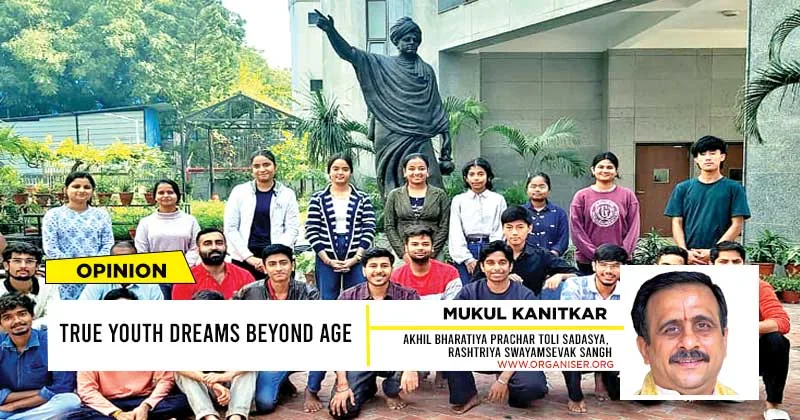
(The article is based on the speech by Mukul Kanitkar given at Bal Mandir School, Delhi, on January 4, 2026)