





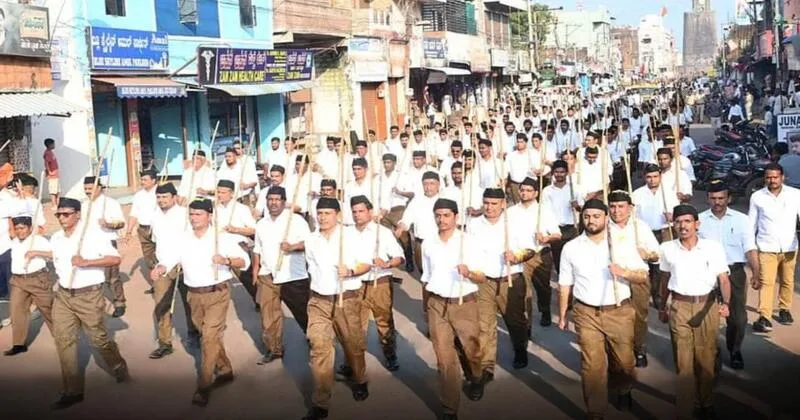
Belagavi: A detailed written reply by Karnataka home minister G Parameshwar in the Legislative Assembly has brought out a striking contrast between ground reality and political rhetoric. In response to a question raised by Karkala BJP MLA V S Sunil Kumar, the minister confirmed that RSS has so far conducted 518 path sanchalans with two lakh swayamsevaks ,across the state this year, all of them peaceful, disciplined and incident-free without a single communal clash, disturbance or law-and-order problem.
According to the data placed before the Assembly, 97 path sanchalans were held in Bengaluru city alone, with nearly 30 thousand swayamsevaks participating. In Uttara Kannada district, 45 marches were organized, and in Shivamogga district 19 marches were conducted again, with no incidents, violence, or disruption to the public. It is noted that RSS volunteers conducted themselves with discipline comparable to soldiers, strictly following rules and maintaining decorum.
However, despite this clean record, the minister’s reply indirectly exposed a contrasting political narrative. In several places, a few Congress leaders allegedly attempted to obstruct or politicize the path sanchalans, portraying them as potential triggers for communal tension. BJP leaders have criticized these attempts as politically motivated efforts to target the RSS despite factual evidence of peaceful conduct.
Political objections despite peaceful events
One of the most controversial episodes unfolded in Chittapur of Kalaburagi district, where the RSS had scheduled its special Patha Sanchalana in October as part of its centenary celebrations. The march was expected to witness significant participation, marking 100 years of the organization. But IT/BT minister Priyank Kharge, who represents Chittapur, openly opposed the march.
Local authorities, allegedly under political pressure, removed RSS flags, banners, posters and flex boards put up for the event. The action immediately triggered protests from BJP and RSS supporters, who accused the Congress government of deliberately targeting the organisation.
Kharge had earlier written to Chief Minister Siddaramaiah urging him to ban RSS activities in government institutions and public premises, as well as prohibit government employees from participating in them. His stand was seen by opposition leaders as an attempt to curb the presence and visibility of the RSS under the guise of administrative regulation.
New restrictions, seen as targeting RSS
Amid the controversy, the Karnataka cabinet announced a new rule: private organizations could not hold events in government schools, colleges or public spaces without prior permission. Although presented as a general-order regulation, critics argued that it was specifically aimed at preventing RSS activities in public areas.
The rule also required organizers to obtain multiple layers of permission, a move which the BJP alleged was a deliberate tactic to restrict the path of sanchalans.
However, this attempt was short-lived. The High Court intervened and stayed the government order, ruling that the restrictions were excessive and not backed by law. This was widely perceived as a setback to the Siddaramaiah-led Congress government, which appeared determined to limit RSS programs through administrative barriers.
RSS marches remain calm; Govt under fire
The facts presented in the Assembly 518 peaceful marches without a single incident have strengthened the BJP’s accusations that the Congress government is manufacturing unnecessary controversy for political gain.
The core argument being made is simple: If hundreds of path sanchalans can be held across Karnataka without any disturbance, why portray them as a threat?
The BJP maintains that the Congress is intentionally building a false narrative to appease certain vote banks, even though ground-level data does not support claims of communal tension or security risk.
Opposition calls it political suppression
Leaders from the BJP and RSS circles argue that the government is selectively targeting one organization while ignoring the legal and peaceful manner in which it carries out its activities. The removal of flags in Chittapur, objections from ministers, and an attempt to push new restrictions — despite no incidents of violence — have been projected as examples of political suppression.
The state home minister’s own report, ironically, has given the opposition stronger grounds to attack the CM Siddaramaiah-led government. The fact that the High Court struck down the government’s restrictions has further bolstered claims that the Congress administration acted with political motives rather than legal necessity.











Comments