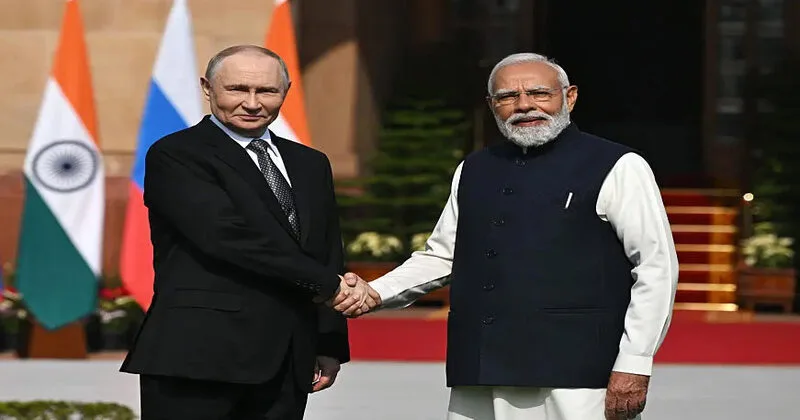
As the Russo-Ukrainian War gets dragged beyond anticipated limits and as Russia gets increasingly isolated in the global community – both politically and economically, the recent visit by Russian President Vladimir Putin to New Delhi holds extreme significance. Under the leadership of Prime Minister of India, Narendra Modi the 23rd India-Russia Annual Summit yielded 16 bilateral agreements under the “Special and Privileged Strategic Partnership.” These agreements span across the wide-ranging aspects from defence, energy, trade, to emerging sectors. These agreements aim to elevate the Indo-Russian bilateral trade from current levels of US$ 65 bn in FY 2024-25 to a target of US$ 100 bn by 2030. This is, of course, a modest growth of 9 per cent CAGR.
Amid growing and tightening Western sanctions on Russia, these deals with India emphasize resilience, diversification, and de-dollarization. It positions India and Russia as counterweights to the Transatlantic-dominated world order. In this article, we try to analyse the qualitative aspects of Indo-Russian pacts during this visit by President Putin, with quantitative aspects in absolute value terms, over the next 10 years. Certain experts peg the estimated direct economic activity between these two nations of the Eurasian bloc at around US$1.5-1.5 trillion in the next 10 years and have the potential to grow to around US$3-4 trillion in 20 years.
Indo-Russian ties trace back to the 1971 Indo-Soviet Treaty. It has evolved from barter exchanges to a robust and vibrant economic and geostrategic partnership post the 2022 Russo-Ukrainian War. Russia’s isolation has made India a key outlet for its energy exports, with New Delhi importing over 1.5 million barrels of crude oil per day. This accounts for nearly 40 per cent of Russia’s seaborne oil trade. Needless to specifically mention, this significant increase in energy purchases from Russia has created a 9:1 export-import imbalance favouring Russia. It is dominated by energy imports, which account for nearly 60 per cent of the trade between the two friends and allies since the Cold War Era, with a balance being defence hardware and equipment, for which India has preferred American hardware ever since the Cold War Era.
The Indo-Russian Summit focused on 10 sectors of significance for India and Russia, viz., energy, transport, agriculture, pharmaceuticals, Information Technology, nuclear power, space, finance, and critical minerals. The pacts focus on promoting tariff reduction, logistics enhancements, and rupee-rouble settlements. It also aligns with India’s “multi-alignment strategy” to secure resources without straining Quad alliances. At the same time, these pacts intend to provide Russia a resilient, sanctions-resistant lifeline which will extend economic support to India’s strategic and reliable partner.
The energy deal is the core of Indo-Russian Economic Ties. In this front, President Putin has assured uninterrupted crude, LNG, and coal supplies to India, despite US secondary sanctions on shadow fleets. Russian Urals crude, which is offered to India at a discount of US$ 10-15 below Brent, has helped India to annually save US$ 5-7 bn. It is estimated that in the next 10 and 20 years, India could potentially save anywhere around US$ 60 bn and US$ 120 bn, respectively, only on account of lower Russian Urals Crude prices. This will also help India in creating an adequate buffer in its nearly 5.5 million barrels / day import needs by covering nearly 20-25 per cent of our import requirements from Russia. This will also help India in freeing its already scarce and equally important fiscal resources for infrastructure and other budgetary requirements.
Beyond fossil fuels, nuclear cooperation between the two nations has revived Kudankulam’s 12 GW expansion plan. Here, Russia will invest around US$ 25 bn by 2035. This will add around 50-60 TWh of clean power annually and help India hedge its uranium sourcing risks arising from dependency on other suppliers. Critical minerals deals – lithium, rare earths, and graphite, from Russia’s Arctic reserves, will address India’s full import dependency. It will enable US$ 5 bn in offtake for the US$ 10 bn EV Production-Linked Incentive (PLI) scheme.
Advancing the 2017-initiated Free Trade Agreement with the Eurasian Economic Union (EAEU), comprising Russia, Belarus, Kazakhstan, Armenia, and Kyrgyzstan, this India–Russia Summit finalised terms for zero tariffs on 90 per cent of goods by 2028. This unlocks a 300 mn consumer market for Indian pharma and textiles, boosting exports by US$ 15-20 bn yearly.
In the groundbreaking labour pact, India will supply nearly 0.5 million Indian workers in Information Technology, construction, and nursing by 2030. This will help Russia in addressing a part of their 2 mn shortfall, and help India in addressing its employment generation agenda while leveraging on its demographic dividend. Remittances arising from this supply of skilled, semi-skilled, and unskilled manpower are estimated to be around US$ 4 bn annually. This is a repeat of the Gulf Model of earning foreign exchange, albeit this time in Russian Rubles instead of US Dollars. This will also help in earning foreign currency, bypassing the US Scrutiny, and help India in paying for Russian fossil and nuclear fuel and other imports partly in Russian Rubles. This payment settlement model is more or less in line with our currency swap with the UAE.
The biggest and most significant understanding in this Summit is that both countries have agreed to continue developing and enhancing systems for settling bilateral trade in their national currencies, i.e. Rupee and Ruble. Currently, 96 per cent of the bilateral trade between the two countries is settled in their national currencies. Both countries have agreed to continue jointly developing systems of bilateral settlements through the use of national currencies in order to ensure uninterrupted bilateral trade and seamless payment settlements, bypassing SWIFT and US interference. This will include interoperability of the national payment systems, financial messaging systems, and central bank digital currency platforms. This means integration of India’s UPI system with Russia’s SPFS system. The old rupee-ruble trade arrangement has been revived, where Russia can hold Indian rupees and Indian importers can pay directly to Russian banks like Sberbank. This is considered a step towards de-dollarisation. Indian banks will play a role in this. The Moscow-headquartered joint venture of SBI and Canara Bank, named Commercial Indo Bank LLC (CIBL), will keep connecting with SWIFT-affected Russian banks. In this manner, India will be able to integrate its proprietary payment settlement systems and payment process systems of UPI and RuPay, respectively, with Russia’s SPFS and Mir, respectively. This will be a big step towards de dollarisation and deeper integration of India and Russia’s banking, payments processing, and settlements systems. The success of this integration exercise will result in more and more countries working closely on creating and integrating their own payment systems to reduce dependence on US dollar-denominated trade and SWIFT-determined payments. This success could also help India in internationalising UPI and RuPay systems by enabling other countries to use them.
Globally, the Indo-Russian partnership challenges the unipolarity of the US. India fortifies its energy security amid political and economic volatility of the OPEC countries, coupled with price volatility in global energy markets, and balancing the dependence on trade with the US amid uncertainty in its tariff regime. In essence, Putin’s visit solidifies India-Russia as a multipolar bulwark that is resilient, reciprocal, and value-driven to challenge the unipolar hegemony of the US. Achieving $100 billion in trade early, as PM Modi suggests, could herald the Eurasian renaissance, where pragmatism navigates polycrises. This US$ 3-4 tn worth of economic activity in the next 20-year horizon highlights PM Modi’s and President Putin’s geoeconomic and geostrategic statecraft at work by blending Cold War era historical ties with forward-looking economic and strategic alliance for an enduring impact in the New World Order.