India’s 8% growth highlights Modi govt’s economic reforms
July 17, 2026
  • Read Ecopy
  • Circulation
  • Advertise
  • Careers
  • About Us
  • Contact Us
Android AppiPhone AppArattai
Organiser
  • ‌
  • Bharat
    • Assam
    • Bihar
    • Chhattisgarh
    • Jharkhand
    • Maharashtra
    • View All States
  • World
    • Asia
    • Europe
    • North America
    • South America
    • Africa
    • Australia
  • Editorial
  • International
  • Opinion
  • RSS @ 100
  • More
    • Op Sindoor
    • Analysis
    • Sports
    • Defence
    • Politics
    • Business
    • Economy
    • Culture
    • Special Report
    • Sci & Tech
    • Entertainment
    • G20
    • Azadi Ka Amrit Mahotsav
    • Vocal4Local
    • Web Stories
    • Education
    • Employment
    • Books
    • Interviews
    • Travel
    • Law
    • Health
    • Obituary
  • Subscribe
    • Subscribe Print Edition
    • Subscribe Ecopy
    • Read Ecopy
  • ‌
  • Bharat
    • Assam
    • Bihar
    • Chhattisgarh
    • Jharkhand
    • Maharashtra
    • View All States
  • World
    • Asia
    • Europe
    • North America
    • South America
    • Africa
    • Australia
  • Editorial
  • International
  • Opinion
  • RSS @ 100
  • More
    • Op Sindoor
    • Analysis
    • Sports
    • Defence
    • Politics
    • Business
    • Economy
    • Culture
    • Special Report
    • Sci & Tech
    • Entertainment
    • G20
    • Azadi Ka Amrit Mahotsav
    • Vocal4Local
    • Web Stories
    • Education
    • Employment
    • Books
    • Interviews
    • Travel
    • Law
    • Health
    • Obituary
  • Subscribe
    • Subscribe Print Edition
    • Subscribe Ecopy
    • Read Ecopy
Organiser
  • Home
  • Bharat
  • World
  • Operation Sindoor
  • Editorial
  • Analysis
  • Opinion
  • Culture
  • Defence
  • International Edition
  • RSS @ 100
  • Magazine
  • Read Ecopy
Home Bharat

Eight per cent growth surge of Bharat shows power of Modi govt’s economic reforms

Over the past decade, India’s economic journey has transformed it into one of the world’s most resilient and high-performing economies. Driven by strong manufacturing, services, and investment-led growth, the country is moving toward self-reliance and global competitiveness

Dr Jagmohan Singh RajuDr Jagmohan Singh Raju
Dec 10, 2025, 08:00 pm IST
in Bharat, World, Analysis, Economy, International Edition
Follow on Google News
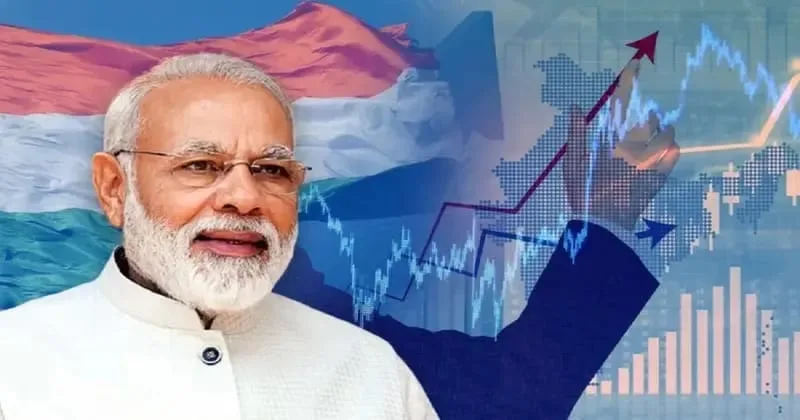
Prime Minister Narendra Modi

Prime Minister Narendra Modi

FacebookTwitterWhatsAppTelegramEmail

Bharat’s economic journey over the past decade reflects more than high growth numbers; it represents a deeper shift in national capability, confidence and economic direction. At a time when many large economies have struggled with inflation, sluggish demand and policy uncertainty, India has emerged as one of the world’s most resilient performers. GDP growth in Q2 FY26 again crossed 8 per cent, driven by strong manufacturing, buoyant services, high construction activity and a steady revival in private consumption. Inflation, which unsettled advanced economies, has remained largely within the RBI’s tolerance band for most of the past two years.

This momentum is visible on the ground. Passenger-vehicle sales crossed 4.3 million units in Financial Year 2025, while two-wheeler sales approached 20 million. Urban housing transactions hit their highest levels in more than a decade. Festive-season retail spending, especially during Deepawali, surged past earlier benchmarks, indicating strong household sentiment. These trends confirm a wider shift towards aspiration-led consumption across both urban and semi-urban India.

A key enabler of this demand surge is India’s changing socio-economic profile. According to the World Bank’s Spring 2025 Poverty and Equity Brief, India lifted 171 million people out of extreme poverty between 2011–12 and 2022–23. The proportion of citizens living in extreme poverty fell from 16.2 per cent to just 2.3 per cent. This expanding middle class is now driving consumption in automobiles, electronics, housing and services, reinforcing the domestic growth cycle.

Also Read: Amit Shah highlights ‘repeated disrespect’ to Vande Mataram by Congress & opposition leaders in a letter to RS Chairman

New Economic Architecture

At the core of this transformation lies a new economic architecture shaped by Prime Minister Narendra Modi, a framework combining fiscal discipline, institutional reform, formalisation, manufacturing revival and digital governance. The Goods and Services Tax stands out as a structural milestone, replacing a fragmented indirect tax system with a unified national market. GST rationalisation reduced compliance costs, improved logistics efficiency and widened market access for businesses of all sizes.

Boost to Swadeshi Manufacturing

A major dimension of this new economic strategy has been the rise of MSMEs and the strengthening of domestic value chains under the Aatmanirbhar Bharat and Swadeshi thrust. MSMEs contribute nearly 30 per cent of GDP, over 45 per cent of manufacturing output and almost half of India’s exports. Over the past decade, formalisation through GST, digital invoicing and the UPI ecosystem has expanded their market access and reduced compliance barriers. The Emergency Credit Line Guarantee Scheme (ECLGS) supported more than 1.2 crore small units during the pandemic, helping them revive operations and protect jobs. These measures have produced visible outcomes: Indian toys, handlooms, coir products, agro-based industries and domestic electronics brands have significantly increased market share, reducing import dependence in several categories. India now produces almost all mobile phones sold domestically, demonstrating how Swadeshi-driven manufacturing is improving self-reliance while boosting exports.

The revival of India’s financial system has been equally important. When PM Modi took office, public-sector banks were burdened with stressed assets and stalled projects. The government undertook structural repair through the Insolvency and Bankruptcy Code, bank mergers and large-scale recapitalisation. As NPAs fell to their lowest levels in years, credit flow revived across infrastructure, MSMEs and manufacturing.

Push to reforms during pandemic

The COVID-19 crisis became a turning point. While many nations experienced prolonged disruption, India used the period to accelerate long-term reforms. The Production-Linked Incentive (PLI) schemes encouraged global supply chains to shift manufacturing to India in sectors such as electronics, pharmaceuticals, medical devices, EVs and solar modules. Apple exported nearly $10 billion worth of iPhones in the first half of FY25, and India now reportedly accounts for around 20 per cent of global iPhone production.

Infrastructure expansion has been another powerful engine of growth. The national highway network expanded from about 97,000 kilometres in 2014 to over 146,000 kilometres in 2024, with daily highway construction rising from 12 to nearly 30 kilometres. Operational airports doubled from 74 to 149, transforming regional connectivity through the UDAN scheme. Railway capital expenditure rose five-fold, enabling modernised stations, dedicated freight corridors and expanded Vande Bharat services. India’s ranking in the World Bank’s Logistics Performance Index improved from 54 to 38, reflecting major efficiency gains.

International institutions have taken note. The IMF projects that India will cross the $4-trillion mark in FY26, reach nearly $5 trillion in FY28 and exceed $6 trillion by 2030.

What defines this moment is not just growth but the nature of growth. India is moving from a consumption-led, import-dependent model to one anchored in investment, manufacturing, technology and exports. This shift reflects a deeper economic self-confidence, the belief that India can produce for itself, compete globally and build resilient supply chains.

 

Topics: India EconomyGDP GrowthDigital GovernanceEconomic ReformsMSMEs GrowthAatmanirbhar Bharat
ShareTweetSendShareSend
✮ Subscribe Organiser YouTube Channel. ✮
✮ Join Organiser's WhatsApp channel for Nationalist views beyond the news. ✮
Previous News

Illegal immigrants: Violators not victims

Next News

RSS core mission is national development, not power or political control: Dr Mohan Bhagwat at Chennai event on RSS 100

Related News

Union Minister Piyush Goyal (Left) and European Commissioner for Agriculture and Food, Christophe Hansen (Right)

India-EU FTA legal scrubbing nears completion; Trade pact set to become operational in early 2027

(Source: PIB)

India commissions indigenous warships, strengthens multi-layered maritime defence under Aatmanirbhar Bharat

An ASSOCHAM report says India is emerging as the biggest beneficiary of global supply chain shifts amid the China+1 strategy

ASSOCHAM Report: How India is emerging as the biggest beneficiary amidst shifts in global supply chains!

Indian Coast Guard (ICG) team with indigenous Air Cushion Vehicles (ACVs) in Goa on June 18, 2026

Indian Coast Guard inducts Indigenous Air Cushion Vehicle (ACV) for coastal security operations

A representative image

World Bank praises India’s economic resilience, highlights opportunities in manufacturing and food processing

Representative Image

From Undersea Titans to Unstoppable Missiles: How Bharat became an invincible nuclear superpower

Load More

Latest News

More than 1,800 RSS swayamsevaks carried out large-scale seva operations during the 2026 Puri Rath Yatra, ensuring devotee safety through medical aid

Puri Rath Yatra 2026: RSS swayamsevaks lead massive seva operations, ensure devotee safety through human chains

Jharkhand: NIA cracks down on RSS office petrol bomb attack case, raids multiple locations in Lohardaga

Maharashtra FDA cracks down on food adulteration, suspends Parsi Dairy Farm's licence

Mumbai’s iconic Parsi Dairy Farm loses license in Maharashtra FDA crackdown; Rs 1.9 crore worth adulterated food seized

A representative image

ED probe uncovers FCRA fund diversion network linked to Rohingya, Bangladeshi infiltration across Bengal, UP, Haryana

The secret Kalat offer that could have redrawn the map of South Asia, and the decision that changed its course

What if India’s western frontier had reached Balochistan? The secret 1948 offer that could have changed history

Former US Navy personnel Jordan Brown under investigation after attempting to enter Nepal illegally.

Former US Navy officer arrested at Nepal Border visited Mysuru, Bengaluru; Probe uncovers suspicious India trail

India's first privately developed orbital rocket, Vikram-1, built by Skyroot Aerospace, is set for its historic maiden launch from Sriharikota on July 18

Vikram-1 Mission Aagaman: India’s first private orbital rocket to attempt historic satellite launch on July 18

A representative image

One Nation, One Election gains momentum; Nationwide simultaneous polls aimed for 2029

A representative image

PM Modi set to flag off India’s first hydrogen-powered train today; Nation joins global green rail club

The Parliament of India

Parliament Monsoon session agenda unveiled: 5 new bills, education reforms and FCRA changes on legislative list

Load More
  • Privacy
  • Terms
  • Cookie Policy
  • Refund and Cancellation
  • Delivery and Shipping

© Bharat Prakashan (Delhi) Limited.
Tech-enabled by Ananthapuri Technologies

  • Home
  • Search Organiser
  • Bharat
    • Assam
    • Bihar
    • Chhattisgarh
    • Jharkhand
    • Maharashtra
    • View All States
  • World
    • Asia
    • Africa
    • North America
    • South America
    • Europe
    • Australia
  • Editorial
  • Operation Sindoor
  • Opinion
  • Analysis
  • Defence
  • Culture
  • Sports
  • Business
  • RSS @ 100
  • Entertainment
  • More ..
    • Sci & Tech
    • Vocal4Local
    • Special Report
    • Education
    • Employment
    • Books
    • Interviews
    • Travel
    • Health
    • Politics
    • Law
    • Economy
    • Obituary
  • Subscribe Magazine
  • Read Ecopy
  • Advertise
  • Circulation
  • Careers
  • About Us
  • Contact Us
  • Policies & Terms
    • Privacy Policy
    • Cookie Policy
    • Refund and Cancellation
    • Terms of Use

© Bharat Prakashan (Delhi) Limited.
Tech-enabled by Ananthapuri Technologies