The Court described the involvement of children in such campaigning as being in “bad taste” and reflecting “poor parenting”, but held that the allegations did not disclose a triable issue of undue influence.
Justice Bharatha Chakravarthy said this while disposing of a petition filed by K Sivakumar, the DMK candidate who contested the 2026 Tamil Nadu Assembly elections from Salem North, challenging the election of Rajendran R., the TVK candidate. Rajendran was declared elected after securing 85,710 votes, while Sivakumar secured 71,676 votes.
The court had reserved its orders on September 15 and pronounced them on October 15. In his 36-page order, Justice Bharatha Chakravarthy said, “The Election Petition is filed primarily on two grounds.
“The first ground is pleaded in detail in paragraph No. 10 of the Election Petition. It is stated that on 11.04.2026, one M. Karthikeyan of the DMK Legal Wing lodged a complaint that children had been used for campaigning on behalf of the returned candidate. The complaint was forwarded to the Returning Officer.
“Two videos showing children taking part in the rallies were enclosed. The complaint and the videos are also produced as documents, with the due certificate under Section 63(4)(c) of the Bharatiya Sakshya Adhiniyam, 2023 (hereinafter referred to as ‘BSA’) along with the Election Petition. Such conduct materially affects the election.”
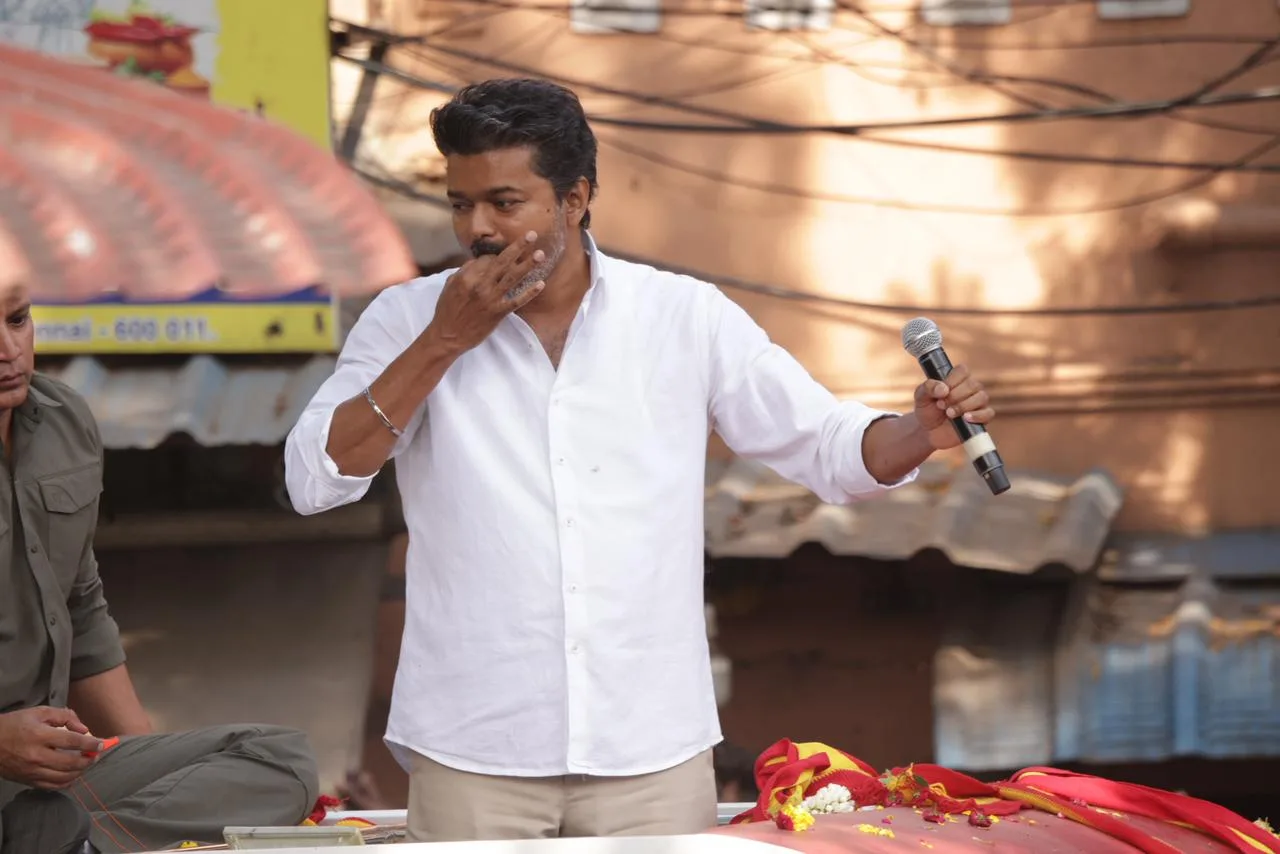
The petitioner also stated, “In a speech delivered on 21.04.2026 at YMCA Grounds, Joseph Vijay, the president of the political party of the returned candidate, made a direct appeal to children, urging them to influence their parents and other family members to cast their votes in favour of the TVK and its Whistle symbol. He drew an analogy with children persistently demanding chocolates such as Kinder Joy and encouraged them to similarly pester their parents to vote for TVK, asking them directly to do it for Vijay Mama (Vijay Uncle).
“The aforesaid appeal was intended to exploit familial relationships and exert emotional influence by encouraging minors to pressure eligible voters to cast their votes in favour of the returned candidate and his political party.”
It was argued, “Pursuant to the speech, in the days preceding the election, various items of social media content, including Instagram Reels and similar digital media, were circulated depicting children and young adults urging, pressuring and, in certain instances, threatening their parents and other family members to vote for the returned candidate. Such content reinforced and amplified the campaign message of Mr Joseph Vijay, the president of the returned candidate’s political party.”
To prove his case, the petitioner mentioned some instances:
A minor boy threatened to fling cow dung at his parent unless the parent voted for the TVK’s Whistle symbol.
A young woman threatened to poison her father’s food/rice unless he voted for Vijay/TVK.
A minor child threatened to commit suicide if the grandparents did not agree to vote for TVK.
A minor child physically hit and slapped an adult family member while demanding a vote for TVK.
A minor child threatened to break an adult’s phone and spectacles unless the adult voted for TVK.
Multiple minor children were generally shown shouting “shut up” at elderly family members who expressed an intention to vote for other political parties. Videos of elders stating that they had voted for the Whistle symbol only because of their children’s tantrums were also taken. The videos were annexed as documents along with the due certificate under Section 63 of the BSA. Even after his victory in the election, Joseph Vijay specifically thanked the children for campaigning on his behalf and for his political party.
He argued that, because of the said campaign, voters were subjected to emotional and familial pressure exerted through their children, through which the returned candidate derived substantial benefit.
Countering this, Rajendran of the TVK said, “The first contention is that the circular of the ECI cannot be deemed to be a law or an order, as at best it is only a guideline, along with the Model Code of Conduct, and thus, violation of the circular, per se, does not amount to violation of any order or law issued by the Election Commission.”
The judge said, “The entire act of involving tender children is in bad taste, and the tasks they were allowed to perform reflect poor parenting; making reels out of it is cheap and politically motivated. This is a larger debate for the nation and Parliament to consider, including whether to prohibit it or make it grounds to set aside the election.”
“The plea, the children’s consequential actions, and the adults’ disclosure and behaviour do not disclose a triable issue of undue influence, even assuming that the allegations contained in the Election Petition are uncontroverted and true. I am unable to hold that the Election Petition discloses a cause of action for the grant of relief to the election petitioner,” the judge added.
The court said, “Thus, it cannot be seen as the tender children’s sole act of committing tyranny over the mind, overpowering volition. At best, it can be seen as convincing adults to vote for the party and the candidate. It is not based on informed consideration of the candidates or the way adults are supposed to make choices in a democracy.”
The judge said, “The Election Petition does not rest solely on unconnected social media material. The campaigning has been video-graphed by Manikandan, who is the official-in-charge of the Video Surveillance Team, and consequently, a case has also been registered in Crime No. 84 of 2026. Minor children have no electoral rights. They cannot vote. Using them in a campaign exploits the natural emotional bond between parents and children to create familial and social pressure on adult voters to vote in consonance with the party, which squarely falls within Section 123(2) of the Act.”
