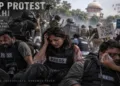
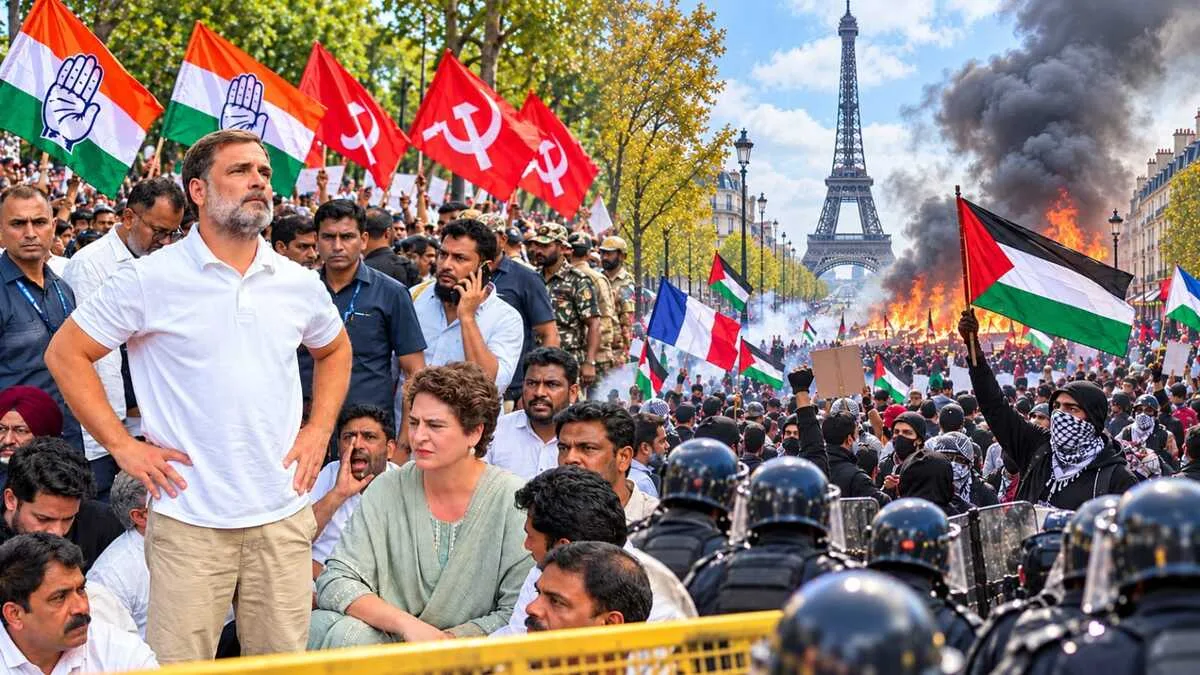
The Congress and the Communist parties have joined hands with the Cockroach Janata Party (CJP) and Islamist organisations to stage protests in Delhi, with demonstrators raising a range of demands extending beyond the resignation of Chief Election Commissioner Gyanesh Kumar.
While the leaders are demanding CEC’s resignation, the followers have also been raising slogans against the Citizenship Amendment Act (CAA), the National Register of Citizens (NRC), and the Foreign Contribution (Regulation) Act (FCRA), besides expressing support for Palestine.
The protest has brought together political parties and affiliated organisations that have suffered repeated electoral defeats, with the Congress losing ground across much of the country and the Communist parties facing a steady decline in electoral support. Having been rejected by voters at the ballot box, these parties and groups are now seeking to regain power through street mobilisation and violence.
The Delhi protests mirror a pattern seen in Europe and other parts of the world, where divisive and destructive forces are exploiting global crises and international instability to advance their political agendas. To understand this pattern, it is essential to examine the economic turmoil and geopolitical tensions currently reshaping the global landscape.
How divisive forces exploit global economic turmoil to fuel protests
The world is grappling with mounting economic pressures, with rising oil prices, the Russia-Ukraine war and continuing conflicts in West Asia, including the war involving Iran, adding to inflation and the cost of living. From the United States and Europe to Russia and China, the economic fallout is being felt in different ways, fuelling public discontent and protests in several countries.
In the United States, rising fuel prices have put pressure on household budgets and businesses. President Donald Trump has announced plans to resume oil imports from Russia despite the tensions between the two countries. China, meanwhile, is dealing with its trade war with Washington, overproduction and mounting challenges in export markets, including Europe. Russia continues to face the economic consequences of its war with Ukraine.
The economic turmoil has opened new avenues for communist and Islamist groups to intensify their activities across several countries, turning localised protests into broader political campaigns and using international crises to push agendas that extend beyond the immediate causes of public demonstrations.
In France, left-wing and Islamist groups have mobilised students around issues such as teacher shortages, poor school infrastructure and financial restrictions in the education sector. Similar protests have spread to Belgium, Italy, Greece, Ireland, Germany and Austria. Meanwhile, Spain’s left-wing government has also fallen amid widespread protest.
Economic hardship, public protests and political instability in India’s neighbourhood, including Bangladesh, Nepal and Sri Lanka, have provided an opening for divisive and destructive forces to exploit public unrest and bring about changes in government.
These developments have highlighted how left-wing and Islamist groups along with Congress are seeking to exploit economic grievances and institutional challenges to fuel public unrest and sway public opinion. The same groups have long sought to overthrow the Modi government and challenge India’s existing political order.
European-style unrest and attempts to mobilise students in India
Efforts to mobilise large-scale protests in Delhi have, however, struggled to gain comparable public support. The demonstrations have largely drawn people driven by specific political agendas and religious interests, rather than attracting broad participation from the general public.
Unlike countries where economic discontent has fuelled widespread demonstrations, India has continued to record economic growth and stability. This has limited the scope for building a mass movement around claims of an impending economic collapse.
Rahul Gandhi, the Congress leadership and left-wing groups had hoped that the Iran war and the resulting oil crisis would severely disrupt the Indian economy, creating an opportunity to launch a large-scale public agitation against the Modi government.
However, growth projections and assessments by major international financial institutions have underscored the resilience of the Indian economy, weakening the prospects of building a mass protest around the threat of an economic crisis. CJP leader Abhijit Deepke also attempted to mobilise protests by visiting schools in India, following a strategy associated with student protests in France. That effort, too, failed to generate the anticipated response.
Rahul Gandhi’s initial economic push to replicate European-style protests
Before the NEET-related protests and the demand for Chief Election Commissioner Gyanesh Kumar’s resignation became the focus of agitation, LoP Rahul Gandhi had sought to mobilise public anger over economic issues to launch a broader movement against the Union government, following a pattern seen in parts of Europe.
On 3 June 2025 Rahul Gandhi alleged that Prime Minister Narendra Modi had “surrendered” to US President Donald Trump under American pressure, compromising India’s national interests. On July 31, 2025, when President Trump described India as a “dead economy”, Rahul and the Congress party supported the criticism rather than standing with the country.
On 16 October 2025 he accused PM Modi of being afraid of Trump after the US President claimed India had agreed to stop buying Russian oil. He alleged that PM Modi was allowing Trump to dictate India’s decisions. In March 2026, Rahul accused PM Modi of compromising India’s economic security through a trade agreement with the United States. He also claimed that India needed Trump’s permission to purchase oil from Russia, Iran and Saudi Arabia.
In April 2026 he claimed that India could not purchase Iranian or Russian oil without Trump’s approval. He also alleged that the US trade deal would harm Indian farmers by opening the agricultural sector to American products. In May 2026, Rahul called Modi “Inflation Man Modi” amid concerns over rising oil prices. He accused the government of increasing fuel prices and making ordinary people bear the burden of inflation.
In June 2026, he alleged that Modi’s economic policies were hurting poor people, workers, farmers, women and the middle class, arguing that ordinary citizens were paying the price for the government’s economic decisions. However, economic data and international growth forecasts have challenged claims that India is heading towards a severe economic crisis. The Economic Survey 2025–26 projected India’s GDP growth at 7.4% for FY2025–26, while the World Bank forecast growth of 6.6% for FY2026–27.
Unlike in parts of Europe and other regions, where economic pressures have fuelled large-scale protests, India’s growth outlook has made it difficult for the Congress, Communist groups, Islamist organisations and other divisive forces to exploit fears of an economic collapse to mobilise widespread public anger against the BJP government.
The focus of the agitation subsequently shifted to other subjects. Groups operating under the CJP banner began mobilising around the National Eligibility-cum-Entrance Test (NEET), seeking to connect students’ concerns over alleged examination irregularities with a wider campaign against the Union government.
However, following the resignation of Union Education Minister Dharmendra Pradhan, the NEET issue lost its position as the central focus of the agitation. Attention then shifted to allegations against the Election Commission and demands for the resignation of election commissioners.
The campaign has since expanded to include criticism of the Supreme Court and the Chief Justice of India. The political demands will also be extended to calls for the removal of the elected government, with the broader objective of destabilising the country through street protests, mobilisation and violence.
The French model of Islamist-Left mobilisation and civil unrest
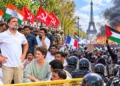
The New Delhi protests have drawn comparisons with demonstrations in Europe, particularly France, where left-wing and Islamist groups have been using students to advance their political agendas. The French government has identified France Unbowed, a radical-left political organisation, as a factor behind the escalation of unrest, according to the reports. More than 50 organisations, including Muslim student groups supportive of Hamas and Gaza, have participated in the protests.
Nearly 600,000 people took part in nationwide protests across France on October 8, according to the CGT trade union, following a strike call by unions opposing proposed spending cuts in next year’s budget. The French Interior Ministry put the turnout significantly lower at around 195,000, including 24,000 protesters in Paris.
On October 7, during a school occupation organised in the name of students at Beaugency High School in France’s Loiret region, protesters sang a rap song referring to Islamist extremists. The song, titled “MRH”, referred to Mohammed Merah, who carried out a terrorist attack in Toulouse in 2012, and Salah Abdeslam, who was involved in the November 2015 Paris terrorist attacks. The incident led to mass arrests.
France has witnessed a series of violent incidents amid under the banner of student protests, including an attack in Marseille’s 7th arrondissement in which a teenager dressed in black sprayed a flammable substance directly into a woman’s face in front of other high-school students.
In separate incidents, a police sting-ball grenade exploded in a student’s hand, a woman lost an eye after being struck by a stone thrown by a student, and a high-school student sustained serious injuries while handling an explosive device.
An undercover police commissioner was chased and beaten unconscious outside a high school, while a school principal and staff members in Marseille were attacked and doused with gasoline. The scale and severity of these incidents have raised questions about whether the unrest goes beyond conventional student protests.
The violence has been described as a possible rehearsal for a wider political confrontation ahead of France’s presidential election in May 2027, a contest expected to have significant implications for the country’s political direction and Europe’s future.
A similar combination of political and student groups has emerged in New Delhi, with a section of students from religiously affiliated groups at universities across the capital participating in the protests. The demonstrations have also drawn participation from radical left-wing organisations such as AISA, CPI(M), CPI (M-L), SFI, AISF, INDI Alliance parties and Islamist organisations such as the Youth League, the Muslim Students Federation (MSF) etc.
The involvement of these organisations has brought together communist, left-wing and Islamist groups alongside CJP and opposition political parties, creating a coalition that extends beyond the immediate demand for the Chief Election Commissioner’s resignation.
The sequence of events has seen the focus of the agitation move from economic concerns and the NEET controversy to the Election Commission and the judiciary. Each issue has provided a new platform for divisive groups seeking to mobilise protests against the Modi government.
The Congress party’s association with left-wing and Islamist organisations has also become a central feature of the political mobilisation. Rahul Gandhi and the Congress leadership are increasingly operating within a protest movement in which these destructive groups play a significant role.
Rejected ideologies, street protests and the search for an alternative
The protests unfolding in New Delhi, Paris and other European countries raise a larger question about the relationship between electoral legitimacy, political opposition and street mobilisation. When political parties lose public support at the ballot box, do they accept the verdict and rebuild their support through democratic means, or attempt to weaken elected governments by mobilising unrest?
In India, the Congress and Communist parties have suffered significant electoral setbacks over the years. The Communists once governed West Bengal, Kerala, and Tripura for decades, but voters eventually removed them from power.
The historical record of communist revolutions provides another important dimension to this debate. The Russian Revolution of 1917, the Chinese Revolution of 1949, the Cuban Revolution of 1959 and the Khmer Rouge takeover of Cambodia in 1975 promised radical social transformation, equality and an end to exploitation.
North Korea established another authoritarian communist system. However, these revolutions produced vastly different outcomes, including mass repression, political purges, forced collectivisation, economic hardship and restrictions on individual freedom.
The Soviet Union and Maoist China witnessed mass deaths associated with political campaigns and state policies, while Cambodia experienced genocide under the Khmer Rouge. Although China subsequently achieved substantial economic growth through market-oriented reforms, its political system remains authoritarian.
A similar question applies to Islamist political movements. Iran’s theocratic system, Saudi’s Islamic monarchial system, the Taliban’s Sharia rule in Afghanistan and the continuing instability in countries such as Yemen, Syria, Bangladesh and Pakistan demonstrate the serious challenges associated with political systems shaped by Islamic religious authoritarianism, armed conflict and institutional weakness. Restrictions on women’s rights, political freedoms and dissent remain major concerns in several of these contexts.
The Congress leadership under Rahul Gandhi has increasingly aligned itself with Communist groups and Islamist organisations, bringing these forces together in a common political campaign. Their association raises questions about the extent to which the Congress is relying on divisive ideological groups to mobilise opposition against the government and advance a political agenda that could deepen social divisions.
Ultimately, the debate is not simply about who can bring the largest number of people onto the streets or mobilise opposition against an elected government. It is about what kind of political and social order these movements seek to establish. India has experienced Congress-led governments under Jawaharlal Nehru, Indira Gandhi, Rajiv Gandhi and the later Congress leadership, while the BJP’s rise has reflected a significant shift in the country’s electoral landscape.
Successive governments must be judged by their records on economic development, social welfare, civil liberties, institutional accountability and public welfare not merely by their ideological claims. The same standard must apply to movements seeking to replace them. If communist and authoritarian Islamist models have failed to deliver political freedom and accountable government in several countries, what alternative are their contemporary supporters proposing?
And if their objective is to displace an elected government, can they demonstrate that their proposed replacement has a stronger democratic mandate and a more credible record of delivering development, freedom and social justice? These are the questions that should guide any serious examination of the protests in New Delhi, the unrest in Europe and the political transformations taking place across the world.
While the forefathers of this nation, including Mahatma Gandhi, envisioned building a society rooted in non-violence or Ahimsa, what the so-called Gandhis of Nehru dynasty seek to build is a society plagued by unrest and chaos, mirroring the turmoil seen in Europe, with weakened national defence.