West Bengal SIR Data Questions TMC Manipulation Claims
KOLKATA: The Trinamool Congress (TMC), Congress and the Citizens for Justice and Peace (CJP) have raised allegations concerning voter deletions and additions during the Special Intensive Revision (SIR) of West Bengal’s electoral rolls. But constituency-level figures cited by political commentator Rishi Bagree present a challenge to the broad claim that the exercise systematically favoured the Bharatiya Janata Party (BJP).
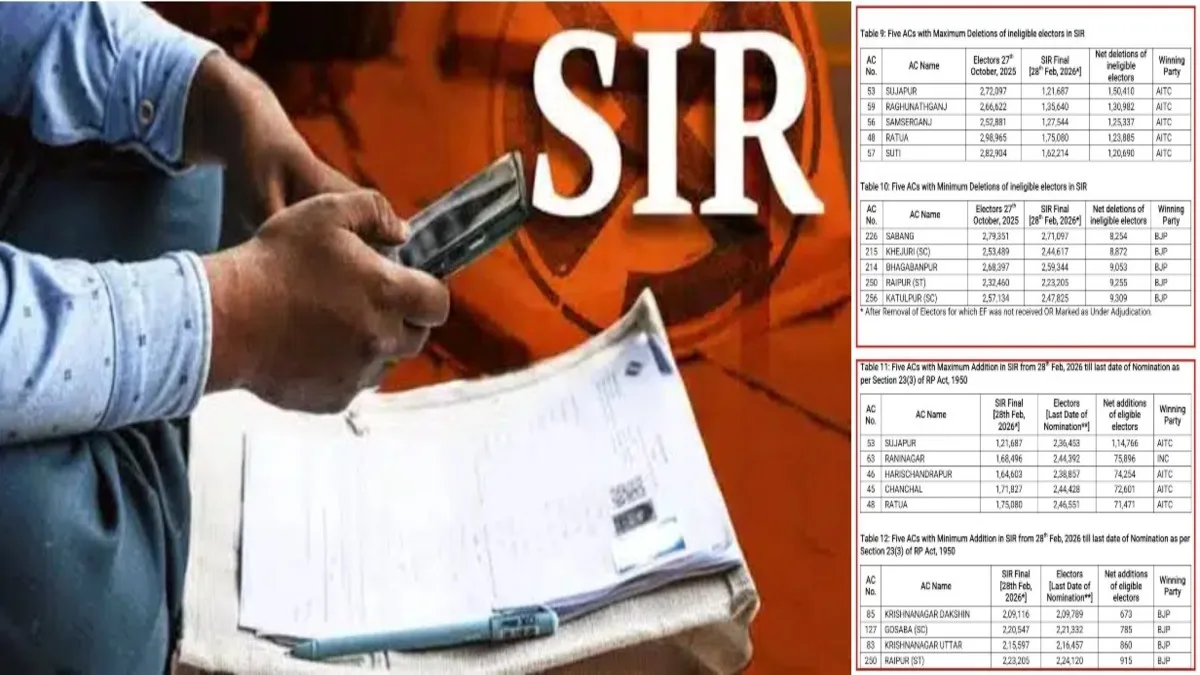
Bagree’s central argument rests on four sets of data: the five constituencies recording the highest deletions, the five with the lowest deletions, the five with the highest additions and the five with the lowest additions.
The pattern that Bagree highlights is striking. All five constituencies with the highest deletions were won by the TMC, while all five with the lowest deletions went to the BJP. In the rankings for voter additions, the five constituencies with the highest additions were won by the INDI Alliance, four by the TMC and one by the Congress. The five with the lowest additions were BJP wins.
The figures challenge the suggestion that the scale of deletions and additions, by itself, establishes that the electoral-roll revision was designed to secure BJP victories.
The five constituencies identified in the maximum-deletion category are Sujapur, Raghunathganj, Samserganj, Ratua and Suti, located in Malda and Murshidabad districts.
According to figures attributed to Election Commission of India (ECI) data, all five were won by the TMC despite recording the highest numbers of deletions.
Sujapur recorded 1,50,410 deletions in the electoral roll published on February 28. Of these, 1,14,766 names were subsequently restored before the deadline for filing nominations, according to figures reported on October 8.
The contrast is equally notable at the other end of the rankings. Sabang, Khejuri (SC), Bhagabanpur, Raipur (ST) and Katulpur, identified as the five constituencies with the lowest deletions, were all won by the BJP.
These figures make the argument (that the absolute number of deletions alone demonstrates a systematic electoral advantage for the BJP) fall flat on its face. The party accused of benefiting from the exercise did not win the constituencies with the highest deletions, while the party alleging electoral wrongdoing won all five.
The second allegation concerns the wrongful addition of voters, including claims that electors from Uttar Pradesh and Bihar were being brought onto West Bengal’s rolls.
Bagree’s analysis points to the constituency rankings for additions after publication of the final SIR roll. According to his post, all five constituencies recording the highest additions were won by the I.N.D.I alliance, with four going to the TMC and one to the Congress.
Conversely, the five constituencies with the lowest additions were won by the BJP.
This pattern does not support a simple argument that the constituencies with the largest additions necessarily benefited the BJP.
However, the geographical origin of newly registered electors cannot be established from constituency-level addition totals alone. Claims of fraudulent registrations require evidence concerning individual electors, eligibility and compliance with electoral law. The figures challenge a sweeping political narrative, but they are not a substitute for examining specific allegations of illegal enrolment.
Bagree makes a further argument about the approximately 27 lakh cases involving electors removed following adjudication.
His post proposes a hypothetical calculation: restore all these electors in every constituency and assume that every one of them votes for the TMC. According to Bagree, his seat-wise analysis still leaves the BJP ahead of the TMC in 181 constituencies, well above the majority mark.
This is a claim made by Bagree and should be assessed against the underlying constituency-wise data and methodology. The hypothetical assumes both universal restoration and a uniform voting preference, neither of which represents an observed election result.
Nevertheless, the calculation poses a pertinent question: can the disputed adjudication cases, even under an assumption deliberately favourable to the TMC, account for the BJP’s overall victory?
The answer depends on the accuracy of the seat-wise calculation. The underlying tables and constituency results are therefore essential to independently reproduce the exercise.
The central point is not that every deletion or addition during the SIR was necessarily correct. It is that aggregate figures must be examined in the context of constituency-level outcomes before being used to substantiate claims of electoral manipulation.
The highest-deletion constituencies went to the TMC. The lowest-deletion constituencies went to the BJP. The highest-addition constituencies went to the I.N.D.I Alliance, while the lowest-addition constituencies went to the BJP.
These patterns undermine the use of deletion and addition totals alone as proof that the SIR systematically favoured the BJP. Any allegation of wrongful exclusion or fraudulent enrolment must be supported by specific evidence rather than inferred solely from the number of names removed or added.
The official Chief Electoral Officer, West Bengal website publishes the SIR final roll, deletion lists, supplementary lists and related records, providing a basis for checking the electoral data.
The political argument over SIR will continue, but the numbers cited by Bagree demand that the allegations be tested against the complete constituency-level record.
On the SIR exercise, former judge of the Kerala High Court, Justice PN Ravindran has called out against the allegations of malicious deletion of voters. In a video interview, Justice (Retd) Ravindran told news agency ANI, “Special Intensive Revision is the ninth edition of the SIR. It has happened earlier, eight times it has happened. Even when the Congress Party was in power, it happened. Doesn’t mean that the Congress Party controlled the Election Commission. No. It is an exercise that has taken place over several years… The whole idea is to have a clean electoral roll, which is a significant requirement: a valid electoral roll. It’s a significant need for an election. So, the duty lies with the Election Commission. It’s an insulated body; the government doesn’t control it. The charter was written several decades ago when the Constitution was framed… If I am a voter and my name is deleted, it is for me to work out my remedies. I don’t go to the streets and fight. I go to the authority, namely the courts, and seek redressal of my grievances. There are other authorities also set up…”
Now the question for the parties alleging “vote chori” and SIR exercise manipulation is straightforward: do their claims withstand scrutiny against the actual deletion, addition and election-result data, constituency by constituency?
