On the occasion of Prime Minister Narendra Modi completing 25 years as Head of Government and marking his 76th birthday, it is an appropriate moment to reflect on the remarkable journey of a public life shaped by spiritual discipline, national service, cultural rootedness and an unwavering commitment to the idea of Bharat. On October 7, 2026, Narendra Modi completed 25 continuous years at the helm of government, beginning with his assumption of office as Chief Minister of Gujarat in 2001 and continuing as Prime Minister of India since 2014. His 76th birthday, celebrated on September 17, 2026, provided another occasion to recall the values and influences that have shaped his public life.
After undergoing rigorous spiritual discipleship at the Vivekananda Math, Narendra Damodardas Modi was initiated into spiritual wisdom. During his residence at Belur Math and the Rajkot Ramakrishna Ashram, the youthful Narendra Modi immersed himself heart and soul in the teachings of the warrior-monk, Swami Vivekananda. From Vivekananda, he indelibly inscribed upon his tender mind ideals of a culturally rooted spiritual society, economic equity, political liberty, pristine moral virtue, intellectual growth, sublime cultural heritage, and reciprocal human respect.
Young Narendra Modi received stirring counsels of Swami Vivekananda as sacred Deeksha from Swami Atmasthanandaji Maharaj, the revered leader and spiritual beacon of the Ramakrishna Order. Holding also Swami Dayananda Saraswati as his spiritual guru, Prime Minister Narendra Modi maintains a profound personal bond with the Ramakrishna Math, forged under the tutelage of Swami Atmasthanandaji.
In a public life spanning sixty-five years, including over twenty-six years presiding at the pinnacles of state and national governance as Chief Minister of a powerhouse state and Prime Minister of India, not a single blemish of corruption has ever been substantiated against Narendra Modi. How has he stood as the devoted son of this sacred land—an upright, uncorrupted, transparent, and truthful statesman? In the hearts of 1.48 billion people of multifaceted languages, races, arts, and cultures, he dwells with unassuming simplicity: as a man of impeccable integrity, an illustrious son of the soil, and a resolute guardian of the masses.
Guided by the sublime vision of Vasudhaiva Kutumbakam—the world is one family—he has striven tirelessly to champion a borderless humanism transcending caste, creed, and nationality, fostering global harmony and mutual cooperation. No discerning citizen can dispute that Prime Minister Modi acts with utmost vigilance in nurturing India’s international relations: undertaking official visits to over a hundred nations, receiving the highest civilian honours from thirty-four sovereign states, and addressing the parliaments of seventy nations, shining across global forums with intellectual majesty. While a few myopic detractors within India have sought to confine him to partisan labels, the citizenry has thoroughly unmasked their rhetoric; notably, it is Islamic nations that have conferred upon him several of their highest civilian accolades.
I venture here to present a panoramic comparison between Prime Minister Narendra Modi and the towering political luminaries of India, particularly the beloved icons of Tamil Nadu. Like a feline aspiring to lap up the vast ocean, my deep devotion to Modi’s ideals will carry it through.
Narendra Modi is giving living reality on the Indian political landscape to the sublime dreams of those selfless souls of freedom fighters who offered their blood, toil, sweat, and very lives. The resolute vow to protect this motherland and breathe life into the vision sketched by our forebears was carved into his consciousness as an eighteen-year-old youth.
Long before assuming office as the Chief Minister of Gujarat on October 7, 2001, he traversed the length and breadth of India, mingling intimately with common citizens and discerning firsthand the trials of their existence. Like a penetrating beam, he absorbed the philosophies, selfless service, industry, sacrifice, and patriotism of our ancestors, evolving into a vessel of mature wisdom.
Ever since receiving initiation, Narendra Modi has marched forward with an identical indomitable spirit, impassioned by the unity, prosperity, and global stature of India. Struck with awe at Netaji’s valour, Modi imbibed that very intrepidity into his life.
Narendra Modi measures his days entirely through dedicated public service. Pondering the welfare of the citizenry round the clock through sweat, sacrifice, and total devotion, he has occupied the highest corridors of power for twenty-six years without allowing the faintest trace of hubris or arrogance to touch him.
Adhering to an ascetic personal discipline, his governance philosophy—Sabka Saath, Sabka Vikas, Sabka Vishwas—embodies equitable development embracing every citizen without distinction of caste or creed. It represents a collective endeavour where welfare schemes and fundamental amenities reach the poorest uninterrupted. Uprooting terrorism through decisive cross-border security operations reflects the martial resolve of Subhas Chandra Bose; similarly, the Gandhian paradigm of indigenous economic production is reborn in Modi’s Make in India and Made in India economic renaissance.
In 1857, Veer Vinayak Damodar Savarkar sounded a clarion call to Hindus and Muslims alike: “Where is our wealth? Where is our land? Where is our strength? All lie eclipsed beneath the yoke of bondage! If we forfeit the fortitude to shield our faith and motherland, the sin of their destruction shall rest squarely upon our own shoulders.”
Savarkar’s rallying cry ignited a volcanic eruption among the populace, sparking the First War of Independence. Today, Modi has resolved historical fissures born of that struggle; the triumphant fluttering of the tricolour across the hamlets of Kashmir and the reverberating echoes of Bharat Mata Ki Jai stand as testament.
Drawing comparisons between Prime Minister Modi and the legendary stalwarts of Tamil Nadu’s political history serves to illustrate the profound kinship of spirit that exists between the Prime Minister and the ethos of Tamil self-sacrifice.
While Tamil Nadu long revered V. O. Chidambaram Pillai primarily as the “Tamilian who launched a ship” (Kappalottiya Thamizhan), his granddaughter graciously unveiled a broader national horizon by publishing a work titled ‘The Indian Who Launched a Ship through Alliance Company’—an effort worthy of high commendation.
For decades, a certain political cabal played self-serving games by marginalising numerous freedom heroes—Pooli Thevan, Velu Nachiyar, Veerapandiya Kattabomman, the Marudhu Brothers, Dheeran Chinnamalai, Veeran Azhagu Muthu Kone, Perumbidugu Mutharaiyar, Subramania Bharati, and Pasumpon Muthuramalinga Thevar—confining national icons to narrow sectarian boundaries. This remains a historical tragedy.
Towering statesmen like Rajaji, Perunthalaivar Kamarajar, V. V. S. Iyer, Thiru. Vi. Ka., Omandur Ramasamy Reddiyar, P. S. Kumaraswamy Raja, Arignar Anna, and Puratchi Thalaivar M.G.R. emerged as authentic leaders of the masses. Dedicating themselves as full-time servants for the progress of Tamil Nadu, they stood as blazing pillars of integrity in public life, presiding over unblemished administrations without compromising fundamental convictions.
Prime Minister Narendra Modi stands shoulder-to-shoulder with such towering personalities and their ideals, striving untiringly to uplift the impoverished so that all resources reach all citizens. Just as Kamarajar was venerated as the patron of the poor who opened the eyes of the masses through education, Modi emerges as a modern incarnation of that administrative ethos.
As Chief Minister of Gujarat, Modi auctioned all the state gifts he received, channelling the proceeds into a charitable trust that provides free higher education to thousands of underprivileged girls year after year.
Furthermore, his practice of visiting a remote village at the crack of dawn, spending the entire day living among rural citizens, engaging with farmers and children, staying overnight, and personally enrolling out-of-school children into educational institutions highlights his nature as a jewel among men. He is truly our Living Sage-Statesman (Vazhum Periyavar).
Arignar Anna represented social justice, self-respect, Dravidian culture, noncorrupt governance, and devotion to parliamentary democracy, famously reconciling diversity with unity under the dictum “One clan, one God.”
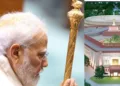
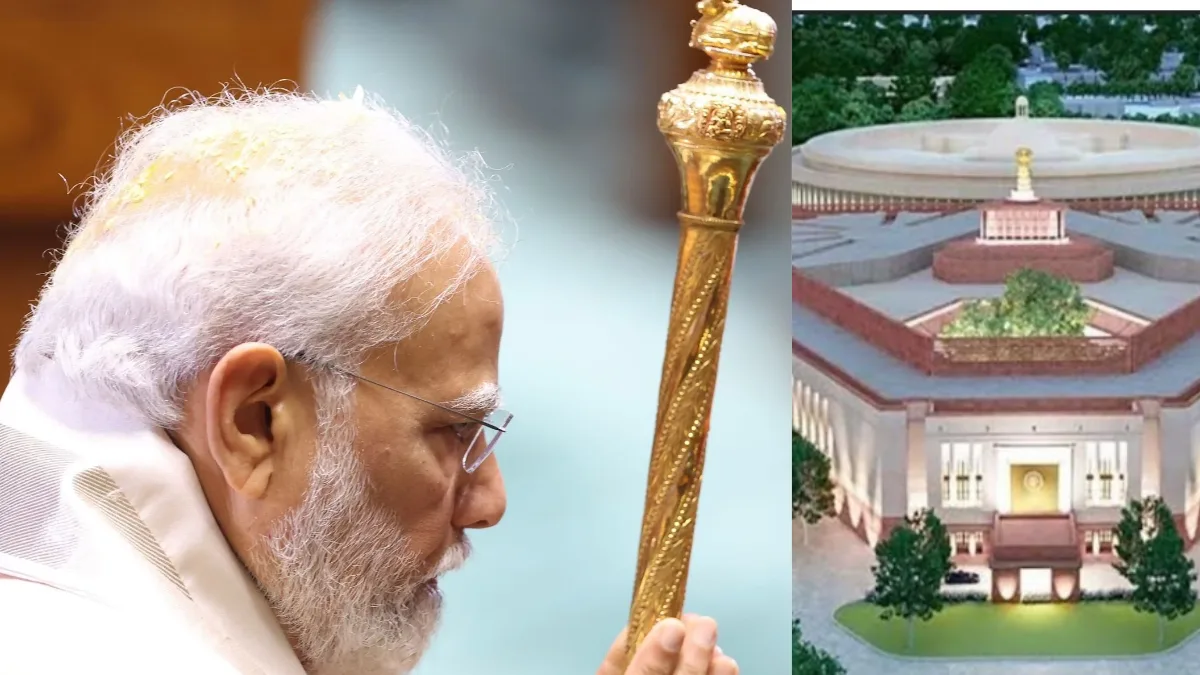
Prime Minister Modi aligns thoroughly with these ideals through his dedication to national defence, administrative probity, public service, and his profound reverence for Tamil culture—most visibly symbolised by the installation of the sacred Tamil Sengol in the new Parliament. In this light, to speak of Modi as Perarignar (The Great Scholar-Statesman) alongside Arignar Anna is no hyperbole.
Those who conspired to fracture India along North-South and East-West axes have seen their divisive designs dismantled by Modi’s governance. He proceeds with purposeful resolve towards national cohesion founded on shared cultural roots. He has realised on Indian soil the civilisational visions of Pandit Deendayal Upadhyaya, Ram Manohar Lohia, Jayaprakash Narayan, Syama Prasad Mookerjee, L. K. Advani, and former Prime Minister Atal Bihari Vajpayee, elevating India’s stature on the world stage.
Narendra Modi has achieved an unmatched civilisational renaissance in India. He liberated the people from sixty years of dynastic hegemony, consolidating our citizenry into a unified, resurgent Bharat.
The ancient Chinese philosopher Lao Tzu imparted a timeless maxim for public servants: “Go to the people. Live with them. Learn from them. Love them.”
Holding this counsel close to his heart and embodying the simplicity of Swami Vivekananda, Prime Minister Modi treats every assembly of the Indian diaspora across the globe as a sacred shrine, engaging with their concerns and instituting supportive policies.
Through his monthly radio address Mann Ki Baat, broadcast on the final Sunday of every month—reaching its 137th episode on August 30, 2026—he has systematically showcased traditional artisans, celebrated gifted youth, lauded athletic champions, and revitalised our national cultural pride.
To safeguard our heritage crafts, he introduced the PM Vishwakarma Scheme. Yet, just as reactionary elements once derided Rajaji’s vocational educational proposals, an anti-national cabal in Tamil Nadu refused to support the Vishwakarma initiative; history will inevitably consign them to oblivion.
On July 31, 2026, Prime Minister Modi reflected on social media with characteristic magnanimity: “To err is human. Yet hearing unseemly remarks from some of our nation’s daughters is painful; it does not reflect our ethos. We must pardon those of our youth who have strayed and guide them back towards righteousness. When we bite our tongue, we do not extract our teeth; our youth belong to us in the same manner. They must step forward and learn from their mistakes. Our nation is advancing; our youth must advance in tandem.”
When detractors hurled unworthy abuse at Narendra Modi and his late mother, he shared his pain with the nation while maintaining supreme equanimity. A soul possessing such boundless patience deserves to be celebrated as our Living Sage-Statesman (Vazhum Periyavar).
President John F. Kennedy challenged the American people with words relevant to every society: “Ask not what your country can do for you; ask what you can do for your country.” Prime Minister Modi summons the people of India with an equivalent call: “Citizens of India, walk beside me; stand shoulder to shoulder! Let us achieve advancement across all spheres and secure prosperous livelihoods for all!” He rallies us to forge an affluent, powerful Bharat.
As Sun Tzu observed in the sixth century CE in The Art of War: “He will win who knows when to fight and when not to fight.” When Prime Minister Narendra Modi addressed the President of Russia and the leadership of Ukraine, stating unequivocally that “This is not an era of war,” the entire international community stood in silent admiration.
The legends who lived in past centuries and the Living Sage-Statesman of the twenty-first century shall both endure across the annals of history. Long live the renown of Modi! Let his ideals, vision, and dedication be realised under the rousing banner: “Protect the Nation! Win Tamil Nadu!”