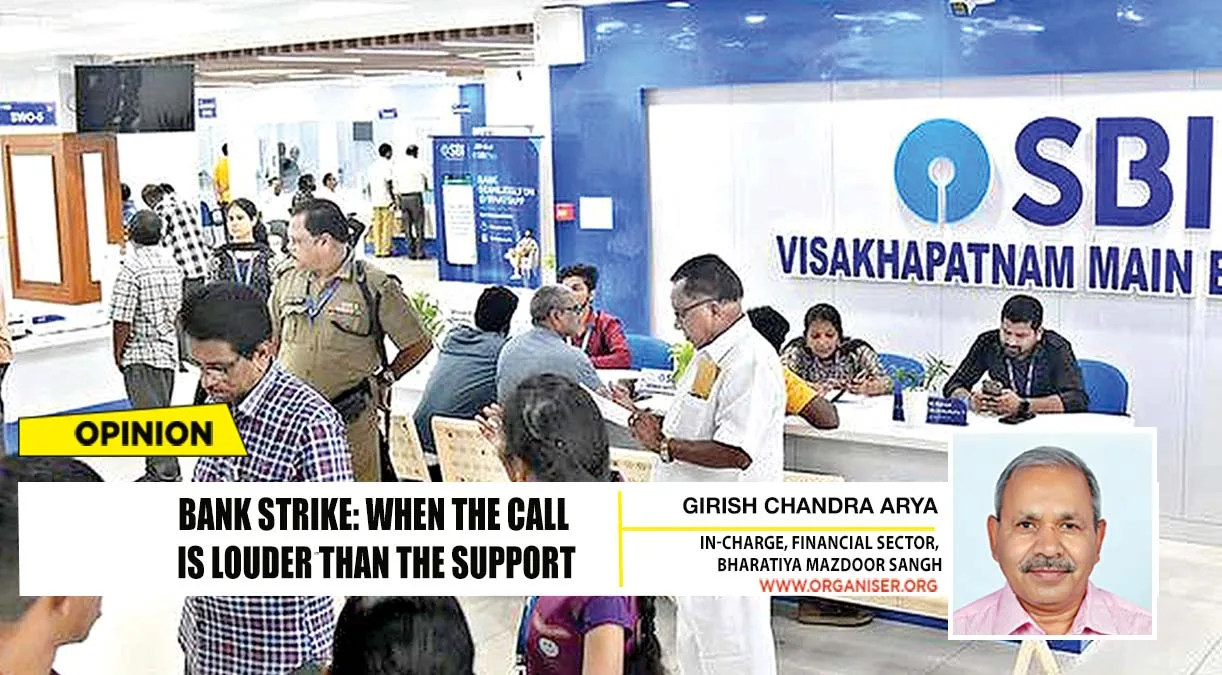
Bank Strike: When the call is louder than the support
October 8, 2026
  • Read Ecopy
  • Circulation
  • Advertise
  • Careers
  • About Us
  • Contact Us
Android AppiPhone AppArattai
Organiser
  • ‌
  • Bharat
    • Assam
    • Bihar
    • Chhattisgarh
    • Jharkhand
    • Maharashtra
    • View All States
  • World
    • Asia
    • Europe
    • North America
    • South America
    • Africa
    • Australia
  • Editorial
  • International
  • Opinion
  • RSS @ 100
  • More
    • World Hindu Congress 2026
    • Op Sindoor
    • Analysis
    • Sports
    • Defence
    • Politics
    • Business
    • Economy
    • Culture
    • Special Report
    • Sci & Tech
    • Entertainment
    • G20
    • Azadi Ka Amrit Mahotsav
    • Vocal4Local
    • Web Stories
    • Education
    • Employment
    • Books
    • Interviews
    • Travel
    • Law
    • Health
    • Obituary
  • Subscribe
    • Subscribe Print Edition
    • Subscribe Ecopy
    • Read Ecopy
  • ‌
  • Bharat
    • Assam
    • Bihar
    • Chhattisgarh
    • Jharkhand
    • Maharashtra
    • View All States
  • World
    • Asia
    • Europe
    • North America
    • South America
    • Africa
    • Australia
  • Editorial
  • International
  • Opinion
  • RSS @ 100
  • More
    • World Hindu Congress 2026
    • Op Sindoor
    • Analysis
    • Sports
    • Defence
    • Politics
    • Business
    • Economy
    • Culture
    • Special Report
    • Sci & Tech
    • Entertainment
    • G20
    • Azadi Ka Amrit Mahotsav
    • Vocal4Local
    • Web Stories
    • Education
    • Employment
    • Books
    • Interviews
    • Travel
    • Law
    • Health
    • Obituary
  • Subscribe
    • Subscribe Print Edition
    • Subscribe Ecopy
    • Read Ecopy
Organiser
  • Home
  • Bharat
  • World
  • Operation Sindoor
  • Editorial
  • Analysis
  • Opinion
  • Culture
  • Defence
  • International Edition
  • RSS @ 100
  • Magazine
  • Read Ecopy
Home Bharat

Bank Strike: When the call is louder than the support

Repeated strike calls, negotiations and committees have again brought banking trade unionism into focus. The deferment of the September 28–30 strike has brought the issues of representation, five-day banking, industrial relations and the effectiveness of repeated strike action back to the centre of the debate

Girish Chandra AryaGirish Chandra Arya
Oct 8, 2026, 08:20 pm IST
inBharat, Opinion, Economy
Follow on Google News
The banking community realised that UFBU was using bank workers as fodder and collateral damage in this process. Hence, most workers had already abandoned the strike calls

The banking community realised that UFBU was using bank workers as fodder and collateral damage in this process. Hence, most workers had already abandoned the strike calls

Facebook
Twitter
WhatsAppTelegramEmail

The announcement by the United Forum of Bank Unions (UFBU) to defer the strike scheduled for September 28 to 30 must be recorded in Bharat’s labour history. On the face of it, the UFBU claimed that it had reached an understanding with the Indian Banks’ Association (IBA) and that this was why the strike was deferred. However, the truth is that the strike was not gathering the support from bank workers that its organisers had expected.

The National Organisation of Bank Workers (NOBW) and the National Organisation of Bank Officers (NOBO), the bank unions affiliated with the Bharatiya Mazdoor Sangh (BMS), had already made their position clear. A major section of bank employees was also questioning the wisdom of shutting down public sector banks around the half-yearly closing, particularly when the country was dealing with the larger requirements of economic activity and development.

It became clear on the eve of the proposed strike that close to 70 per cent of branches were likely to remain open, rendering the strike ineffective. The main reason, it is argued, was that workers had come to know that the strike notice had not been served in accordance with the Industrial Relations Code, 2020 (IR Code). There were several issues raised in this regard. The IR Code requires notice of a strike to be given within 60 days before the proposed strike and bars a strike within 14 days of giving such notice. The notice for the proposed action was served only around 15 days in advance. Additionally, the UFBU, being an umbrella organisation, was not itself authorised to serve the notice and that IBA was not the appropriate body to receive it.

The Strike & Its Withdrawal

The September 11 strike deserves particular attention because of its timing. Bharat was preparing to host the BRICS Summit, an important international gathering centred on cooperation amongst major emerging economies. Banking is part of the country’s economic infrastructure. Disrupting banking services immediately before such an event was politically irresponsible and could create an adverse impression about Bharat’s financial and business environment. Any logical person would consider the timing deeply objectionable. When Bharat was presenting itself as a major economic power and seeking greater international investment and financial cooperation, a nationwide banking disruption immediately before an international summit sent the wrong signal. The 18th BRICS Summit was held in New Delhi on September 12–13, 2026, making the September 11 strike immediately prior to the summit.

The September 28–30 programme was no better. September 30 is the half-yearly closing of banks, involving reconciliation, provisioning, treasury operations and financial reporting. The proposed strike would have come after the fourth Saturday and Sunday and could have disrupted banking for several consecutive days. The fact that banks had to be opened on Sunday to prepare for the strike showed that its consequences were being felt even before it began. The eventual outcome was not the resolution of five-day banking. It was a late-night meeting with IBA and the formation of another committee and workers had to bear the consequences of this process.

Five-Day Banking: An Old Issue

The five-day banking issue exposes the problem most clearly. It is not a new demand. On March 8, 2024, the 12th Bipartite Settlement and 9th Joint Note recorded the proposal for declaring all Saturdays as holidays, with the necessary changes in working hours to be taken forward for Government approval. The proposal had therefore already passed through the bipartite process. Yet in September 2026, after another strike call, the solution offered through the IBA-UFBU understanding was a new High-Level Committee to examine the same question. The committee is now to examine possible alternatives and modalities for implementing five-day banking. The bipartite settlement was signed by the participating bank unions, minority-majority alike, representing a broad process of negotiation. That was the biggest and most inclusive committee which had achieved significant gains
for workers.

The question becomes straightforward from here: what exactly is this committee going to decide that could not be dealt with after the March 2024 settlement? A committee can discuss working hours and implementation modalities. It cannot replace the approval of the Government where Government approval is required.

Representation and Negotiation

BMS does not accept this arrangement. NOBW and NOBO are not constituents of UFBU and were not consulted before the latest strike programme was decided. They did not support the strike. A forum cannot claim to represent organisations that it did not consult when taking the very decision for which it subsequently claims a mandate. There is also a serious question of generational representation. The seven unions that issued the strike notice are led largely by long-retired office-bearers, with several principal leaders reported to be above 80. This is not a question of age. It is a question of whether the people making decisions about wage loss, working conditions and industrial action remain sufficiently connected with the realities of the serving workforce.

The record of BMS offers a different model. BMS representatives met the Union Finance Minister on July 9 and September 7 and raised five-day banking, pensioners’ issues, medical facilities, ex-gratia, PLI and grievance redressal. The PLI issue is particularly significant. BMS had consistently objected to the discriminatory structure of the proposed scheme and pressed the Government to defer it. Following sustained intervention and the assurance given to BMS, the 2025–26 PLI scheme was kept in abeyance, with the matter to be taken up during the ongoing Bipartite Settlement and  Joint Note discussions.

That is what we mean by Sangharsh evam Samvaad (Struggle and Dialogue). It does not mean surrendering a demand or avoiding collective action. It means using organisational strength, political engagement and negotiation together. The objective of a trade union is not to announce a strike and then claim success when the strike is withdrawn. The objective is to secure an outcome for employees.

BMS will continue to pursue five-day banking, PLI, pensioners’ concerns, medical facilities, grievance redressal, transfers, working conditions and employment security independently. We are not part of UFBU, and we will not allow our organisational position to be determined by a forum in which we have no representation.

Topics: Bank StrikeUnited Forum of Bank UnionsFive-Day Banking: An Old IssueNational Organisation of Bank WorkersStrike & Its WithdrawalHigh-Level Committee to examine the same questionModi governmnent
Girish Chandra Arya
Girish Chandra Arya
In-Charge, Financial Sector, Bharatiya Mazdoor Sangh [Read more]
Share
Tweet
SendShareSend
✮ Subscribe Organiser YouTube Channel. ✮
✮ Join Organiser's WhatsApp channel for Nationalist views beyond the news. ✮
Previous News

World Hindu Congress 2026: A strategic direction for Hindus to connect, collaborate & advance civilisational prosperity

Next News

Keralam govt orders vigilance probe against Tiruvananthapuram CPM councillor Ajin over Rs 10 lakh bribe demand video

Related News

The September 28–30 bank strike was deferred after IBA-UFBU agreed to discuss five-day banking, PLI and other pending demands

Bank Strike Deferred: The Demands vs What UFBU Actually Won — Top 5 Takeaways

Bank Strike Called Off for Now After UFBU-IBA Meeting

Bank Strike Deferred: UFBU, IBA reach late-night understanding; 5-day work week, PLI issues to be reviewed

BMS will not participate in UFBU strike

Bank Strike September 28–30 | BMS will not participate in UFBU strike, says strike approach is wrong

Load More

Latest News

The SIR controversy has raised questions over street pressure on constitutional institutions and judicial decision-making

Democracy or Mobocracy: Can street pressure influence constitutional institutions and judicial outcomes in India?

Swami Vigyananand, Joint General Secretary of Vishwa Hindu Parishad(VHP) and Initiator of the World Hindu Congress(WHC)

World Hindu Congress 2026: 60 countries, 4000 delegates & Hindu Expo; Hindu leaders unite for civilisational resurgence

Ajin, a CPM councillor in the Tiruvananthapuram Municipal Corporation (File Photo)

Keralam govt orders vigilance probe against Tiruvananthapuram CPM councillor Ajin over Rs 10 lakh bribe demand video

The banking community realised that UFBU was using bank workers as fodder and collateral damage in this process. Hence, most workers had already abandoned the strike calls

Bank Strike: When the call is louder than the support

Swami Vigyananand, Joint General Secretary of Vishwa Hindu Parishad(VHP) and Initiator of the WHC

World Hindu Congress 2026: A strategic direction for Hindus to connect, collaborate & advance civilisational prosperity

Tribute to RSS Pracharak MA Krishnan: The “SIR” who awakened the nationalist spirit

Punjab Assembly Elections 2027: Confronting a political and leadership vacuum

The new NCERT Class 9 Social Science textbook explores India’s traditions of governance through references to the Sengol, Gandhi’s Ram Rajya and the Mahabharata

NCERT’s new Class 9 Social Science textbook connects Sengol, Ram Rajya and Mahabharata to good governance

Bangladeshi Infiltrators

Assam Crackdown: 22 Bangladeshi infiltrators held in Guwahati; 13 were fleeing from Srinagar after staying 15 years

Maharashtra defends public security law before Bombay HC, cites ‘Urban Maoist’ network

Load More
  • Privacy
  • Terms
  • Cookie Policy
  • Refund and Cancellation
  • Delivery and Shipping

© Bharat Prakashan (Delhi) Limited.
Tech-enabled by Ananthapuri Technologies

  • Home
  • Search Organiser
  • Bharat
    • Assam
    • Bihar
    • Chhattisgarh
    • Jharkhand
    • Maharashtra
    • View All States
  • World
    • Asia
    • Africa
    • North America
    • South America
    • Europe
    • Australia
  • Editorial
  • Operation Sindoor
  • Opinion
  • Analysis
  • Defence
  • Culture
  • Sports
  • Business
  • RSS @ 100
  • Entertainment
  • More ..
    • Sci & Tech
    • Vocal4Local
    • Special Report
    • Education
    • Employment
    • Books
    • Interviews
    • Travel
    • Health
    • Politics
    • Law
    • Economy
    • Obituary
  • Subscribe Magazine
  • Read Ecopy
  • Advertise
  • Circulation
  • Careers
  • About Us
  • Contact Us
  • Policies & Terms
    • Privacy Policy
    • Cookie Policy
    • Refund and Cancellation
    • Terms of Use

© Bharat Prakashan (Delhi) Limited.
Tech-enabled by Ananthapuri Technologies