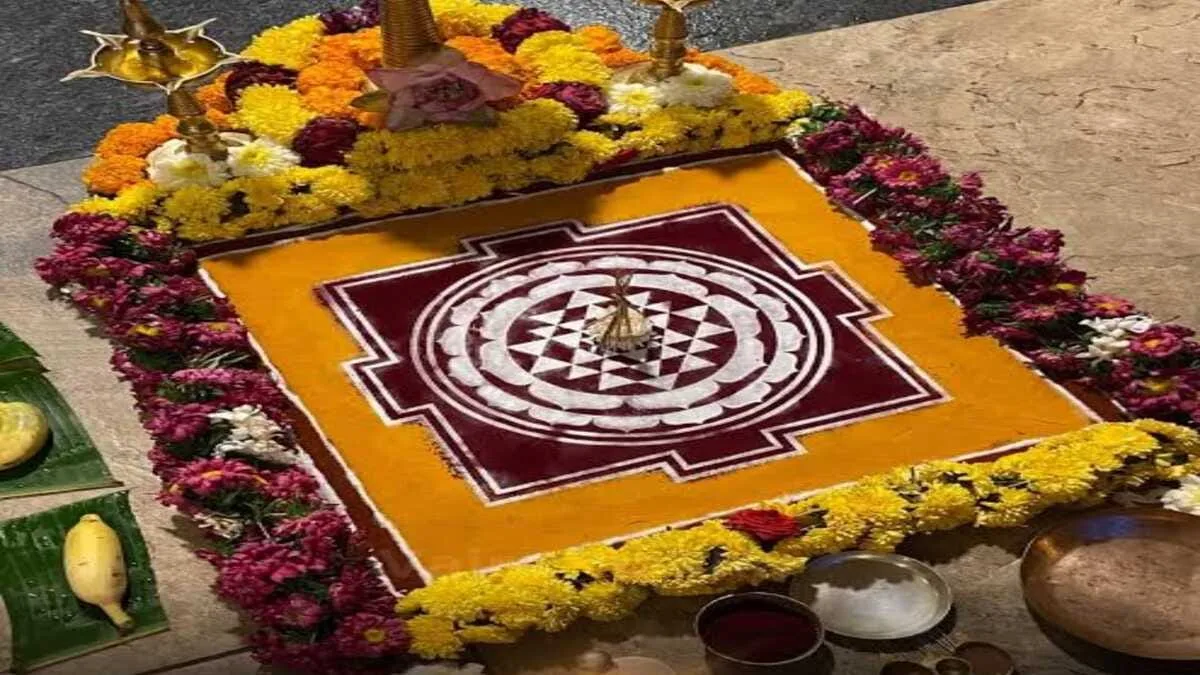
The Shrichakra Rangoli reflects the ancient Indian interplay of geometry, mathematics, spirituality and cosmic symbolism
The intricate Shrichakra Rangoli, traditionally drawn during Yagya and Pooja, offers a striking glimpse into the extraordinary relationship between geometry, mathematics and spirituality in India’s ancient traditions. Formed through an intricate arrangement of intersecting triangles, circles and lines, the design is far more than a decorative pattern, it represents a sophisticated geometric tradition deeply embedded in Hindu spiritual practice.
The Shrichakra, also known as the Sri Yantra, consists of nine interlocking triangles arranged around a central point, or bindu. The upward-facing triangles are traditionally associated with Shiva, while the downward-facing triangles are associated with Shakti. Their intersection produces a complex geometric structure containing numerous smaller triangles.
What makes the Shrichakra particularly fascinating is the precision required to construct it. A seemingly simple pattern emerges from a carefully organised network of intersecting lines, symmetry and proportions.
In traditional practice, creating such designs required an understanding of spatial relationships and geometric balance. The central bindu provides a focal point, while the surrounding geometry expands outward in a structured manner. For generations, Indian traditions have treated geometry not merely as a practical mathematical discipline but also as a means of representing the order of the cosmos.
Ancient India developed significant traditions in mathematics and astronomy. Indian scholars made important contributions to concepts such as the decimal place-value system, sophisticated astronomical calculations and methods of geometry.
The Sulba Sutras, among India’s early mathematical texts, describe geometric procedures associated with the construction of ritual fire altars. Some of these constructions demonstrate sophisticated knowledge of geometric relationships and transformations.
This historical record provides a fascinating context for understanding why geometric forms occupy such an important place in Indian ritual traditions.
A Shrichakra Rangoli created for a Yagya or Pooja therefore carries layers of meaning. To the devotee, it is a sacred representation associated with Shakti and the cosmic order. To someone studying its construction, it is an intricate exercise in symmetry, proportion and spatial geometry.
The belief that each line or intersection embodies cosmic energy belongs to the spiritual understanding surrounding the Shrichakra. It should not be confused with a scientifically measured form of energy, but it reflects the traditional Indian idea that the universe possesses an underlying order that can be represented through sacred geometry.
The Shrichakra ultimately represents something larger than a beautiful rangoli. It reflects an intellectual and spiritual tradition in which mathematics, geometry, ritual and cosmology could exist alongside one another.
While claims that a specific 5,000-year-old Shrichakra design proves that ancient India possessed all modern sciences are difficult to establish historically, the broader record of India’s ancient mathematical and astronomical traditions is substantial.
What survives today in the form of a carefully drawn Shrichakra is therefore a reminder of an enduring Indian idea: that the universe is not chaos, but an ordered reality—and that mathematics can become a language through which that order is contemplated.
From the tiny bindu at its centre to the countless intersections that radiate outward, the Shrichakra Rangoli transforms geometry into symbolism, and tradition into a visual expression of India’s ancient fascination with the cosmos.
