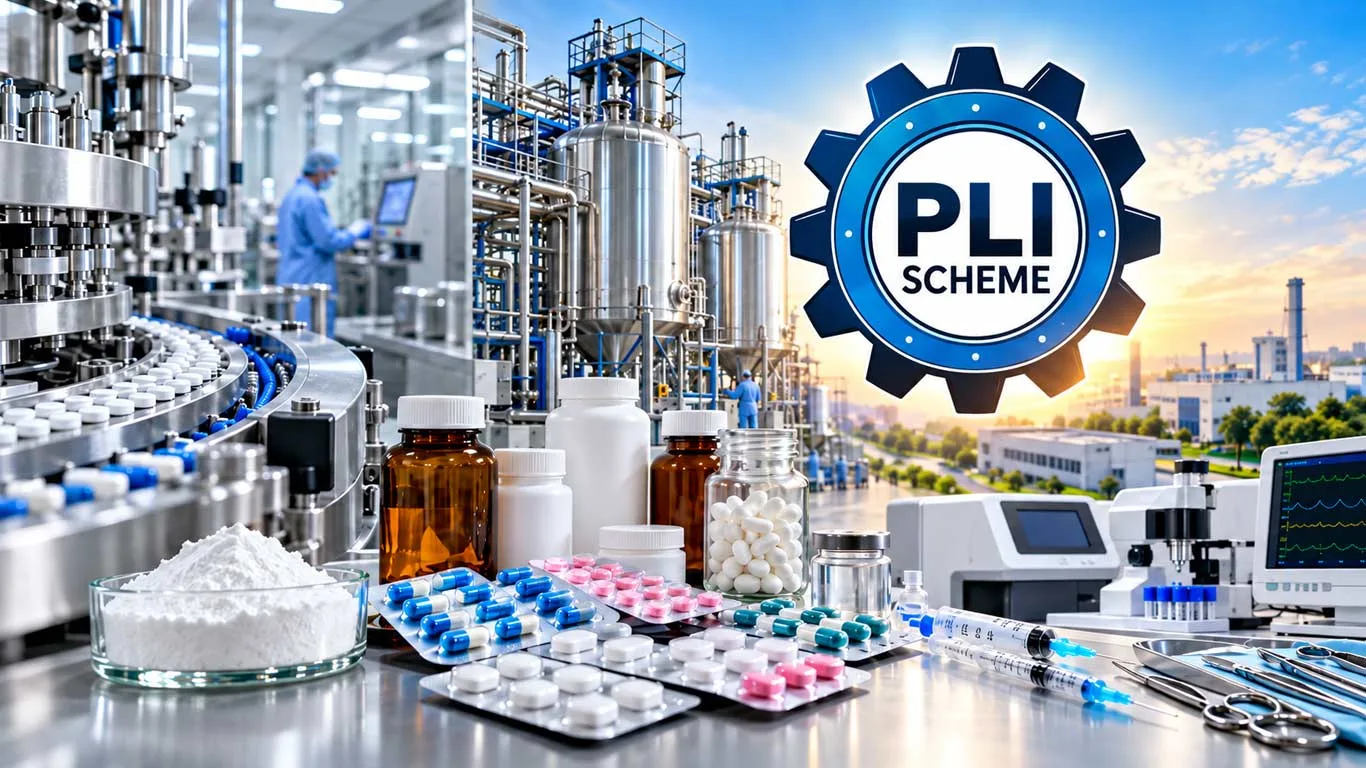
India’s Production Linked Incentive (PLI) schemes for bulk drugs, pharmaceuticals and medical devices are expanding domestic manufacturing capacity, attracting investment and supporting the production of products that were previously heavily dependent on imports.
Government data shows that the three schemes have helped create manufacturing capacity across critical APIs, high-value medicines and advanced medical devices while generating investment, sales, exports and employment.
The Production Linked Incentive (PLI) schemes implemented by the Department of Pharmaceuticals under the Ministry of Chemicals and Fertilizers are aimed at strengthening India’s pharmaceutical and medical devices manufacturing ecosystem.
The three schemes cover different stages of the healthcare manufacturing chain, from critical pharmaceutical raw materials and active pharmaceutical ingredients (APIs) to complex medicines and high-end medical equipment.
The three major initiatives are the PLI Scheme for Bulk Drugs, the PLI Scheme for Pharmaceuticals, and the PLI Scheme for Promoting Domestic Manufacturing of Medical Devices.
According to the government, the schemes are intended to reduce import dependence, encourage investment in domestic manufacturing, promote technology adoption and strengthen supply-chain resilience.
Bulk drugs PLI targets critical pharmaceutical ingredients
The PLI Scheme for Bulk Drugs was approved in 2020 with a financial outlay of Rs 6,940 crore.
The scheme focuses on strengthening domestic manufacturing of 41 identified critical products and reducing India’s dependence on imports for APIs, key starting materials (KSMs) and other essential pharmaceutical building blocks.
A total of 48 projects have been approved under the scheme. As of June 2026, investments of Rs 5,210.74 crore had been made, against a committed investment of Rs 4,330 crore.
Of the approved projects, 39 projects covering 28 APIs and KSMs have been commissioned.
The scheme has also supported the domestic production of fermentation-based products such as Penicillin-G, Clavulanic Acid and Rifampicin, areas where India had previously relied substantially on imports.
As of June 2026, beneficiaries had recorded cumulative sales of Rs 3,792.49 crore, including exports worth Rs 560.16 crore.
The projects have also generated employment for around 5,127 people.
Manufacturing capacity expands in Andhra Pradesh
Projects established in Visakhapatnam, Andhra Pradesh, have contributed to India’s domestic capacity for manufacturing several critical pharmaceutical ingredients.
Companies including Lyfius Pharma, Kinvan Private Limited, Andhra Organics Limited, Meghmani LLP and Centrient Pharmaceuticals India Pvt. Ltd. are among those involved in manufacturing products under the initiative.
The products manufactured include Penicillin G, Clavulanic Acid, Sulfadiazine, Atorvastatin and Para Amino Phenol.
The government has positioned these investments as part of efforts to build a more resilient domestic pharmaceutical supply chain and reduce exposure to disruptions in global supplies.
Pharmaceuticals PLI pushes high-value drug manufacturing
The PLI Scheme for Pharmaceuticals was approved in 2021 with a financial outlay of Rs 15,000 crore.
Unlike the bulk drugs scheme, which focuses primarily on critical pharmaceutical inputs, this initiative is designed to encourage investment and production of higher-value pharmaceutical products.
The scheme covers areas including biopharmaceuticals, complex generics, patented and off-patent drugs, orphan drugs and autoimmune medicines. It also covers specified APIs, drug intermediates and KSMs that are not covered under the Bulk Drugs PLI scheme.
A total of 55 applicants, including 20 MSMEs, have been selected under the programme.
By June 2026, the scheme had attracted Rs 46,744 crore in actual investment, substantially exceeding the targeted investment of Rs 17,275 crore.
The initiative has generated around 1,21,294 jobs.
Beneficiary companies recorded cumulative sales of Rs 4,02,869 crore, including exports worth Rs 2,57,370 crore, from the beginning of the performance period in FY 2022-23 through June 2026.
Major pharmaceutical companies expand capacities
Several major pharmaceutical companies have expanded their manufacturing capabilities under the scheme.
These include Sun Pharmaceutical Industries, Aurobindo Pharma, Dr Reddy’s Laboratories, Lupin, Cipla, Intas Pharmaceuticals and Torrent Pharmaceuticals.
The companies have expanded production capabilities in areas such as complex generics, biosimilars, autoimmune medicines and other high-value pharmaceutical products.
The focus on these segments is aimed at moving beyond conventional pharmaceutical manufacturing and increasing India’s capacity to produce technologically advanced medicines domestically.
Medical Devices PLI expands indigenous manufacturing
The PLI Scheme for Promoting Domestic Manufacturing of Medical Devices was approved in 2020 with a financial outlay of Rs 3,420 crore.
Under the scheme, eligible manufacturers receive an incentive equivalent to 5 per cent of incremental sales of qualifying medical devices manufactured in India for five years.
The programme covers four broad categories:
1. Cancer care and radiotherapy medical devices
2. Radiology and imaging devices
3. Anaesthesia, cardio-respiratory and renal care devices
4. Implants, including implantable electronic devices
The scheme is aimed at developing domestic manufacturing capabilities for high-end medical equipment that was previously largely dependent on imports.
MRI, CT scanners and other advanced devices now made in India
According to the government, production of 57 unique medical devices has commenced under the scheme.
These include MRI machines, CT scanners, Cath Labs, Linear Accelerators, C-Arms, mammography machines, ultrasound systems, anaesthesia machines and heart valves.
The expansion is significant because several of these products require advanced manufacturing capabilities and specialised technology.
Global companies including GE Healthcare, Siemens, Philips, Varex, Nipro and Omron have established or expanded manufacturing operations in India under the broader push to develop domestic medical device production.
Several participating companies have also entered into technology-transfer arrangements with global partners.
Domestic manufacturers have simultaneously expanded their capabilities in the implant segment, creating additional scope for domestic production as well as exports.
Three PLI schemes cover different parts of the healthcare supply chain
Together, the three schemes address multiple stages of India’s pharmaceutical and medical technology manufacturing ecosystem.
The Bulk Drugs PLI focuses on critical raw materials, APIs and KSMs. The Pharmaceuticals PLI targets high-value medicines and complex pharmaceutical products, while the Medical Devices PLI supports manufacturing of advanced medical equipment and implants.
This creates a broader manufacturing framework rather than focusing on a single stage of production.
The government has linked the initiatives to the wider objectives of Make in India and Atmanirbhar Bharat, with an emphasis on increasing domestic production and strengthening supply chains.
Focus shifts from imports to domestic manufacturing
The data from the three schemes shows increased investment, production and employment across different segments of the pharmaceutical and medical devices industries.
Under the Bulk Drugs PLI, commissioned projects are producing critical pharmaceutical ingredients. The Pharmaceuticals PLI has attracted investments beyond its initial target and expanded production of complex medicines. The Medical Devices PLI has supported manufacturing of high-end equipment ranging from diagnostic imaging systems to specialised medical devices.
By linking incentives to incremental production and sales, the PLI framework seeks to encourage companies to establish and expand manufacturing facilities in India.
The broader objective is to strengthen India’s domestic healthcare manufacturing base while improving supply-chain resilience and creating capabilities in areas where the country has historically depended on imports.
The three schemes therefore represent a coordinated approach to pharmaceutical and medical-device manufacturing, covering raw materials, medicines, medical technology, investment, employment and exports.