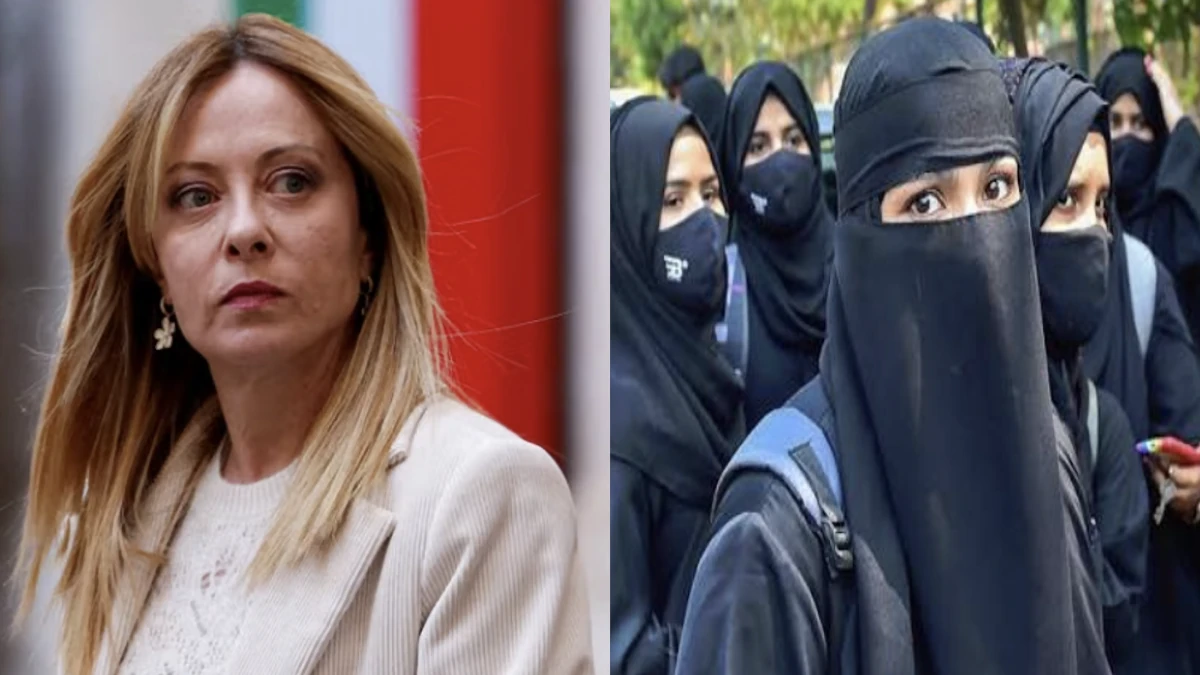
ROME: Italian Prime Minister Giorgia Meloni has put integration, language and gender equality at the heart of Italy’s education debate, announcing plans to ban face-covering garments such as the burqa and niqab in schools, limit the number of foreign students in individual classrooms and require some parents of foreign students to learn Italian.
Meloni announced the proposals at an event organised by the youth wing of her Brothers of Italy party, arguing that Italy’s schools should remain places where students can communicate, participate and integrate into Italian society.
“You must go to school with your face uncovered”
The most striking element of the proposed package is the planned prohibition of the burqa and niqab, which cover the face. The proposal does not target the hijab, which leaves the face visible.
Meloni has presented the measure as a question of women’s freedom and equality, arguing that no purported tradition should be used to force a young woman to conceal her face.
Her position is that schools must provide an environment where students can participate fully and where basic principles of equality apply regardless of cultural or religious background.
A tougher approach to classroom integration
Meloni is also proposing a legal limit on the number of foreign students who can be placed in the same classroom.
The government’s stated rationale is integration. Meloni has argued that when only a small number of pupils have difficulty speaking Italian, teachers and classmates can help them learn the language. She says the situation becomes substantially more difficult when pupils with inadequate Italian-language skills constitute a large proportion of a class.
The proposal would therefore attempt to prevent schools from becoming divided along linguistic lines.
Foreign students or students without Italian citizenship currently make up a significant share of Italy’s school population. Reuters, citing Fondazione ISMU, reported that non-Italian citizens accounted for 11.6 per cent of pupils in Italian schools.
The government has not yet announced the precise numerical ceiling that would apply to individual classes.
Parents could also be required to learn Italian
Meloni’s plan goes beyond students. Parents of foreign students who are experiencing serious difficulties integrating into the school system could be required to learn Italian under the proposed legislation.
The underlying argument from the government is straightforward: integration cannot be left entirely to schools when children are growing up in families that may struggle to communicate with teachers and institutions.
Meloni has said that people coming to Italy should learn the language, understand Italian culture and respect the country’s rules.
From migration policy to the classroom
The announcement represents a further extension of Meloni’s broader approach to immigration and integration. Since taking office in 2022, her government has pursued policies aimed at reducing irregular migration and strengthening controls while simultaneously emphasising integration and national identity.
A wider European debate
Italy’s proposal comes amid a broader European debate over face coverings and integration. France, Belgium, Denmark and Austria have restrictions on face-covering garments, while Switzerland introduced a nationwide face-covering ban in 2025.
The Netherlands has a narrower restriction covering certain public settings, including educational institutions.
The Italian proposal would specifically apply to schools and would distinguish between garments that cover the face and headscarves such as the hijab.
Meloni is presenting the package as a statement about what she expects from Italy’s education system, students should be able to communicate in Italian, families should engage with the country’s institutions, and schools should operate according to common rules.