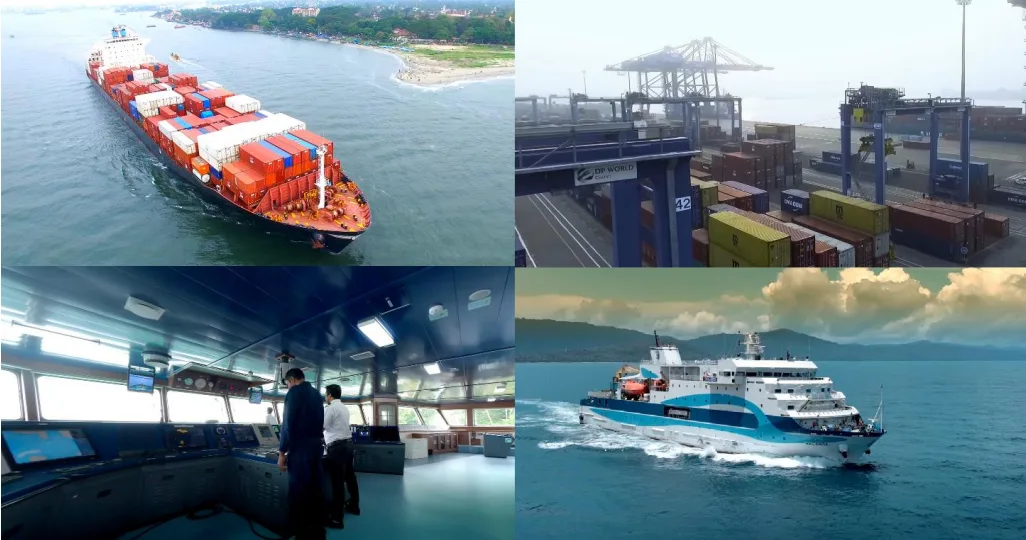
India’s maritime sector is entering an important phase of transformation. Investments in ports, shipbuilding, ship repair, ship recycling, inland waterways and maritime infrastructure are creating new opportunities. Yet the long-term objective cannot be limited to building more ships or expanding shipyard capacity. The real test of maritime self-reliance is whether India can design, build, equip, operate and maintain ships using technologies and equipment developed substantially within the country.
The strategic objective should therefore be clear: Indian cargo should increasingly be carried by Indian ships, operated by Indian crews and supported by Indian technology and equipment. Such a transformation would retain greater economic value within India while strengthening supply-chain resilience and reducing vulnerability to external technological and geopolitical pressures.
This is particularly important because global shipbuilding is highly concentrated. China, South Korea and Japan accounted for about 95 per cent of global shipbuilding output in 2023, while China alone held 63.7 per cent of the global orderbook by gross tonnage at the beginning of 2025. At the same time, the next generation of ships are becoming more technologically complex, with demand increasingly focused on alternative fuels, automation, digital systems, energy efficiency and advanced propulsion.
India therefore faces a strategic choice: remain primarily an assembler of imported maritime technologies or build an integrated domestic maritime technology ecosystem.
The Hidden Vulnerability: Import Dependence
India’s weakness is not simply the small number of ships built domestically. It is the limited domestic capability to manufacture the critical systems inside those ships.
Indian shipyards remain dependent on imports for major engines, generators, navigation systems, electronic equipment, automation systems, communications equipment and satellite communication systems. The absence of indigenous large marine-engine manufacturing is particularly significant because the main engine is among the most expensive components of a commercial vessel. Foreign dependence exposes Indian shipbuilders and operators to exchange-rate fluctuations, long delivery periods, spare-parts constraints and geopolitical disruptions.
Navigation and communication systems present another strategic vulnerability. ECDIS, radar, gyrocompasses, GMDSS equipment, SATCOM terminals and integrated bridge systems are largely supplied by foreign manufacturers.
India has promising capabilities through institutions and companies working on radar, SATCOM and integrated bridge systems, while NavIC provides the foundation for an indigenous positioning ecosystem. Yet these technologies require commercial type approval, production scale and integration into merchant shipping before they can significantly reduce dependence on imports.
The problem extends beyond initial procurement. Dependence on foreign equipment creates a spare-parts trap. Failure of a foreign engine component or electronic system can result in weeks or months of waiting, potentially grounding vessels and increasing operating costs. In a crisis, such dependence becomes a question of national resilience rather than merely commercial efficiency.
Indigenisation Must Mean Technology Ownership
India must avoid equating domestic assembly with genuine indigenisation. A vessel assembled in an Indian shipyard but powered by an imported engine, navigated through imported systems and dependent on foreign software, components and spare parts remains technologically dependent.
The existing policy architecture provides an important foundation. The Shipbuilding Financial Assistance Scheme (SBFAS), Maritime Development Fund (MDF) and Shipbuilding Development Scheme (SbDS) together constitute a ₹69,725-crore package. However, the central challenge is to ensure that financial assistance translates into domestic technological capability rather than merely higher shipyard output.
The answer is to progressively raise domestic value addition. The present 30 per cent threshold should become part of a clear glide path towards 50 per cent, 60 per cent and eventually higher levels. Financial assistance should be increasingly linked to equipment-level domestic value addition, certified Indian suppliers, indigenous intellectual property and technology development rather than simply the number or value of vessels constructed.
Foreign investment should not be rejected; it should be strategically structured. Joint ventures with global shipyards and equipment manufacturers can accelerate technological learning, but such partnerships should contain measurable technology-transfer, local sourcing, skills-development and manufacturing commitments.
Building an Indian Marine Equipment Ecosystem
A dedicated Marine Equipment Manufacturing Cluster programme can become the backbone of this strategy. The proposed clusters around Kochi/Alappuzha, Visakhapatnam, Surat/Hazira and Chennai/Ennore would bring equipment manufacturers closer to shipyards and provide common testing, certification, machining, incubation and supplier-development infrastructure.
Such shared facilities are essential because many Indian manufacturers possess engineering capabilities but lack the testing infrastructure, classification approvals and anchor customers required to enter commercial shipbuilding. The ecosystem must therefore connect shipyards, MSMEs, universities, research institutions, classification societies and financial institutions.
A dedicated Production-Linked Incentive scheme for marine equipment should cover engines, generators, boilers, heat exchangers, power-management systems, navigation equipment, GMDSS, SATCOM, integrated bridge systems and automation. Higher incentives should be reserved for technologically intensive systems such as main engines, ECDIS and integrated automation.
Engines and Electronics: The Two Strategic Frontiers
The most ambitious component of technological self-reliance is the development of indigenous marine engines. India should adopt a staged approach. In the initial phase, domestic firms should develop engines for fishing vessels, inland vessels and small coastal craft while simultaneously pursuing licensed manufacturing and technology transfer for larger engines. The medium-term objective should be indigenous low-speed two-stroke engines for coastal tankers, bulk carriers and offshore vessels, followed eventually by engines for large container ships, Capesize vessels and VLCCs.
Electronics offer a comparatively faster route to self-reliance. India already possesses substantial capabilities in information technology, electronics, space and defence. Wherever security considerations permit, indigenous naval technologies should be transferred to commercial maritime applications after appropriate classification and certification.
NavIC should be integrated into domestically manufactured marine receivers. A national GMDSS indigenisation mission should develop type-approved communication equipment, while an “ECDIS India” programme could bring together the Indian Maritime University, IITs, IISc, the Directorate General of Shipping and industry to develop a domestic platform.
Learning from Korea, China and Japan
India need not copy another country’s model, but the experience of successful shipbuilding nations offers important lessons.
South Korea combined long-term state support, low-cost finance, export credit, demand aggregation, shipyard clusters and intensive technology development. Its shipyards also embraced digital design, modular construction, automation, robotics, digital twins and strong industry–university collaboration.
China demonstrates the power of scale and an integrated domestic supply chain. Its model combines large shipbuilding complexes with domestic production of engines, propulsion systems, electrical equipment and other components, supported by extensive digitalisation and state-backed finance.
Japan offers perhaps the most relevant combination of lessons for India: technological quality, productivity, lean manufacturing, strong equipment suppliers and high-value vessel development. Mitsubishi Heavy Industries demonstrates technological sophistication; Imabari demonstrates modular and lean production; and Japan Marine United illustrates diversification across commercial, specialised and defence vessels.
India can combine these lessons with its own strengths: engineering talent, a large domestic market, competitive costs and strategic location in the Indian Ocean.
A Roadmap to 2047
India’s technological independence should be pursued in phases. Between 2026 and 2030, the priority should be technology audits, mandatory indigenous-content targets, marine-equipment incentives, common testing infrastructure and technology-transfer frameworks. Between 2030 and 2035, India should scale domestic propulsion and automation capabilities and demonstrate alternative-fuel vessels using Indian systems. Beyond 2035, entry into highly complex vessel categories should depend on demonstrated productivity, design ownership and supplier depth.
By 2047, the ambition should extend beyond building ships for India. India should aim for more than 70 per cent indigenous content in Indian-built vessels, become a net exporter of marine equipment to Southeast Asia, Africa and the Middle East, and develop a domestic spare-parts ecosystem capable of supporting the national fleet.
Conclusion: A Declaration of Strategic Technological Independence
India cannot achieve its maritime revival by building larger shipyards alone. A shipyard without indigenous engines, electronics, navigation systems, automation, software, components and after-sales support remains dependent on external technology.
The objective, therefore, should be technological sovereignty across the maritime value chain. Financing must create scale; scale must create markets for Indian suppliers; suppliers must generate R&D and it must produce intellectual property; and intellectual property must translate into globally competitive products.
The ultimate goal is not simply to increase India’s gross tonnage. It is to capture a progressively larger share of the value, technology, intellectual property, employment and export earnings embedded in every vessel.
A genuinely self-reliant maritime India would not merely build ships in India. It would own the technology that makes those ships possible. That is the real meaning of a declaration of strategic technological independence.