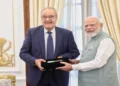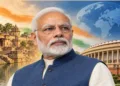
When I first met him, I was shocked by his humbleness and knowledge of the NE region, especially Manipur. As someone from the state that is called the ‘jewel of India ‘, I have always been irked by the ignorant responses of people not knowing my state. But that changed when I met the Hon’ble PM.
Here was the CM of a state that is on the extreme other side of the nation talking about my state and its potential, its significance to ‘Bharat.’ I was in total awe of this person, who not only became the PM of our great nation but also the longest-serving head of government. His humility, dedication, service and knowledge of our nation’s vast diversity, its pulse and the pride in its greatness are what separate him from other PM’s who have served the nation before him.
Our nation was great and is great, but it was forgotten. PM Modi is reviving that sentiment and bringing us closer to our roots, history and heritage. PM Modi made us fall in love with our nation and its people, and take pride in our shared heritage, not just the success and achievements, but the raw, intrinsic love and pride for Bharat.
As someone from a small state in the NE region, PM Modi has done more to develop the region and share culture and traditions not just within the country but to the world as well. He has diminished the lines that defined the mainland and the NE region. His policies show that clearly, from the ‘Look East’ policy of yesteryear to ‘Act East.’
Without love for your nation, pride in its heritage, and respect for it, you can’t serve the nation; that is the lesson we learn from PM Modi.
The first time I met Shri Narendra Modi ji, I was struck by something I had not expected. It was not the aura of a
Prime Minister or the presence of a towering political leader. It was his humility. But what truly surprised me was his knowledge of the Northeast – and, more particularly, Manipur.
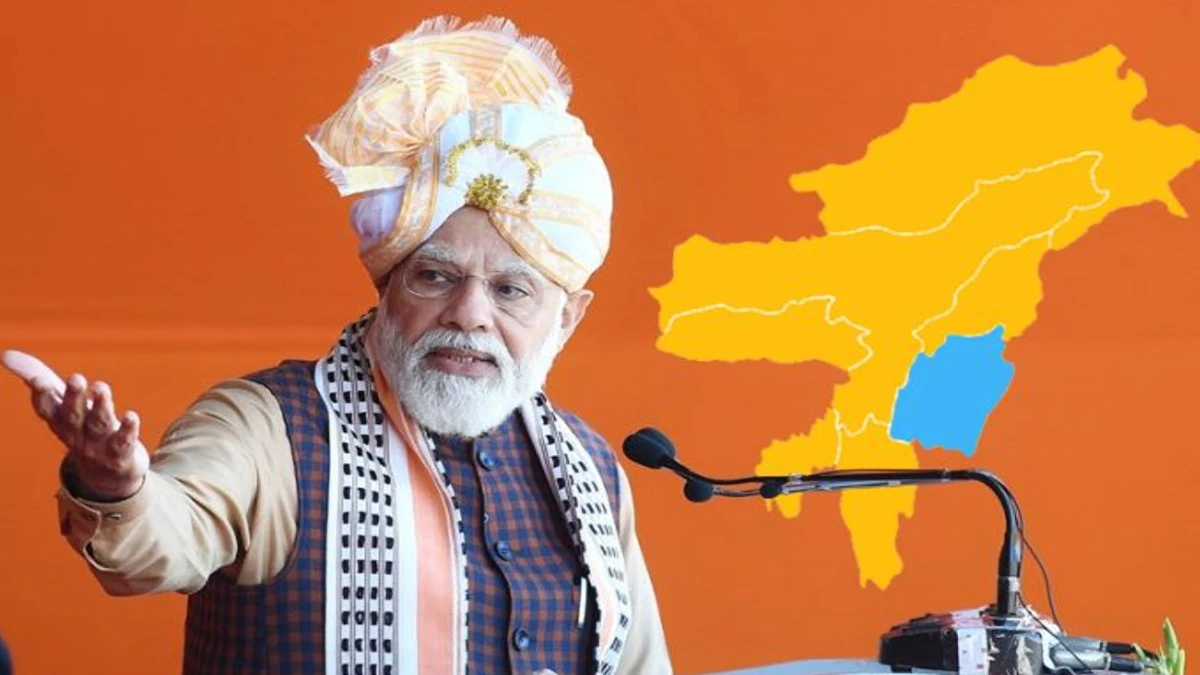
As someone from Manipur, the state often described as the “Jewel of India”, I have always been somewhat irked by the ignorance that exists about my state. I have encountered people from different parts of the country who could barely place Manipur on a map, let alone understand its history, culture, people or contribution to India.
So, meeting a person from the extreme western end of the country who could speak with such familiarity about Manipur was a deeply personal experience for me.
Here was a leader who, even before becoming Prime Minister, had developed an understanding of a region thousands of kilometres from his own home state. He spoke not merely about Manipur’s problems, but about its potential, its culture, its people and its significance to Bharat.
I was in awe.
Over the years, I had the opportunity to meet him multiple times, with my last meeting being in 2022. What stayed with me was the consistency of his warmth, interest and enthusiasm for the Northeast, and particularly for my home state of Manipur.
Each meeting reinforced the impression created during our first encounter in 2014. Despite the enormous responsibilities that came with becoming Prime Minister, and despite the passage of almost a decade, I continued to sense the same genuine interest in the region. It was not simply a passing curiosity. His conversations reflected an appreciation of the Northeast’s culture, its people, its strategic importance and, above all, its potential.
For me, that continuity was significant.
A leader’s familiarity with a region can come from briefings and official files. But the enthusiasm with which one speaks about its people and possibilities is something one feels in a personal interaction. In my encounters with Narendra Modi, I felt that enthusiasm remained undiminished.
That is perhaps why those meetings have remained particularly memorable for me. I did not merely encounter the Prime Minister of India; I encountered a leader who seemed to see the Northeast not as a distant periphery, but as an integral and important part of Bharat.
Today, Narendra Modi is not only the Prime Minister of India but, since June 2026, the country’s longest-serving democratically elected Prime Minister in consecutive terms. Yet, for me, his significance goes beyond the length of his tenure or the scale of his political achievements.
What distinguishes his leadership, in my view, is the combination of humility, dedication, service and an extraordinary awareness of India’s diversity and civilisational inheritance.
Rediscovering Bharat
India was always a great civilisation. Bharat was always great. But somewhere along the way, many of us became disconnected from that inheritance.
We knew our history as chapters in textbooks. We knew our traditions as customs. We knew our monuments as tourist destinations. We knew our diversity as a statistic.
Something changed when Narendra Modi became Prime Minister.
One of the most important aspects of his leadership has been the attempt to make Indians look at their own country again – with curiosity, affection and pride.
The idea of Bharat has increasingly been presented not simply as a geographical territory, but as a civilisational continuum: a nation whose strength lies in its languages, traditions, philosophies, communities, cultures and centuries-old connections.
This is not merely about celebrating India’s achievements. It is about rediscovering the emotional connection between the people and the nation.
It is about making a young Indian feel that India’s history is not somebody else’s history. It is ours.
And perhaps this is one of the most important lessons of the Modi era: national pride need not come at the expense of diversity. Our diversity itself can be a source of national pride.
A Vision That Goes Beyond Tenure
To me, Narendra Modi is a true visionary, transformer and reformer. His significance cannot be measured only by the years he has spent in office or by the policies of any particular government. His deeper impact lies in the changes he has sought to bring to India’s institutions, its governance and, perhaps most importantly, the way Indians perceive themselves and their nation.
One of the most significant aspects of his leadership has been the effort to help India move beyond the colonial mindset that continued to influence our systems of governance and, in subtle ways, our own thinking about ourselves.
For generations after Independence, many of our institutions, practices and ways of thinking continued to carry the imprint of our colonial past. Modi has sought to replace that inherited mindset with an Indian civilisational confidence, one that looks at Bharat not through the lens of what it once was under colonial rule, but through the prism of what it has been, what it is and what it can become.
This is visible not only in changes to governance and public institutions, but also in the renewed emphasis on India’s languages, traditions, heritage, indigenous knowledge and civilisational achievements. It is about moving from an India often taught to look outward for validation to a Bharat that can engage the world with confidence in its own identity.
To me, that marks a transformative leader.
Governments change, and political power changes hands. But ideas that reshape how a generation thinks can endure far beyond any particular tenure. The renewed sense of civilisational confidence, national pride and responsibility that has emerged during the Modi era has the potential to remain an important part of India’s continuing journey.
And perhaps that is the distinction between merely administering a country and helping to transform its national consciousness.
From the Northeast to the national imagination
For someone from Manipur, this change is particularly visible. For decades, the Northeast was often spoken about as India’s distant frontier. Geography, inadequate connectivity and a lack of wider national awareness created a psychological distance between the region and what was commonly called “mainland India”.
The language of policy itself reflected that distance.
The shift from the earlier “Look East” approach to the more action-oriented Act East policy represented a different way of viewing the region. Prime Minister Modi has repeatedly described the Northeast as a gateway to Southeast Asia and placed connectivity, infrastructure, tourism, trade and cultural links at the centre of this approach.
His government has also consistently described the Northeast not merely as a region requiring development, but as one with enormous potential.
In Manipur, the Prime Minister has spoken of the state’s sporting talent, culture, connectivity, trade potential and its strategic location. In 2022, while inaugurating and laying the foundation stones of development projects in Imphal, he described the Northeast as becoming a gateway to India’s development. He highlighted Manipur’s potential for trade and exports.
These words matter. They matter because recognition is itself a form of empowerment.
When a Prime Minister speaks about a Manipuri athlete, a traditional art form, a cultural tradition or the state’s geographical importance in the same breath as the country’s larger development story, it tells people in the Northeast that they are not peripheral to India.
They are integral to India.
The Northeast as a bridge, not a border
I believe this is one of the more profound changes in the national conversation. The Northeast is increasingly being presented not as the end of India, but as a bridge – to Southeast Asia, to new markets, to cultural exchanges and to new opportunities.
The Prime Minister has described the region as one of the most diverse parts of the world’s most diverse nation and has repeatedly linked its development with India’s larger growth story.
This is an important psychological shift.
Development is, of course, about roads, railways, airports, digital connectivity, jobs, investment and infrastructure. But it is also about belonging.
A road can connect two places. A shared sense of national belonging can connect two peoples. For the Northeast, both forms of connectivity matter.
A leadership rooted in service
Another quality has stayed with me since that first meeting: humility. Power has a way of creating distance. Public office can easily become an exercise in authority rather than service.
But the image of leadership that Narendra Modi has consistently sought to project is that of a sevak – someone who sees public life as an opportunity to serve.
Whether one agrees with every policy of his government or not, the scale and duration of his public life are remarkable. His political journey – from a grassroots organisational worker to Chief Minister of Gujarat and then Prime Minister of India – has placed him at the centre of India’s public life for decades.
But perhaps the more important question is what leadership leaves behind in the minds of ordinary people. For me, it is a renewed confidence in Bharat.
The lesson of Bharat
Coming from Manipur, I have often felt that our greatest challenge has not always been the absence of talent or potential. Sometimes, it has been the absence of recognition.
The young people of the Northeast have always had talent. Our athletes have won medals. Our artists have preserved traditions. Our soldiers have served the nation. Our farmers, entrepreneurs, students and professionals have contributed to India in countless ways.
What has changed is how much these stories are becoming part of the national narrative. That is why my first meeting with Narendra Modi remains significant to me.
I met a leader who knew something about my small state that many educated Indians did not know. I met someone who spoke about Manipur not as a remote corner of India, but as a part of India’s larger story.
And I realised that perhaps the greatest service a national leader can render is not merely building infrastructure or formulating policies. It is to make people believe that they belong to something larger than themselves.
Pride with responsibility
Narendra Modi’s public life offers a lesson that goes beyond politics. You cannot truly serve a nation unless you love it. And you cannot fully love a nation unless you understand and respect the civilisation, heritage and people that constitute it.
For me, this is the essence of the Modi phenomenon.
He has encouraged millions of Indians to look again at their own heritage, to speak about Bharat with confidence, to celebrate the diversity of its people and to see India’s rise not merely as an economic story but as the revival of a civilisational self-belief.
Our nation was great before Narendra Modi. Our nation remains great today.
But his contribution, as I see it, has been to awaken in many of us a stronger consciousness of that greatness – and to connect that pride with the responsibility of building the Bharat of tomorrow.
As someone from Manipur, I am particularly grateful for that.
Because when the Prime Minister of India speaks of the Northeast as a vital part of India’s future, when he speaks of Manipur’s potential and when he treats our culture and traditions as part of the nation’s heritage, it does something more than shape policy.
It tells a young Manipuri that their identity is not at the margins of Bharat. It is Bharat.
And perhaps that is the deepest lesson I have taken from Narendra Modi ji: that patriotism is not merely about being proud of the nation when it succeeds. It is about knowing its history, respecting its heritage, embracing its people and dedicating oneself to its future.
That is how a nation moves forward. That is how Bharat rediscovers itself.