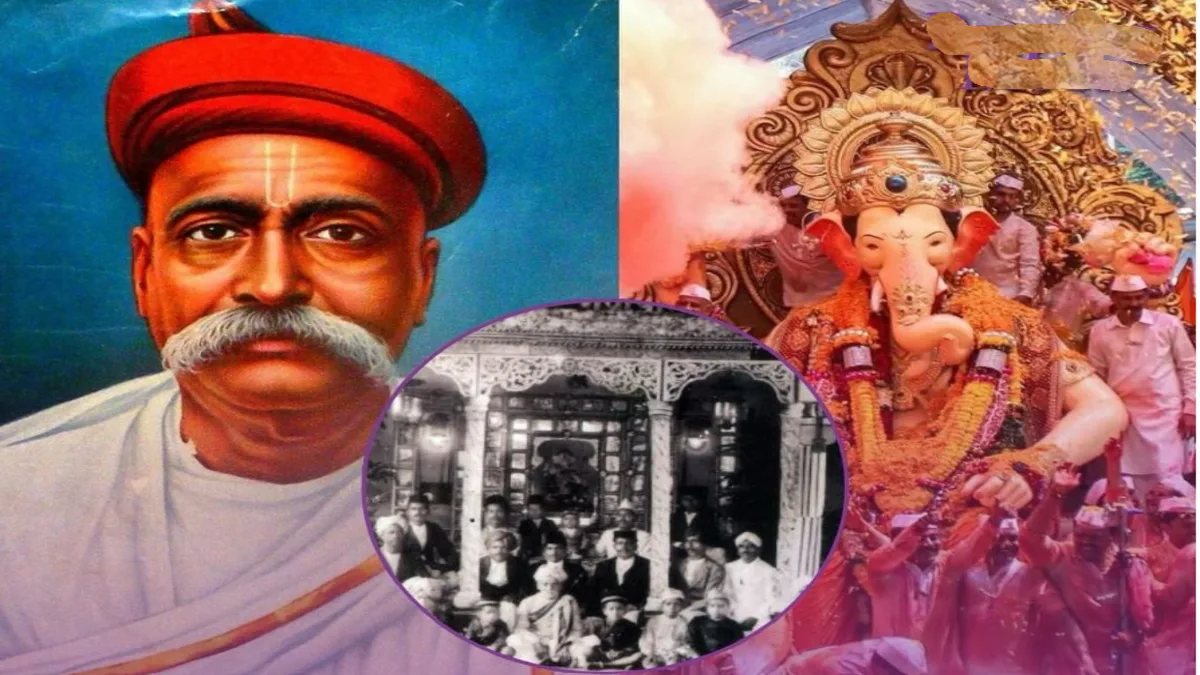
The rain-swept air of Pune in September 1893 witnessed an unprecedented political transformation. The auspicious occasion of Ganesh Chaturthi, which had hitherto been celebrated as a private, domestic worship within individual Maharashtrian households, was transformed into a public and social festival through the extraordinary historical foresight of Bal Gangadhar Tilak. Defying the draconian British laws prohibiting public assembly, the Lokmanya chose the platform of the Ganesh festival to initiate the masses into the mantra of nationalism. In their authoritative biography, Lokmanya Tilak: A Biography (Popular Prakashan, Bombay, 1965), A.K. Bhagwat and G.P. Pradhan describe in detail how this festival spread from the lanes of Pune across Maharashtra, and eventually throughout India, becoming a powerful instrument of anti-British mass mobilization. In his famous book, Tilak and Gokhale: Revolution and Reform in the Making of Modern India (University of California Press, Berkeley, 1962), Stanley Wolpert demonstrates how, long before Mahatma Gandhi, Tilak shifted Indian politics from elite drawing rooms to the streets, aligning it with the aspirations of the common man. Geeta Tilak, in her research paper titled “A Study of Lokmanya Bal Gangadhar Tilak and Court Cases,” published in the Mahratta Journal (Volume 39, September 2020), highlights how this political application of religion and culture struck terror into the hearts of British administrators.
Yet, this brilliant cultural foresight and nationalist awakening was analyzed by Indian left-wing and communist theorists from a completely different and distorted perspective. In their view, this was a “high-caste Brahminical assembly” designed to alienate Muslims and lower-caste communities from the freedom struggle. A review of the early history of the Communist Party of India reveals that Marxist theoreticians like Manabendra Nath Roy and Rajani Palme Dutt dismissed this profound cultural revival as mere “Hindu Revivalism.” This ideological attack became even more pronounced among later left-wing historians, who have made persistent efforts to project Tilak as a pioneer of communal polarization. Parimala V. Rao explores these socio-political dynamics deeply in her paper, “Nationalism and the Visibility of Women in Public Space: Tilak’s Criticism of Rakhmabai and Ramabai,” published in the Indian Historical Review (2008), and in her monograph published by the Centre for Women’s Development Studies in Delhi, entitled Educating Women and Non-Brahmans as Loss of Nationality: Bal Gangadhar Tilak and the Nationalist Agenda in Maharashtra. Rao argues that Tilak equated his “nationalism” with opposition to the education and social emancipation of women and non-Brahmins.
What a fascinating historical irony, however, that the prominent historian J.V. Naik, through his painstaking research in the Economic and Political Weekly (Volume 34, No. 18, May 1, 1999) under the title “Lokmanya Tilak on Karl Marx and Class Conflict,” and his earlier 1998 paper “B.G. Tilak’s Perception of Karl Marx and Class Conflict,” proved that Tilak was actually the first Indian nationalist leader to introduce Karl Marx’s socialist thoughts and the concept of class struggle to Indian readers back in 1881.
On this auspicious day of Ganesh Chaturthi, as we remember the legacy of the Lokmanya with deepest respect, we must also confront the long history of systematic propaganda and character assassination orchestrated against him by India’s left-wing intellectual establishment. Looking back at Tilak’s contributions, we see how his divine endeavor to unite the nation through cultural threads has been consistently minimized by left-wing writers for decades.
Historical Context — Why Tilak Was the Primary Target of the Leftists
Bal Gangadhar Tilak was one of the foremost heroic sons of the Indian freedom struggle, famously termed the “Father of Indian Unrest” by the British colonial state. Along with Lala Lajpat Rai and Bipin Chandra Pal, the “Lal-Bal-Pal” triumvirate stood as a symbol of uncompromising anti-imperialist struggle. In 1881, in Pune, with the cooperation of Vishnushastri Chiplunkar and G.G. Agarkar, Tilak founded the Marathi weekly Kesari and the English weekly Mahratta. These publications were not merely newspapers; they were intellectual battlegrounds against British rule.
For communist and Marxist historians, Tilak was a complex and unresolved enigma. On one hand, his uncompromising opposition to British imperialism, his immense popularity among the masses, and his six-year imprisonment in Mandalay Jail for demanding Swaraj made him an undisputed leader in the eyes of Indians. On the other hand, his philosophy, deeply rooted in the Upanishads, the Vedas, and the Shrimad Bhagavad Gita, was completely antithetical to Marxist historical materialism. Marxist theoreticians believed that unless an anti-colonial struggle was linked with the internationalism of the working class, it merely served bourgeois interests.
Consequently, Tilak’s immense influence and mass appeal became a source of anxiety for the Left. They realized that unless they could break his hold on the masses, they could not establish a distinct communist-led worker-peasant movement in India. Senior journalist Dhaval Kulkarni, in his recent 2025 research utilizing colonial intelligence files, shows that in his speeches in London, Tilak explicitly described British rule as a “capitalist regime” that was ruthlessly exploiting the working class. A notorious Scotland Yard intelligence report from 1919 explicitly stated that Tilak was closely observing Bolshevik developments and, while in London, believed that “the 1917 Russian Bolshevik Revolution would accelerate India’s struggle for independence.” Despite these facts, the Left chose to launch a relentless intellectual and institutional campaign to defame Tilak’s politics, religious consciousness, and social reform perspectives.
Marxist Theoretical Framework and the Core Principles of Anti-Tilak Opposition
The primary theoretical weapon used by communists to attack Tilak was the Marxist analysis of nationalism. To the communists, the Indian national movement was not a grand idealistic struggle but an instrument to protect the interests of the rising Indian bourgeoisie. One of the chief architects of this view was Rajani Palme Dutt. In his well-known book, India Today (Victor Gollancz, London, 1940), he meticulously presented this thesis. According to Dutt, although the Indian bourgeoisie opposed imperialism, they were closely allied with feudalism and landlordism and opposed radical land reforms. Within this theoretical framework, he depicted Tilak as a figure who used his high-caste Hindu identity and religious culture to protect the interests of Indian capitalism and feudalism.
Similarly, sociologist A.R. Desai, in his book Social Background of Indian Nationalism (Popular Prakashan, Bombay, 1948; fifth edition, 2016), analyzed Indian nationalism as a project controlled by high-caste, wealthy elites. Desai argued that Tilak’s Shivaji and Ganesh festivals were bourgeois strategies to protect the interests of Maharashtrian merchants and wealthy landlords, using religious emotions to suppress the genuine economic grievances of the working class. Marxist historian Biswamoy Pati, in his book Situating Social History: Orissa 1800-1997 (Orient BlackSwan, 2007), asserted even more explicitly that Tilak represented bourgeois interests in the colonial context. In this way, left-wing intellectuals began a systematic process of erasing Tilak’s uncompromising anti-imperialist image and reducing him to a narrow class representative.
Manabendra Nath Roy, in his influential research work India in Transition (R.C.P., Berlin, 1922), launched a scathing attack on Tilak’s movement. He wrote that the Extremists lacked any “scientific theoretical foundation” and were dreaming of a reactionary revival of ancient glory primarily to protect the political and economic interests of the Indian bourgeoisie. In Roy’s view, Tilak’s politics was merely the “vanguard of the rising bourgeoisie.” This was reinforced by Rajani Palme Dutt’s highly aggressive book, Modern India (1927), preserved in the Comintern archives, where he bitterly attacked Tilak and his extremist group. Dutt wrote that they sought to “reconstruct a golden dream of Hindu culture from the corrupt metaphysics of a decaying past” and emerged as the “champions of superstition, caste, and social division.” Dutt lamented that Tilak wasted his political energy defending child marriage and establishing his Anti-Cow-Killing Society.
Distortion of Gita Rahasya and Philosophical Attacks
During his imprisonment in Mandalay Jail (1908–1914), Tilak’s greatest intellectual achievement was the composition of Shrimad Bhagavad Gita Rahasya (commonly known as Gita Rahasya). In this text, Tilak offered a revolutionary and unique interpretation of Nishkama Karma Yoga (selfless action). He demonstrated that the core message of the Gita was not passivity or ascetic renunciation, but active duty and righteous struggle against injustice. This work became a primary catalyst in inspiring the youth of India toward revolutionary nationalism.
But left-wing and Marxist theoreticians launched a fierce intellectual attack on this text. The eminent Marxist historian Damodar Dharmananda Kosambi, in his celebrated book An Introduction to the Study of Indian History (Popular Prakashan, Bombay, 1956), attacked the Vedic and Upanishadic foundations of Tilak’s philosophy through a materialist analysis of Indian culture. Kosambi and his followers claimed that this spiritual interpretation was merely a clever tool to maintain Brahminical hegemony over the lower castes. In their view, by promoting the ideal of selfless action, the Gita was used to make the exploited classes accept their fate and divert them from the path of active revolution.
Similarly, B.T. Ranadive, a prominent theoretician of the Communist Party of India, attacked Tilak in his long essay “Caste, Class and Property Relations,” published in the left-wing journal Social Scientist. Ranadive accused Tilak of being a staunch supporter of the caste system and using nationalism as a shield to protect the Varnashrama order. According to Ranadive, Tilak’s nationalist project was a backward-looking and anti-reformist conspiracy designed to prevent progressive change in India.
In An Introduction to the Study of Indian History (1956), Kosambi rejected Tilak’s Vedic and Upanishadic foundations as unscientific and contrary to historical materialism. Building on this legacy, sociologist Sanjay Seth, in his essays “The Critique of Renunciation: Bal Gangadhar Tilak’s Hindu Nationalism” and “Tilak and Hindu Nationalism,” published in the journal Postcolonial Studies (Volume 9, No. 2, 2006), argued that Tilak’s reinterpretation of the Gita was not a simple explanation of selfless action. Instead, it was a complex cultural and political project aimed at establishing the hegemony of the rising bourgeoisie and suppressing secular social reform movements.
The Surat Split (1907) and the Fog of Misinformation
The historic split between the Moderate and Extremist factions of the Indian National Congress occurred during the Surat session of 1907. Tilak rejected the politics of petitions and appeals in favor of direct struggle. Marxist historians have consistently provided a one-sided analysis of this conflict between the Moderate faction and the Extremist faction led by Tilak.
Sumit Sarkar, in his widely read textbook Modern India: 1885-1947 (Macmillan India, New Delhi, 1983), held Tilak and his extremist group responsible for dividing the national movement. He depicted Tilak’s concept of Swaraj as an extremist strain driven solely by Hindu religious emotions, while portraying the path of the Moderates as rational and progressive. Left-wing historians frequently claim that the national movement lost momentum due to Tilak’s uncompromising stance. Yet, they systematically omit the fact that Tilak gave the nation its highly practical four-point program—Swadeshi, Boycott, National Education, and Swaraj—which served as a blueprint for genuine economic and political liberation. Instead, they sought to project Tilak merely as a “rioting extremist” to keep his visionary economic thoughts hidden from the public eye.
In left-wing historiography, the Surat Split is framed as a calculated maneuver. In his celebrated article “At the Ragged Edge of Time: The Legend of Tilak and the Normalization of Historical Narratives,” published in the journal South Asia Research (2004), scholar Raminder Kaur reveals how post-independence institutions systematically sought to “normalize” Tilak’s rebellious legacy by fitting it into a specific political mold, thereby diluting and understating his four-point program.
Personal Attacks and Character Assassination: From Agarkar to Chirol
The history of personal slander and character assassination against Tilak is deeply tragic. The smear campaign began in Pune itself, when Gopal Ganesh Agarkar, a former associate of Tilak and co-founder of Kesari, parted ways with him and established the weekly Sudharak. Narasimha Chintaman Kelkar, in his monumental Marathi biography Lokmanya Tilak Yanche Charitra (Pune, 1923), provided a detailed account of these personal attacks. Agarkar published articles accusing Tilak of being a “hypocritical Hindu leader” simply because Tilak had once consumed tea and biscuits at a Christian mission. Slanderous rumors were also spread claiming that Tilak had eaten food served by a Muslim. When Tilak prepared to file a defamation suit against these malicious campaigns, Justice Mahadev Govind Ranade intervened to defuse the situation.
But this model of personal defamation was adopted as a primary tool by later left-wing propagandists. The most prominent example is found in the work of Sir Valentine Chirol, a British journalist associated with the colonial intelligence services. In his book Indian Unrest (Macmillan & Co., London, 1910), Chirol labeled Tilak as the “Father of Indian Unrest.” Chirol’s book was a conspiracy to depict Indian nationalism in the international arena as a form of terrorism and communal chaos. Tilak filed a historic libel suit against Chirol in a London court, which he ultimately lost in 1919. Shockingly, during this difficult time, no progressive or left-wing publication in India stood by Tilak. Instead, they embraced Chirol’s colonial thesis to brand Tilak as a “social reactionary.” Even today, in the writings of left-wing scholars like Tanika Sarkar in the Economic and Political Weekly, one finds echoes of this colonial narrative, projecting Tilak as a staunch Hindu revivalist reactionary.
Rosalind O’Hanlon, in her extensive historical research on caste and social reform in Western India, has analyzed how Tilak used Kesari and Mahratta to defend traditional social structures. According to her, Tilak believed that English education would ruin girls’ traditional values, making them rebellious. A key piece of evidence cited for this is an editorial in Kesari dated October 4, 1887, titled “Female Hayaskulatil Shikshanakrama” (The Curriculum in Female High Schools), where Tilak warned that modern, unregulated higher education for women would be destructive to society. He consistently advocated for the traditional ideal of a chaste housewife (shalin gruhini) and characterized colonial higher education as a threat to domestic stability.
Sedition Trials and the Conspiracy of Silence
In 1897, Bal Gangadhar Tilak was charged with sedition for the first time. For his powerful writings in Kesari, the British government prosecuted him under Section 124A of the Indian Penal Code. This was the first major colonial attempt to gag the Indian press. After a dramatic six-day trial, a British-dominated jury found Tilak guilty, and he was sentenced to eighteen months of rigorous imprisonment. In 1908, following the attempt on colonial magistrate Kingsford’s life by young revolutionaries Khudiram Bose and Prafulla Chaki in Muzaffarpur, Tilak defended the revolutionaries in Kesari and demanded Swaraj. Under the orders of Governor Lord Sydenham, the British government arrested Tilak on charges of sedition once again. Justice Dinshaw D. Davar of the Bombay High Court sentenced him to six years of deportation, sending him to the notorious Mandalay Jail in Burma.
Following Tilak’s conviction, the Russian Bolshevik leader Vladimir Ilyich Lenin, in his famous 1908 essay “Inflammable Material in World Politics,” praised the subsequent general strike of Bombay textile workers and hailed Tilak as an “Indian democrat” (the Indian democrat). Lenin wrote that the infamous sentence pronounced by the British jackals proved how much the colonizers feared the awakening of the masses. Yet, when the Communist Party of India was subsequently formed, it completely abandoned Lenin’s perspective. While communists eagerly used the legacy of the 1908 Bombay textile strike to build their own trade unions, they showed no gratitude to Tilak, systematically erasing his contribution from their historiography.
Legal and political research on Tilak’s sedition trials continues to this day. Detailed analyses published in legal portals like The Leaflet (November 2024), under the title “No Unrest, No Sedition: How Lokmanya Tilak Challenged Section 124A,” and in Countercurrents (June 2021), entitled “In the Courtroom: Second Case of Sedition Against Lokmanya Tilak, 1908,” demonstrate how the British Empire used the judiciary as a political weapon to suppress Tilak’s influential writings.
Planned Oblivion and Omission from Textbooks in the Post-Independence Era
After 1947, control over India’s academic institutions and historical research fell largely into the hands of the Nehruvian and left-wing intellectual establishment. They initiated a systematic effort to downplay Tilak’s role in the national curriculum. Bipan Chandra’s widely used textbook India’s Struggle for Independence (Penguin Books India, 1988; co-authored with Mridula Mukherjee, Aditya Mukherjee, Sucheta Mahajan, and K.N. Panikkar) became the primary reference work in Indian universities. In this text, Tilak’s role was severely marginalized, depicting him primarily as a “social conservative” and a proponent of “communal politics,” while focusing almost exclusively on magnifying the contributions of Nehru and Gandhi.
Eminent journalist and researcher Arun Shourie, in his famous book Eminent Historians: Their Technology, Their Line, Their Fraud (ASA Publications, 1998), provided exhaustive documentary evidence showing how the National Council of Educational Research and Training (NCERT) systematically omitted or severely marginalized leaders like Tilak, Lala Lajpat Rai, and Madan Mohan Malaviya. Between 1970 and 2002, NCERT Class 12 history textbooks reduced Tilak’s Swaraj movement, the role of Kesari, and his Mandalay imprisonment to a single paragraph, while dedicating pages to the early strikes of the communist movement. Similarly, in Ranajit Guha’s Subaltern Studies series (Oxford University Press, 1982–1989) and Partha Chatterjee’s The Nation and Its Fragments: Colonial and Postcolonial Histories (Princeton University Press, 1993), Tilak’s nationalism was dismissed as an elite strategy of high-caste hegemony designed to assert dominance over marginalized classes.
Labor Movements and the Political Opportunism of the Communists
The communist movement in India was built upon the foundations of labor organizations that had originally been mobilized by Tilak. Tilak played a pioneering role in the establishment of the All India Trade Union Congress (AITUC) in 1920. He was nominated as its Vice-President, but passed away shortly before its inaugural session, leaving Lala Lajpat Rai to preside as its first President. Tilak’s popularity among the textile workers of Bombay was legendary; their historic six-day strike in 1908 protesting his arrest was the first political strike of the Indian working class.
Shripad Amrit Dange, a founding father of the Indian communist movement, began his political career as a devoted follower of Tilak. Influenced by the Russian Revolution, Dange wrote his seminal 1921 pamphlet Gandhi vs. Lenin, which marked his transition from Tilakite nationalism to Marxism.
Subsequently, through the Girni Kamgar Union and the Lal Bawta Union, communists assumed complete control over Bombay’s working class. Following this transition, communists began to systematically deny the legacy of Tilak’s labor mobilization. They argued in their theoretical writings that Tilak’s labor work was merely an appendage of bourgeois nationalism and lacked genuine socialist consciousness. During the Quit India Movement of 1942, while Tilak’s followers sacrificed their lives fighting British rule, the Communist Party, following its “People’s War” line, actively opposed the struggle and collaborated with British intelligence—an ultimate betrayal of the Lokmanya’s legacy.
A striking historical irony is found in Shapurji Saklatvala, a prominent communist member of the British Parliament, who proudly identified himself as a “Tilakite Extremist.” In 1920, Saklatvala wrote directly to Tilak, urging him to establish an “International Communist Labour Party of India.” During his visit to Bombay in January 1927, Saklatvala personally paid homage at Tilak’s memorial. Similarly, during the founding session of the Communist Party of India in Kanpur (December 25–27, 1925), M. Singaravelu, in his presidential address, paid glowing tribute to Tilak’s anti-imperialist struggle. S.A. Dange, in Gandhi vs. Lenin (1921), had sought to link Tilak’s uncompromising spirit with Lenin’s revolutionary doctrine. Yet, subsequent communist leaders chose to suppress these historical facts to erase Tilak’s name from labor history.
Social Division and Caste Politics: The Leftist Weapon Against Tilak
In the history of Indian social reform, the anti-caste struggles of Jyotirao Phule, Savitribai Phule, and Dr. B.R. Ambedkar occupy a glorious position. Tilak’s political programs occasionally clashed with the views of these social reformers, centering on the famous debate of “political swaraj versus social swaraj.” Tilak believed that social reforms should emerge organically through education and consciousness within Hindu society rather than being imposed by a colonial state, and that the primary focus must remain on attaining political independence.
Left-wing historians have distorted this intellectual debate. G. Aloysius, in his book Nationalism without a Nation in India (Oxford University Press, New Delhi, 1997), shows how communists attempted to turn the Phule-Ambedkarite movement against the mainstream national struggle. Projecting Tilak as a “high-caste Chitpavan Brahmin,” left-wing writers branded his nationalist movement as a conspiracy to preserve Brahminical interests. They systematically ignored Tilak’s speeches condemning untouchability and advocating social inclusion. For instance, in his historic address at the 1918 conference organized by the All India Depressed Classes Mission, Tilak declared, “If a God were to tolerate untouchability, I would not recognize him as God.” This statement is completely omitted from Marxist historical accounts, which prefer to depict Tilak solely as an enemy of the marginalized.
Parimala V. Rao, in her influential monograph Foundations of Tilak’s Nationalism: Discrimination, Education and Hindutva (Orient BlackSwan, 2010), analyzed Tilak’s editorials in Kesari and Mahratta to accuse him of defending caste-based discrimination and Brahminical dominance. Left-wing historians frequently cite Tilak’s controversial editorial dated September 17, 1918, titled “Hindu Hindunge Vivaha Sankara” (Inter-caste Marriage among Hindus), where he opposed inter-caste marriages and property inheritance rights for inter-caste children on scriptural grounds. They also point to his letter to Dadasaheb Khaparde opposing Vithalbhai Patel’s Inter-Caste Marriage Bill in the Imperial Legislative Council. Similarly, in Dalit theorist Kancha Ilaiah’s book Untouchable God (Samya, 2013) and in Kanwal Bharti’s articles in Forward Press, Tilak is projected as an opportunistic representative of high-caste social reaction.
Propaganda in the International Arena: Wolpert vs. Shay
This systematic campaign against Tilak was not restricted to India; it was successfully exported to the international academic community. The primary instrument of this globalization was Stanley Wolpert’s famous biography, Tilak and Gokhale: Revolution and Reform in the Making of Modern India (1962). Wolpert depicted Tilak as a highly aggressive, communal, and socially conservative figure, while presenting Gopal Krishna Gokhale as the sole rational and modern leader of the era. Wolpert’s thesis relied heavily on British colonial intelligence files and the writings of Indian left-wing theorists, creating a distorted image of Tilak globally.
Conversely, Theodore Shay, in his seminal study The Legacy of the Lokamanya: The Political Philosophy of Bal Gangadhar Tilak (Oxford University Press, London, 1956), analyzed Tilak’s political philosophy to show that his nationalism was not narrow religious revivalism. Shay demonstrated that Tilak was the pioneer of mass movement in India, whose strategies of non-cooperation and passive resistance were later adopted and refined by Mahatma Gandhi. However, left-wing intellectuals ignored Shay’s rigorous work, choosing instead to institutionalize Wolpert’s colonial-Marxist narrative worldwide.
The New Face of Propaganda in the Digital Era
The twentieth-century campaign against Tilak has seamlessly transitioned into the digital age of the twenty-first century. Today, left-wing and communist-controlled digital news portals, social media channels, and progressive web forums continue to propagate the same historical distortions. Their primary method is “quote-mining”—extracting controversial, historically contextual remarks written by Tilak during the colonial era and presenting them out of context to depict him as a misogynistic, casteist, and Brahminical figure.
Robert E. Upton, in his recent research monograph, The Thought of Bal Gangadhar Tilak: An Intellectual Biography (Oxford University Press, 2024), analyzes the nature of this digital propaganda. Upton demonstrates how critics selectively highlight controversial editorials while completely ignoring Tilak’s monumental work for communal harmony, such as the historic Lucknow Pact of 1916 (which he signed alongside Mohammad Ali Jinnah), or his deep empathy for the working class in his final years. This continuous misrepresentation ensures that the Lokmanya’s rich legacy remains controversial and obscured for the younger generation.