BRICS Summit 2026: Not de-dollarisation, but derisking from dollar
September 13, 2026
  • Read Ecopy
  • Circulation
  • Advertise
  • Careers
  • About Us
  • Contact Us
Android AppiPhone AppArattai
Organiser
  • ‌
  • Bharat
    • Assam
    • Bihar
    • Chhattisgarh
    • Jharkhand
    • Maharashtra
    • View All States
  • World
    • Asia
    • Europe
    • North America
    • South America
    • Africa
    • Australia
  • Editorial
  • International
  • Opinion
  • RSS @ 100
  • More
    • World Hindu Congress 2026
    • Op Sindoor
    • Analysis
    • Sports
    • Defence
    • Politics
    • Business
    • Economy
    • Culture
    • Special Report
    • Sci & Tech
    • Entertainment
    • G20
    • Azadi Ka Amrit Mahotsav
    • Vocal4Local
    • Web Stories
    • Education
    • Employment
    • Books
    • Interviews
    • Travel
    • Law
    • Health
    • Obituary
  • Subscribe
    • Subscribe Print Edition
    • Subscribe Ecopy
    • Read Ecopy
  • ‌
  • Bharat
    • Assam
    • Bihar
    • Chhattisgarh
    • Jharkhand
    • Maharashtra
    • View All States
  • World
    • Asia
    • Europe
    • North America
    • South America
    • Africa
    • Australia
  • Editorial
  • International
  • Opinion
  • RSS @ 100
  • More
    • World Hindu Congress 2026
    • Op Sindoor
    • Analysis
    • Sports
    • Defence
    • Politics
    • Business
    • Economy
    • Culture
    • Special Report
    • Sci & Tech
    • Entertainment
    • G20
    • Azadi Ka Amrit Mahotsav
    • Vocal4Local
    • Web Stories
    • Education
    • Employment
    • Books
    • Interviews
    • Travel
    • Law
    • Health
    • Obituary
  • Subscribe
    • Subscribe Print Edition
    • Subscribe Ecopy
    • Read Ecopy
Organiser
  • Home
  • Bharat
  • World
  • Operation Sindoor
  • Editorial
  • Analysis
  • Opinion
  • Culture
  • Defence
  • International Edition
  • RSS @ 100
  • Magazine
  • Read Ecopy
Home World

BRICS Summit: Not de-dollarisation, but derisking from dollar; India scripts pragmatic shield against external shocks

As speculations soared regarding an exclusive BRICS currency, the New Delhi Declaration, clarified that the aim is to de-risk from dollar-pegged external shocks, but not complete de-dollarisation. India scripted pragmatic solutions such as BRICS Payment Task Force(BPTC) & other safe, cheaper & swift alternate mechanisms. India, thus aims to complement & protect from the dollar ecosystem amid growing weaponisation & other risks from US economy, but not conflict with it!

WEBDESKWEBDESK
Sep 13, 2026, 08:00 pm IST
inWorld, Analysis, Asia, International Edition
Follow on Google News
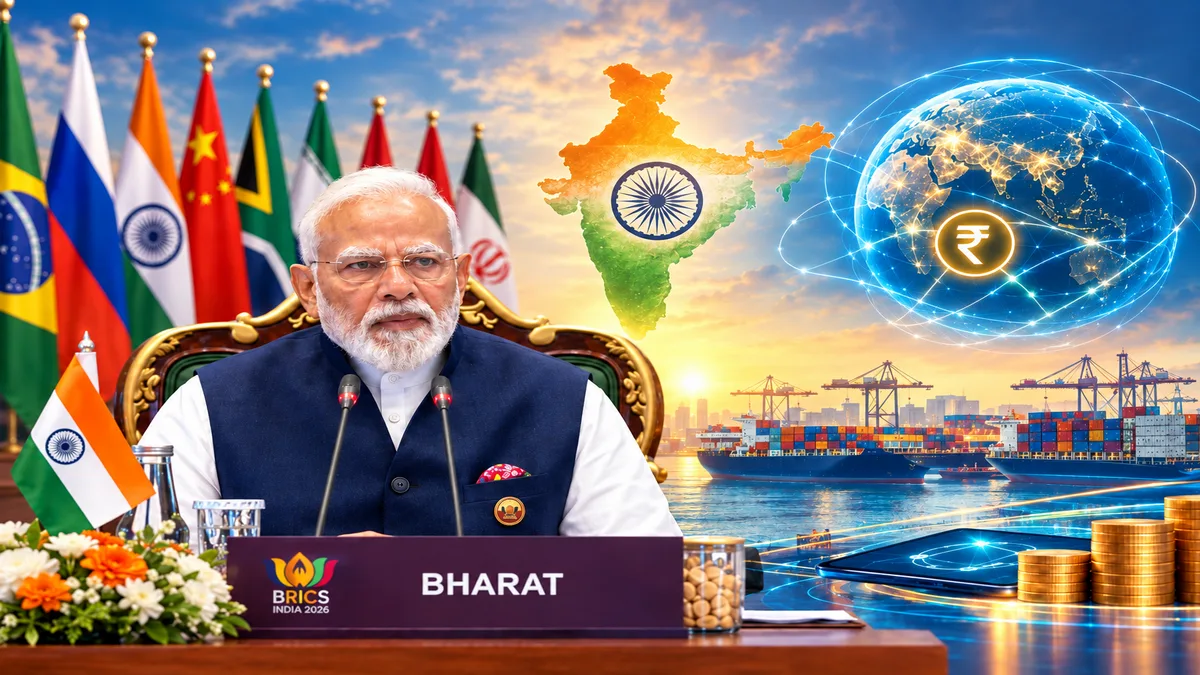
AI Generated Representative Image

AI Generated Representative Image

Facebook
Twitter
WhatsAppTelegramEmail

NEW DELHI: Amid speculations and high-voltage anticipation about coining an exclusive BRICS currency, the grouping has only intensified discussions on cross-border payment mechanisms and greater use of the national or regional currencies for transactions during the Summit under India’s presidency.

India has thus drawn a clear distinction between reducing excessive dependence on the US dollar and seeking to replace it. As per the New Delhi Declaration, India espouses on de-risking from the volatalities  and market exposure of dollar, but not aims to completely disentangle from it, which is practically difficult.

India aims to script pragmatic approaches to de-risk from the dollar and protect domestic currencies & economy from external shocks in an era of increasing geopolitical conflicts, protectionism, trade & tariff tussles, weaponisation of economic tools coupled with soaring debt burden, fiscal deficit and other hiccups of the dollar-pegged American economy.

THIS IS GOING TO HAPPEN.
NOT DE-DOLLARISATION BUT DE-RISKING FROM THE DOLLAR
CLAUSE 90:
BRICS acknowledges the efforts of the BRICS Payment Task Force towards exploring pragmatic solutions for efficient cross-border payment mechanisms… pic.twitter.com/koJztA5ivv

— Rahul Shivshankar (@RShivshankar) September 12, 2026

At the 18th BRICS Summit in New Delhi, the focus thus has remained on building alternative payment and settlement mechanisms, improving financial resilience and lowering transaction costs rather than creating a common BRICS currency or challenging the dollar. India with its long-standing multi-alignment foreign policy approach and emphasis on strategic autonomy, pitches to seal domestic economic architecture & its growth momentum by de-risking from dollar, but does not indulge in non-prudent escalation or stimulation of currency war, given the steep dependence of the world economy, which is weaved to US dollar.

India’s pragmatic approach: De-risk, don’t replace

For years, sections within BRICS have advocated reducing the dominance of the US dollar in global trade and finance. The issue has gained further prominence amid Western sanctions, geopolitical tensions and concerns over the vulnerability of dollar-based financial channels to geopolitical and geo-economic shocks.

Yet India’s approach is considerably more measured and pragmatic, which can be successfully implemented.

Clause 90 of the New Delhi Declaration makes no reference to a common BRICS currency or a formal effort to replace the US dollar. Instead, it clearly advocates interoperable payment systems, trade with local-currency settlements and other voluntary cooperation channels with regional or national currencies.

The declaration explicitly emphasises that there are divergent national priorities and there is no “one-size-fits-all approach”, thus complete de-dollarisation is a distant vision. However, mechanisms such as crossborder payment tools, use of local currencies helps to carve a stable regional economy amid spiking risks.

This distinction is central to understanding New Delhi’s position. India is not advocating de-dollarisation through BRICS. Rather, it is pursuing de-risking from excessive dollar dependence by developing additional channels through which trade, investment and payments can take place and that’s the core strategic objective. The agenda is that countries should have more safe & reliable options when conventional payment channels become expensive, inefficient or vulnerable to geopolitical disruptions.

Also Read: BRICS Summit 2026: Iran-UAE talks amid West Asia conflict; Reflects India’s diplomatic clout for regional peace

Alternative tools complement dollar ecosystem & not conflict with it

India has also made clear that discussions on alternative payment mechanisms should not be confused with plans for a single BRICS currency. Sudhakar Dalela, Secretary (Economic Relations) in the Ministry of External Affairs, said after the summit that there was no proposal for a common BRICS currency “as of now”.

He stressed that discussions on local-currency trade settlements have been underway for some time and should be viewed as a practical mechanism to reduce transaction costs in bilateral trade. According to Dalela, local-currency settlement is being encouraged as a complement to the existing global payment and settlement system rather than as an attempt to dismantle it.

This position reflects that India acknowledges economic realities. BRICS comprises countries with widely different economic structures, monetary policies, exchange-rate regimes and levels of currency internationalisation. Their currencies are also at very different stages of convertibility and global acceptance.

A common currency would therefore require an extraordinary degree of monetary, fiscal and political coordination that does not currently exist among BRICS members or difficult to reach a consensus.

BRICS Payment Task Force(BPTF): Swift, safe & cheaper gateway

The New Delhi Declaration instead of complete de-dollarisation places considerable emphasis on making cross-border payments faster, cheaper, safer and more efficient.

The BRICS Payment Task Force (BPTF) has been examining the cross-border interoperability of payment and messaging channels. The declaration encouraged the task force to continue exploring “pragmatic solutions” for payment mechanisms that are fast, low-cost, accessible, efficient, transparent and safe.

This represents a more pragmatic approach to reducing dependence on existing financial channels, which is increasingly weaponised as a spillover effect of the geopolitical confrontations.

Rather than simply attempting to replace the dollar and indulge in unecessary geo-economic tussle, India under BRICS is attempting to build complementary financial infrastructures that allows businesses and individuals to move money across borders with fewer intermediaries and lower settlement costs.

India has been particularly supportive of this approach, given the success of its domestic digital payments infrastructures such as UPI.  At the BRICS Business Forum, Commerce and Industry Minister Piyush Goyal called for greater linkage between payment systems and increased use of local currencies in trade. India’s Unified Payments Interface (UPI) has emerged as an example of how digital payment infrastructure could potentially support greater cross-border connectivity.

Topics: New Delhi DeclarationBRICS CurrencyBRICS Summit 2026BRICS Payment Task Force(BPTF)IndiaDollarDe-dollarisation
Share
Tweet
SendShareSend
✮ Subscribe Organiser YouTube Channel. ✮
✮ Join Organiser's WhatsApp channel for Nationalist views beyond the news. ✮
Previous News

Education must go beyond livelihood and focus on holistic human development: Dr Mohan Bhagwat

Next News

When a Bengali Hindu suffers in Bangladesh, where does ‘Bangali-Prem’ go?

Related News

The Bottle, the Broom & the Cockroach: How intoxication makes history and suffering disappear!

BRICS Summit 2026: Iran-UAE talks amid West Asia conflict; Reflects India’s diplomatic clout for regional peace

FACT CHECK: ‘Poha For World Leaders’ Claim Blown Apart, Food Was For Journalists (Image generated using AI)

FACT CHECK: Were BRICS leaders served with ‘Poha’? viral claim is completely false

Chinese President Xi Jinping and Prime Minister Modi at BRICS Summit, 2026

BRICS Summit: China inks declaration on Pahalgam attack & counter-terrorism; India’s win amid Beijing-Islamabad ties

Members of the Tibetan community take part in a protest march against Chinese President Xi Jinping’s visit to India in New Delhi on September 11

Tibetans protest Xi Jinping’s India Visit; Demand action on China’s ‘ethnic unity’ law and repression

Prime Minister Narendra Modi arrives at Bharat Mandapam on Day 2 of the BRICS Summit 2026

BRICS Summit: PM Modi warns against weaponisation of critical minerals; Pushes early warning system amid global risks

Load More

Latest News

Chinmoy Prabhu

When a Bengali Hindu suffers in Bangladesh, where does ‘Bangali-Prem’ go?

AI Generated Representative Image

BRICS Summit: Not de-dollarisation, but derisking from dollar; India scripts pragmatic shield against external shocks

RSS Sarsanghchalak Dr Mohan Bhagwat, attended the 37th annual prize distribution ceremony ‘Swaraj’ at L.K. Singhania Education Centre

Education must go beyond livelihood and focus on holistic human development: Dr Mohan Bhagwat

(Left) Prime Minister Narendra Modi and Russian President Vladimir Putin (Right) Prime Minister Narendra Modi and Chinese President Xi Jinping in the backdrop of the Rameshwaram temple corridor in the backdrop of the BRICS 2026 summit

Bharat’s civilisational pride at BRICS 2026: Rameswaram temple corridor frames world leaders

The Bottle, the Broom & the Cockroach: How intoxication makes history and suffering disappear!

ABVP releases manifesto for upcoming DUSU elections

DUSU Elections 2026: ABVP releases student centric manifesto; ‘A- Awas, B- Bhagidari, V- Vishwas, P-Parinaam’

ED raid confirms PWD irregularities; Karnataka PWD Minister Satish Jarkiholi

PWD bribe allegations rock Karnataka as ED raids Satish Jarkiholi-Linked premises

BRICS Summit 2026: Iran-UAE talks amid West Asia conflict; Reflects India’s diplomatic clout for regional peace

Mamata Banerjee, former Chief Minister of Bengal

Will Mamata Banerjee fight Nandigram again? TMC rebels offer to stay out

FACT CHECK: ‘Poha For World Leaders’ Claim Blown Apart, Food Was For Journalists (Image generated using AI)

FACT CHECK: Were BRICS leaders served with ‘Poha’? viral claim is completely false

Load More
  • Privacy
  • Terms
  • Cookie Policy
  • Refund and Cancellation
  • Delivery and Shipping

© Bharat Prakashan (Delhi) Limited.
Tech-enabled by Ananthapuri Technologies

  • Home
  • Search Organiser
  • Bharat
    • Assam
    • Bihar
    • Chhattisgarh
    • Jharkhand
    • Maharashtra
    • View All States
  • World
    • Asia
    • Africa
    • North America
    • South America
    • Europe
    • Australia
  • Editorial
  • Operation Sindoor
  • Opinion
  • Analysis
  • Defence
  • Culture
  • Sports
  • Business
  • RSS @ 100
  • Entertainment
  • More ..
    • Sci & Tech
    • Vocal4Local
    • Special Report
    • Education
    • Employment
    • Books
    • Interviews
    • Travel
    • Health
    • Politics
    • Law
    • Economy
    • Obituary
  • Subscribe Magazine
  • Read Ecopy
  • Advertise
  • Circulation
  • Careers
  • About Us
  • Contact Us
  • Policies & Terms
    • Privacy Policy
    • Cookie Policy
    • Refund and Cancellation
    • Terms of Use

© Bharat Prakashan (Delhi) Limited.
Tech-enabled by Ananthapuri Technologies