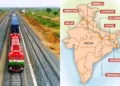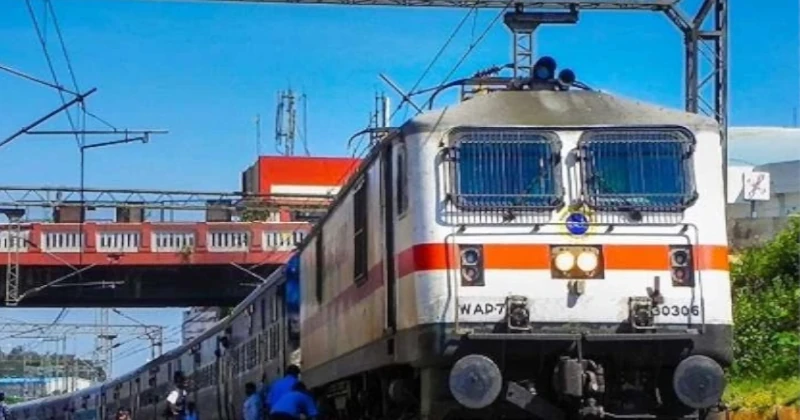
The Cabinet Committee on Economic Affairs (CCEA), chaired by Prime Minister Narendra Modi, has approved three multitracking projects of the Ministry of Railways as part of the government’s continued efforts to expand railway capacity and improve connectivity across the country.
The three projects include the Kharagpur-Jharsuguda (Bagdehi) fourth line, the Katni-Pendra Road fourth line and the Bilaspur (Uslapur)-Pendra Road third line.
Together, the projects will add approximately 656 km to the existing railway network. The expansion is expected to strengthen important railway corridors passing through five states and provide additional capacity for both passenger and freight trains.
The government said the projects are aimed at improving mobility, increasing the efficiency of railway operations and making services more reliable. Additional tracks on busy routes are also expected to help reduce congestion and allow trains to be operated with greater flexibility.
Five states and 14 districts to benefit
The railway projects will cover 14 districts spread across West Bengal, Jharkhand, Odisha, Madhya Pradesh and Chhattisgarh.
The expanded network is expected to improve connectivity to approximately 4,790 villages, which together have a population of around 56 lakh.
For people living in these areas, improved railway infrastructure is expected to make travel easier and provide better access to major towns, cities, markets, educational institutions, healthcare facilities and employment centres.
The projects could also strengthen economic activity in smaller towns and rural areas by improving the movement of people and goods.
Better railway connectivity can help local producers and businesses reach larger markets, while improved passenger services can make it easier for people to travel for work, education and other needs.
Additional tracks to ease congestion
A major objective of the projects is to increase capacity on railway routes that already carry substantial traffic.
When a railway corridor operates close to its capacity, passenger and freight trains can face delays and scheduling constraints. Additional tracks provide railway authorities with more room to manage traffic and improve the overall efficiency of train operations.
The fourth-line projects on the Kharagpur-Jharsuguda and Katni-Pendra Road routes, along with the third-line project between Bilaspur and Pendra Road, are expected to provide this additional capacity.
The government said the projects will help streamline train operations and reduce congestion on key routes. This could improve the reliability of railway services while allowing additional trains to operate as demand increases.
The capacity expansion is particularly significant for freight transportation because the routes are used extensively for the movement of industrial commodities.
Boost to coal, cement, iron and steel transportation
The three railway corridors are important for the transportation of coal, cement, iron and steel, making the projects significant for India’s industrial and infrastructure sectors.
Coal remains an important commodity for the country’s energy and industrial requirements, while cement, iron and steel are essential for construction, manufacturing and infrastructure development.
The government expects the additional railway capacity to facilitate around 27 million tonnes per annum (MTPA) of additional freight traffic.
Greater freight capacity on railways can help industries move large quantities of goods over long distances more efficiently. It can also reduce pressure on roads and help improve the reliability of supply chains.
For industries located in or dependent on the mineral-rich regions of eastern and central India, improved rail connectivity can be particularly important in reducing transportation bottlenecks.
Projects aligned with PM Gati Shakti
The three projects have been planned under the PM Gati Shakti National Master Plan, the government’s framework for integrated infrastructure development and multimodal connectivity.
PM Gati Shakti seeks to improve coordination between different infrastructure projects and transportation systems. The objective is to ensure that roads, railways, ports, airports, waterways and logistics infrastructure complement one another instead of being developed in isolation.
The railway projects approved by the Cabinet are expected to contribute to this approach by strengthening connectivity between production centres, industrial areas, markets and other transport networks.
The government said the projects would support seamless movement of people, goods and services while improving logistics efficiency.
This is expected to have an impact not only on railway operations but also on the wider economy by making the movement of goods more efficient.
Improved access to religious and tourist destinations
The projects are also expected to improve railway connectivity to several important religious, cultural and tourist destinations.
Among the destinations that are expected to benefit are Taratarini Temple, Shri Kshetra Jagannath Temple near Jharsuguda, Bandhavgarh Tiger Reserve, Virateshwar Temple, Amarkantak Temple, Jwaleshwar Dham, Achanakmar Tiger Reserve, Khutaghat Dam, Malhar Archaeological Site and Ratanpur Mahamaya Temple.
Improved rail connectivity can make these destinations more accessible to tourists and pilgrims, particularly during peak travel periods.
Religious and tourism-related travel also supports local economies. Increased visitor movement can create demand for hotels, restaurants, local transport, shops, guides and other services.
For smaller towns and rural areas located around these destinations, stronger railway connectivity could therefore generate economic opportunities beyond the direct benefits of the railway projects.
Economic opportunities for villages
The expansion of railway infrastructure is expected to bring economic benefits to the thousands of villages covered by the projects.
With better connectivity, residents can have easier access to nearby towns and larger urban centres. This can improve opportunities for employment, education, healthcare and business.
Farmers and small producers can also benefit from better access to markets, particularly where railway connectivity helps improve the movement of goods.
The construction phase of the projects is expected to generate employment and demand for various services and materials. Over the longer term, improved connectivity can encourage economic activity along the railway corridors.
The government estimates that around 56 lakh people across 4,790 villages will benefit from the expanded railway network.
Rail expansion expected to lower logistics costs
The government has also highlighted the potential impact of the projects on India’s logistics costs.
Efficient transportation is an important part of a competitive economy. When goods face delays or have to be transported through congested routes, businesses can face higher costs.
Increasing railway capacity can help move bulk commodities more efficiently and provide industries with an alternative to road transportation for long-distance movement.
The expected increase in freight capacity of around 27 MTPA could therefore support the movement of industrial commodities while improving the efficiency of supply chains.
Lower logistics costs can benefit industries as well as consumers by reducing the overall cost associated with moving goods from production centres to markets.
Environmental benefits from greater rail use
The railway projects are also expected to contribute to India’s environmental and climate objectives.
Rail transportation is generally more energy-efficient than road transportation when large volumes of passengers or goods are moved over long distances. Increasing railway capacity can therefore support greater movement of freight by rail.
According to government estimates, the projects are expected to reduce oil imports by approximately 12 crore litres.
The projects are also estimated to reduce carbon dioxide emissions by around 62 crore kg. The government has equated this reduction with the carbon absorption potential of approximately 2.48 crore trees.
The expected reduction in fuel consumption and emissions adds an environmental benefit to the infrastructure investment, alongside the economic and connectivity gains.
Strengthening India’s eastern and central railway network
The projects will further strengthen railway infrastructure across parts of eastern and central India.
The Kharagpur-Jharsuguda corridor passes through regions that are important for industrial and mineral-based activity. The Katni-Pendra Road and Bilaspur-Pendra Road sections are similarly significant for connecting important parts of Madhya Pradesh and Chhattisgarh.
These routes carry substantial freight traffic and are important links in India’s broader industrial supply chain.
By adding additional railway lines, the government aims to ensure that these corridors have enough capacity to handle growing passenger and freight demand in the future.
The projects are therefore not only about adding kilometres of track but also about preparing the network for higher traffic volumes.
Supporting India’s infrastructure and growth
The Cabinet’s decision is part of the broader expansion and modernisation of India’s railway infrastructure.
Multitracking projects can increase the capacity of existing railway corridors and allow more trains to operate without requiring entirely new routes to be built.
For busy routes, additional lines can help separate different types of traffic and provide greater flexibility in train scheduling. This can be particularly useful on corridors where passenger and freight demand is growing simultaneously.
The projects are also expected to support India’s wider infrastructure and economic growth by strengthening links between industrial regions, markets and communities.
A major investment in connectivity
With a combined estimated cost of Rs 10,783 crore, the three projects represent a major investment in railway infrastructure across five states.
The addition of approximately 656 km of railway lines will increase capacity, improve mobility and strengthen the reliability of train operations. At the same time, the projects are expected to connect 4,790 villages with a combined population of around 56 lakh people.
The expected addition of 27 million tonnes of annual freight capacity could provide a major boost to the transportation of coal, cement, iron and steel, while better rail connectivity could support tourism and religious travel.
The projects are also expected to reduce oil consumption and carbon emissions, contributing to India’s environmental goals.
By linking railway expansion with the PM Gati Shakti National Master Plan, the government is seeking to combine better connectivity with improved logistics and economic efficiency.
Overall, the three projects are expected to strengthen India’s railway network across eastern and central India while creating better opportunities for passengers, industries, villages and tourism-dependent communities. The investment is aimed at building additional capacity today while preparing the railway network to meet India’s growing transportation and economic requirements in the years ahead.