
Imagine there is a ball of clay. A person got the opportunity to mould the clay initially and gave it a shape. A second person was handed over the partly shaped clay mound and had to give it a better form. The first person was definitely in a better position, while the second person clearly had more challenges.
Twelve years, in a period of 79 years, is a small proportion, but these 12 years made a huge difference.
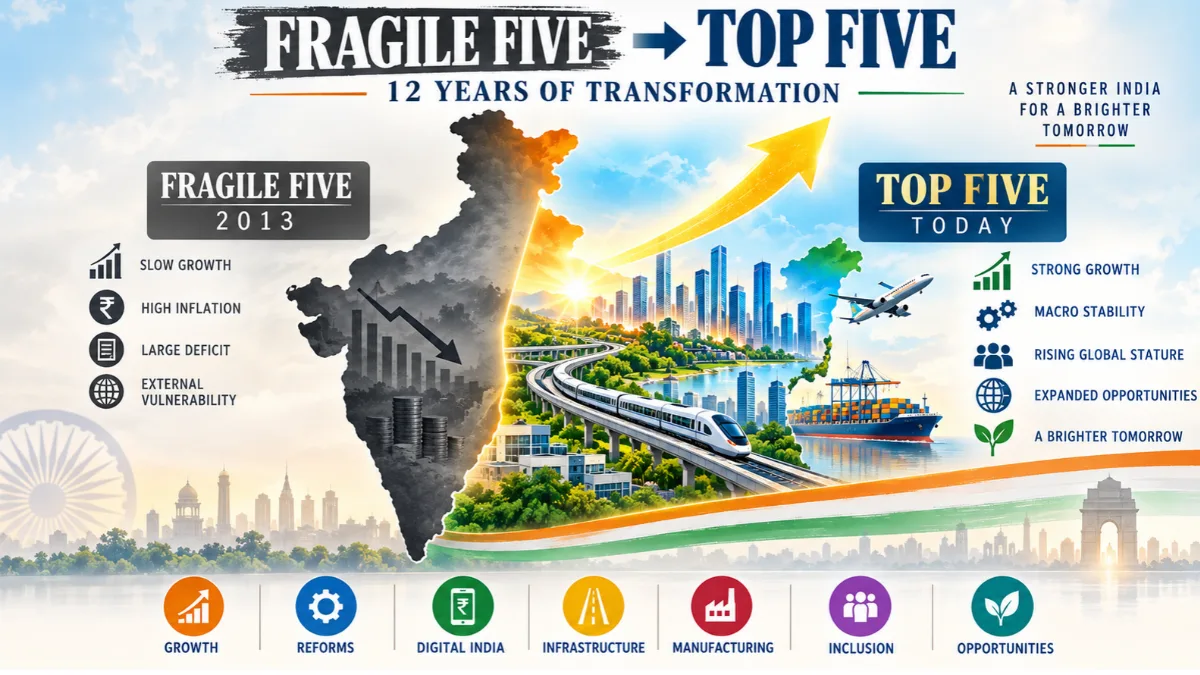
Congress had the opportunity to rule the nation for more than 70% of the time, including the most valuable period of the initial decades. When Modi became Prime Minister in 2014, the situation of the Indian economy was challenging. In 2013, India was widely described as one of the “Fragile Five” emerging economies, along with Brazil, Indonesia, South Africa and Turkey.
India was facing slow growth, high inflation, a large current-account deficit, fiscal pressures and significant dependence on foreign capital. Growth had fallen to around 4.5%, inflation remained close to double digits and investment had weakened.
The Congress-led UPA government did not inherit a weak economy in 2004. It inherited an economy that had just entered a strong growth phase, with GDP growth of around 8.5% in 2003-04, high foreign-exchange reserves and a current-account surplus. However, by 2014, the UPA government handed over an economy facing significant macroeconomic vulnerabilities to the subsequent NDA government.
India transformed incredibly in 12 years, becoming one of the fastest-growing major economies.
India has risen from around the 10th-largest economy in 2014 to the 5th-largest economy today, with nominal GDP crossing $4 trillion.
The IMF has recognised India’s strong economic performance and highlighted the role of sound macroeconomic policies and structural reforms. The Japan Credit Rating Agency has upgraded India’s sovereign long-term foreign- and local-currency issuer rating from BBB+ to A-, reflecting stronger growth prospects, macroeconomic stability and an improving financial system.
How was this transformation possible?
Because of the major reforms taken by the Modi lead NDA government in the last 12 years.
MAJOR MEASURES TAKEN SINCE 2014
1. Jan Dhan + Aadhaar + Mobile = JAM Trinity
Launched in 2014, this was one of the most consequential reforms, bringing more than 57 crore previously unbanked people into the formal financial system.
The JAM architecture enabled direct bank transfers, digital payments, reduced leakages and targeted welfare delivery.
2. UPI and Digital Public Infrastructure
India did not merely digitise government services, but built large-scale public digital infrastructure.
The IMF has specifically highlighted India’s digital public infrastructure as an important foundation for innovation and financial inclusion.
UPI has become a global-scale digital payments platform. In August 2026, there were 24.51 billion UPI transactions worth ₹29.82 lakh crore.
This is not merely a digital-payment revolution. It has reduced transaction costs, increased financial inclusion and enabled millions of individuals and businesses to participate in the formal digital economy.
3. GST
A major reform that created a national common market, reduced tax fragmentation, improved compliance, widened the tax base and made the movement of goods easier across the country.
GST was introduced in 2017. Today, monthly collections are around ₹2 lakh crore, demonstrating the enormous expansion of India’s formal tax base.
GST has become one of the important pillars of India’s formalising economy.
4. Insolvency and Bankruptcy Code (IBC)
One of the major problems inherited by the Modi government was the twin-balance-sheet problem – over-indebted companies and stressed public-sector banks.
IBC created a time-bound insolvency framework and improved India’s ability to address its long-standing exit problem.
The health of India’s financial sector has improved significantly following the stress episodes of the previous decade.
5. Infrastructure Push
A major change was the shift towards large-scale public capital expenditure.
Roads, highways, railways, airports, freight corridors, metro systems and logistics infrastructure became major investment priorities.
This infrastructure push not only improves connectivity but also reduces logistics costs, increases productive capacity and helps crowd in private investment.
6. Make in India + FDI Liberalisation
The government attempted to make India a more attractive manufacturing and investment destination by liberalising FDI rules, simplifying business regulations, introducing single-window systems and removing obsolete regulations.
Around 40,000 compliances have been removed or simplified since 2014.
7. Production Linked Incentive (PLI)
The PLI scheme shifted the focus towards actual production and scale in strategically important sectors such as electronics, mobile phones, pharmaceuticals, automobiles, batteries, telecom, textiles, drones and solar PV.
Electronics production increased from approximately ₹1.9 lakh crore in 2014-15 to ₹11.3 lakh crore in 2024-25.
Mobile-phone exports have risen from negligible levels in 2014 to around ₹2 lakh crore.
India is now the world’s second-largest mobile-phone manufacturing country.
8. Atmanirbhar Bharat
The Modi government turned the COVID-19 crisis into an opportunity to build greater domestic capability and self-reliance.
It combined domestic manufacturing, PLI, infrastructure, logistics and strategic sectors.
The objective was not isolation from the world economy, but greater domestic capacity and resilience within global supply chains.
9. Public Sector Bank Recapitalisation
The government injected substantial capital into stressed public-sector banks while simultaneously pursuing consolidation and banking reforms.
Together with IBC, recognition of stressed assets and improved banking practices, these measures helped strengthen the banking system.
Today, India’s financial and corporate sectors are considerably more resilient, with non-performing loans at multi-year lows.
10. Fiscal Consolidation, Capital Expenditure and Inflation Targeting
India adopted a flexible inflation-targeting framework with the RBI. This was one of the landmark structural reforms of the last decade.
Another major change was the increasing emphasis on capital expenditure rather than simply increasing revenue expenditure.
Building infrastructure increased productive capacity and generated the foundation for future growth.
The IMF has recognised India’s prudent fiscal, monetary and financial-sector policies.
The Modi era has therefore implemented a broad package of structural, financial, digital and infrastructure reforms that have materially changed India’s economic architecture and strengthened its capacity for sustained growth.
THE TRANSFORMATION IN NUMBERS
GST was introduced in 2017. Today, monthly GST collections stand at around ₹2 lakh crore.
UPI transactions now stand at over 24.51 billion in a month. In August 2026, 2451 crore UPI transactions worth ₹29.82 lakh crore took place.
India is now the world’s second-largest mobile-phone manufacturing country. Electronics production increased to ₹11.3 lakh crore in 2024-25 from ₹1.9 lakh crore in 2014-15. Mobile-phone exports have risen to around ₹2 lakh crore.
India is now the third-largest pharmaceutical producer in the world by volume and supplies medicines to more than 190 countries. Pharma exports touched $30.47 billion in 2024-25.
India is now the world’s third-largest automobile market. More than 3.3 crore vehicles were produced in 2025 and automobile exports exceeded 63 lakh vehicles.
India is also the world’s largest two-wheeler manufacturing base, supporting millions of jobs across the automobile ecosystem.
DEFENCE MANUFACTURING – A DRAMATIC TRANSFORMATION
Defence manufacturing is one of the most dramatic transformations.
Defence exports have risen from just ₹686 crore in 2013-14 to ₹38,424 crore in 2025-26 – an extraordinary increase.
Defence production reached approximately ₹1.8 lakh crore in 2025-26.
Earlier, India was among the world’s largest defence importers. Now India is building a domestic defence industrial base and increasingly becoming a defence exporter.
FOREIGN-EXCHANGE RESERVES
India’s external position has also undergone a dramatic transformation.
Foreign-exchange reserves have reached a record $740.80 billion as of the week ending August 28, 2026.
These reserves provide India with a substantial buffer against external shocks and global financial volatility.
FASTEST-GROWING MAJOR ECONOMY
Today, India remains one of the fastest-growing major economies.
The first-quarter GDP growth rate for FY2026-27 was 7.8%.
India is among the nations with the world’s largest foreign-exchange reserves, with reserves now exceeding $740 billion.
FROM FRAGILE FIVE TO TOP FIVE
This journey from Fragile Five to Top Five happened despite unprecedented crises such as the COVID-19 pandemic, the Russia-Ukraine war, major energy and oil shocks, geopolitical tensions and disruptions in global trade and supply chains.
While several nations struggled due to these crises, the Modi government took pragmatic decisions aimed at strengthening domestic demand, infrastructure, manufacturing, financial stability and external resilience.
The transformation of India over the last 12 years is therefore not merely about a change in its ranking.
It is about the transformation of the economic foundation itself.
From financial exclusion to JAM.
From cash-based transactions to UPI.
From a fragmented indirect-tax system to GST.
From the twin-balance-sheet crisis to a stronger banking system.
From dependence on imported mobile phones to becoming the world’s second-largest mobile-phone manufacturing country.
From being one of the world’s largest defence importers to becoming an increasingly important defence exporter.
From vulnerability to stronger foreign-exchange reserves.
From the Fragile Five to the Top Five.
Twelve years may be a small period in the history of a 79-year-old nation.
But these 12 years have demonstrated how structural reforms, infrastructure investment, digital public infrastructure, manufacturing incentives and macroeconomic stability can fundamentally change the trajectory of an economy.
The journey is far from over. But the direction has unmistakably changed.