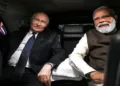
New Delhi: Prime Minister Narendra Modi stepped up India’s diplomatic outreach on the sidelines of the 18th BRICS Summit in New Delhi, holding a series of bilateral meetings with leaders from Iran, Vietnam, the UAE and Ethiopia as India seeks to translate its BRICS Chairship into stronger economic, strategic and development partnerships across the Global South. The engagements predominantly focused on regional peace, maritime security, safety of commercial vessels & seafarers, energy security etc.
PM Modi reiterates maritime security, freedom of navigation during talks with Iran President
During his meeting with Iranian President Masoud Pezeshkian on September 11, Prime Minister Modi discussed bilateral ties and the rapidly evolving situation in West Asia amid continuing conflict and disruptions affecting the strategically vital Strait of Hormuz.
PM Modi reiterated India’s consistent position that all outstanding issues must be addressed through dialogue and diplomacy. He also underlined the need for sustained efforts towards lasting peace and stability in West Asia while stressing the importance of safeguarding freedom of navigation and commerce and ensuring the safety and well-being of seafarers.
From Bishkek to Delhi, the productive discussions continue.
Happy to have met Dr. Masoud Pezeshkian, the President of Iran. This visit is more special because it is his first visit to India.
We talked about the India-Iran friendship. We believe that we should move forward… pic.twitter.com/DtxWuhB9Ba
— Narendra Modi (@narendramodi) September 11, 2026
The meeting was the second interaction between the two leaders in a short period. They had previously met on the sidelines of the Shanghai Cooperation Organisation Summit in Bishkek on August 31.
PM Modi also thanked Iran for its regular, high-level participation in BRICS-related meetings despite the challenging regional circumstances. He also highlighted the potential of BRICS to foster resilience, innovation, cooperation and sustainability among countries of the Global South.
Iran pushes for stronger BRICS economic cooperation
Iran President Pezeshkian, addressing the BRICS Business Forum, called for the grouping to move beyond potential cooperation towards tangible economic outcomes. He emphasised the need to transform the combined economic capabilities of BRICS members into stronger networks of trade, investment and joint financing. The Iranian President also pointed to geopolitical uncertainty, supply-chain disruptions and the growing use of economic instruments as tools of political pressure.
The remarks come at a time when India’s BRICS Chairship is seeking to strengthen economic resilience and cooperation amid increasing global fragmentation.
India-Vietnam partnership gets fresh diplomatic push
On September 12, PM Modi held talks with Vietnamese Prime Minister Le Minh Hung in New Delhi, further reinforcing the India-Vietnam Enhanced Comprehensive Strategic Partnership. The relationship encompasses defence and security, fintech, critical minerals and emerging areas of cooperation, alongside coordination in multilateral organisations.
Vietnam, one of BRICS’ 10 partner countries, views its participation in the New Delhi summit as an opportunity to deepen its relationship with India while expanding engagement with BRICS members and other partner nations.
The meeting also builds on the momentum generated during Vietnamese President To Lam’s State Visit to India in May, when the two countries agreed to elevate bilateral ties to an Enhanced Comprehensive Strategic Partnership based on “shared vision, strategic convergence, substantive cooperation”.
PM Modi-Abu Dhabi Crown Prince discuss strategic partnership
PM Modi also met Abu Dhabi Crown Prince Khaled bin Mohamed bin Zayed Al Nahyan at Hyderabad House, with India and the UAE seeking to further strengthen their Comprehensive Strategic Partnership. The UAE, a full BRICS member since January 2024, has positioned its membership as a means of expanding economic and trade partnerships, strengthening global market access and developing new trade, investment and logistics corridors.
India-UAE cooperation has expanded significantly in recent years, particularly in trade and energy security. The UAE’s expanding Comprehensive Economic Partnership Agreement programme has also created additional avenues for economic integration, with India among the countries with which the UAE has concluded a CEPA.
Ethiopia emerges as a key partner in India’s BRICS outreach
PM Modi also held talks with Ethiopian Prime Minister Abiy Ahmed Ali at Hyderabad House, strengthening India’s engagement with one of Africa’s key emerging economies. Ethiopia joined BRICS as a full member in January 2024. Its membership provides greater access to the markets of BRICS economies and could create opportunities to expand exports of coffee, flowers and other agricultural products.
PM @narendramodi met Prime Minister Dr. Abiy Ahmed Ali, on the sidelines of the 18th BRICS Summit in New Delhi.
Both leaders discussed avenues to further strengthen the India-Ethiopia Strategic Partnership across sectors including economic, defence and security sectors. Both… pic.twitter.com/p4Bq01cGH9
— Randhir Jaiswal (@MEAIndia) September 12, 2026
There is also potential for greater Indian investment in Ethiopia, particularly in telecommunications, infrastructure and other emerging sectors. Such cooperation could support Ethiopia’s efforts to diversify its economy while creating new avenues for Indian businesses.
The India-Ethiopia relationship is also gaining traction in defence. Earlier this month, Indian and Ethiopian officials discussed expanding cooperation in military training, defence industry collaboration and UN Peacekeeping, including new and emerging areas.
Talks with Malaysia Prime Minister
Prime Minister Modi also held bilateral talks with the Prime Minister of Malaysia Anwar Ibrahim on the sidelines of the BRICS Summit. “The leaders reviewed the progress in bilateral cooperation across a range of areas, including trade and investment, defence and security, semiconductors, infrastructure, digital economy, energy, fintech, education, tourism and people-to-people ties. The leaders exchanged views on key regional and global issues of mutual interest”, MEA said in a statement.
Prime Minister @narendramodi met Prime Minister @anwaribrahim of Malaysia on the sidelines of 18th BRICS Summit.
Building on Prime Minister Modi’s visit to Malaysia in February 2026, the leaders reviewed the progress in bilateral cooperation across a range of areas, including… pic.twitter.com/7i1qMLAiy7
— Randhir Jaiswal (@MEAIndia) September 12, 2026
PM Modi speaks to UN Chief; Urges inclusive order & urgent UNSC reforms
On September 11, PM Modi also held discussions with United Nations Sectretary General Antonio Guterres, who is in India for the BRICS Summit. “Discussed ways to strengthen multilateralism, drive sustainable development, promote human-centric and inclusive artificial intelligence and build a more inclusive world order. Both leaders also underscored the need to reform multilateral institutions, including the UN Security Council to reflect contemporary realities”, MEA reiterated, reflecting upon the highlights of the meeting.
PM @narendramodi met with @UN Secretary-General António Guterres @antonioguterres and discussed ways to strengthen multilateralism, drive sustainable development, promote human-centric and inclusive artificial intelligence, and build a more inclusive world order.
Both leaders… pic.twitter.com/3Myvz2Rz1x
— Randhir Jaiswal (@MEAIndia) September 11, 2026
PM Modi’s back-to-back meetings with leaders from West Asia, Southeast Asia and Africa underline New Delhi’s broader diplomatic objective: to use BRICS not merely as a platform for political coordination, but as a vehicle for stronger trade, investment, energy, defence, technology and development partnerships across the Global South.
(With Inputs from ANI)