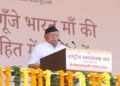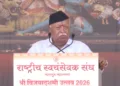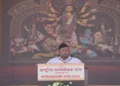
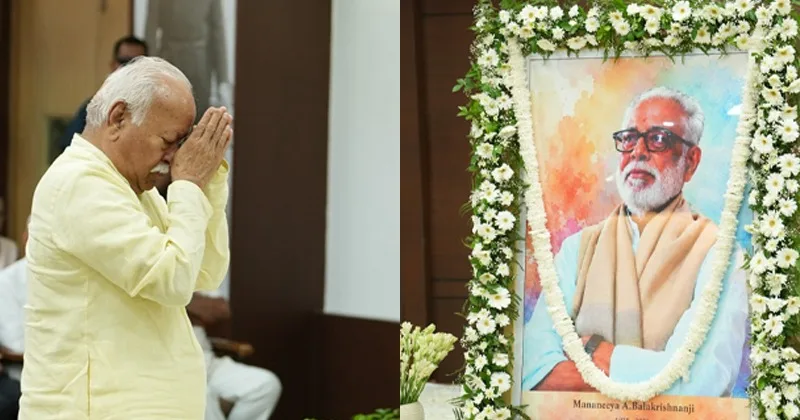
New Delhi: A Balakrishnan Ji’s life was an example of complete dedication, selflessness and immersion in work, as he remained committed to the work of Vivekananda Kendra even during prolonged illness and continued to think about the work until the end, said RSS Sarsanghchalak Dr Mohan Bhagwat at the Shradhanjali Sabha, organised in honour of Mananeeya Shri A Balakrishnan Ji, remembering his long and dedicated association with Vivekananda Kendra and his contribution to nation-building on September 10, 2026.
Recalling Balakrishnan Ji’s final days, Dr Mohan Bhagwat said that although he was around 92-years-old and had been unwell for a long time and undergoing dialysis, everyone felt that his passing was sudden. Even in such a condition, he never spoke about leaving the work. His conversations remained centred on returning from the hospital and resuming his responsibilities.
Dr Mohan Bhagwat recalled that when Gurumurthy Ji had gone to meet Balakrishnan Ji, he spoke about his work and made it clear that the work had not stopped. He said that although he was ill, he would recover and continue working. Even while undergoing dialysis in hospital, he would call for files and examine them.
He said that he had asked Balakrishnan Ji to rest, but he knew that he would not do so. There was nothing else in Balakrishnan Ji’s life apart from the work. His complete immersion in the work and his identity as a worker were reflected throughout his life.
Recalling that he had first seen Balakrishnan Ji in 1992, Dr Mohan Bhagwat said that during his long association with him, it became clear that there was no other passion in his life apart from the work of Vivekananda Kendra. Personal likes and dislikes, if they existed, remained backstage, while work always remained at the centre.
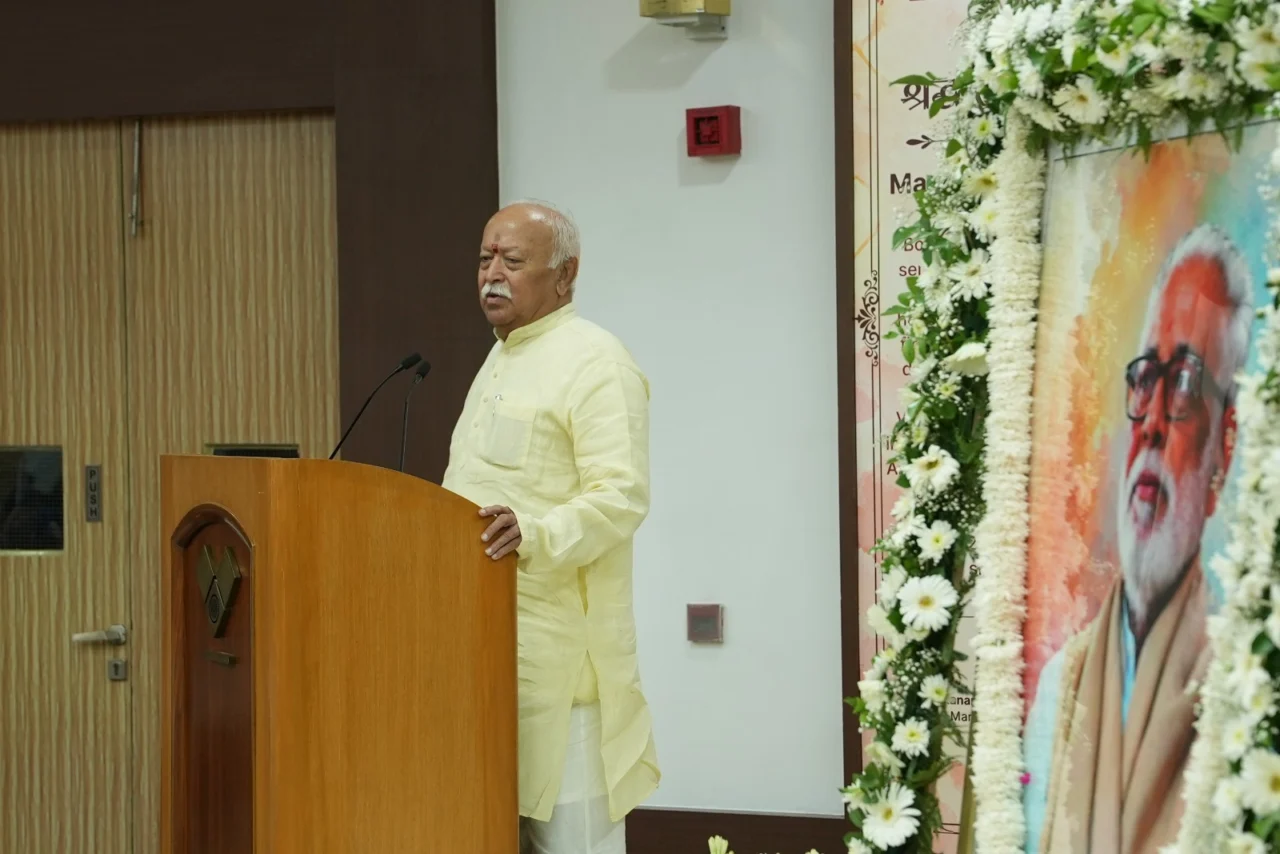
He said that whenever Balakrishnan Ji began speaking about any subject, the conversation would ultimately return to the work. This had become part of his nature. Such persons, he said, become the foundation of an organisation’s work.
Recalling the journey of Vivekananda Kendra after Eknath Ji, Dr Mohan Bhagwat Ji said that the Kendra had gone through many circumstances but continued to function well. In this journey, Balakrishnan Ji had become a central pillar and a reference point on the basis of which many things were carried forward.
Referring to the Bhagavad Gita’s description, he quoted, “मुक्तसंगोऽनहंवादी धृत्युत्साहसमन्वितः, सिद्ध्यसिद्ध्योर्निर्विकारः.” He said that Balakrishnan Ji must have faced many failures and successes during his long journey, but remained unaffected by both.
Dr Mohan Bhagwat further said that when work did not succeed, Balakrishnan Ji would simply begin again from where he had started. When the work succeeded, he would not get caught up in celebration. Although he naturally experienced happiness, he would move beyond it and return to the work.
He said that Balakrishnan Ji could speak to people of all kinds without ego. There was never a feeling in him that he was somebody important. “He was completely in the work,” Dr Mohan Bhagwat said, adding that Balakrishnan Ji had forgotten all consciousness of himself. Work itself was his life and his identity.
Describing his qualities, Dr Mohan Bhagwat said that Balakrishnan Ji had a pure mind and therefore spoke clearly and directly. There was no second intention behind his words. Because of the simplicity, whatever he said appeared to come directly from his heart. Even when someone felt hurt by his words, there was no intention to make anyone angry.
Dr Mohan Bhagwat said that Balakrishnan Ji had immense faith in the work and in his method of working. Because of this, he remained balanced in all circumstances, managed himself and kept the work moving in the best possible manner. He also became an base and reference point for others. His position in Vivekananda Kendra, he said, had come through his tapasya.
He said that Balakrishnan Ji’s departure would naturally create a feeling of emptiness and pain. However, the vacuum would not remain because the tradition created by him teaches others how to continue the work in their absence.
Dr Mohan Bhagwat said that we remember not only the person but also his work and his style. If these are remembered and followed, the work continues. A worker may depart, but the work continues through the manner in which he worked.
He further said that Balakrishnan Ji’s life demonstrated how to work and move forward through different circumstances. Workers must retain the firm faith that their work is the work of God and that it will succeed one day. Success and failure, he said, were ultimately in God’s hands, while the responsibility of workers is to make the effort and become worthy instruments.
“If our tapasya proceeds properly, God will take care of the success and failure of the work,” he said. He further recalled the line, “The work is in our hands; the fruits are in the hands of the God.”,” and said that it was not merely poetry but had been reflected in the lives of many people.
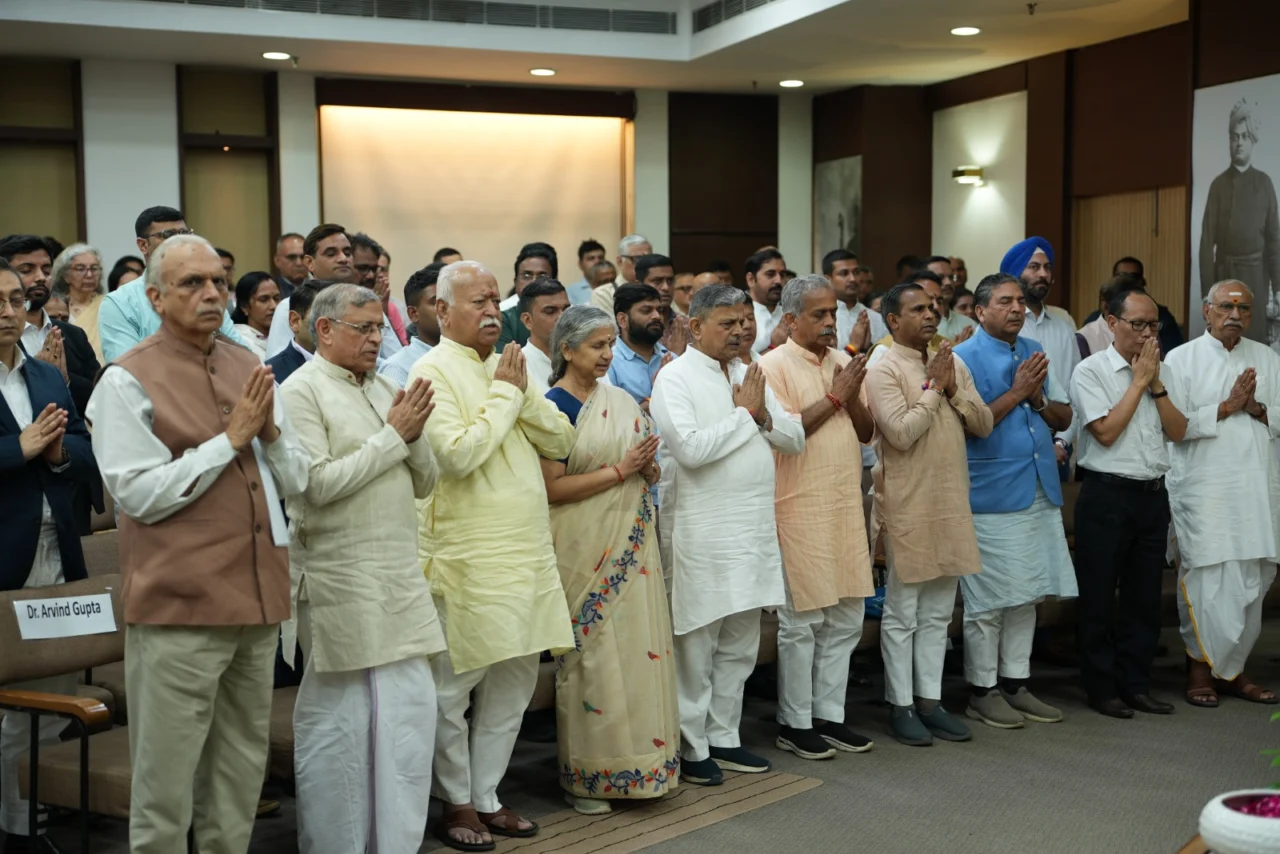
Dr Mohan Bhagwat said that the best tribute to Balakrishnan Ji would be to adopt whatever qualities of his life one could and move forward with the work. He called upon everyone to take a lifelong resolve to remember Balakrishnan Ji and carry forward the work with the same dedication.
Chairman of the Vivekananda International Foundation, S Gurumurthy, said that the Shradhanjali Sabha was different because those present had not assembled merely to praise Balakrishnan Ji. They had assembled to recall and remember the life of an ordinary-looking but extraordinary man.
S Gurumurthy said that great leaders pass away and powerful people disappear, but the people who appear ordinary and yet are extraordinary are the ones who make changes in society and build nations.
He recalled the idea attributed to Galileo that a great nation is one that does not need heroes. He said that the ordinary people who are extraordinary are the ones who sustain society and build the nation.
Recalling Balakrishnan Ji’s decision to dedicate his life to the Vivekananda Kendra, S Gurumurthy said that Balakrishnan Ji had resigned from his job. He recalled that Balakrishnan Ji was in the Air Force at the time and told his nephew that he would resign and join the Vivekananda Kendra.
He further recalled that Balakrishnan Ji told his nephew to take care of the family while he would take care of the work that was going to be given to him. Gurumurthy Ji said that this was not an ordinary decision.
He also referred to the challenges faced by people and organisations working to make society noble and dharmic.
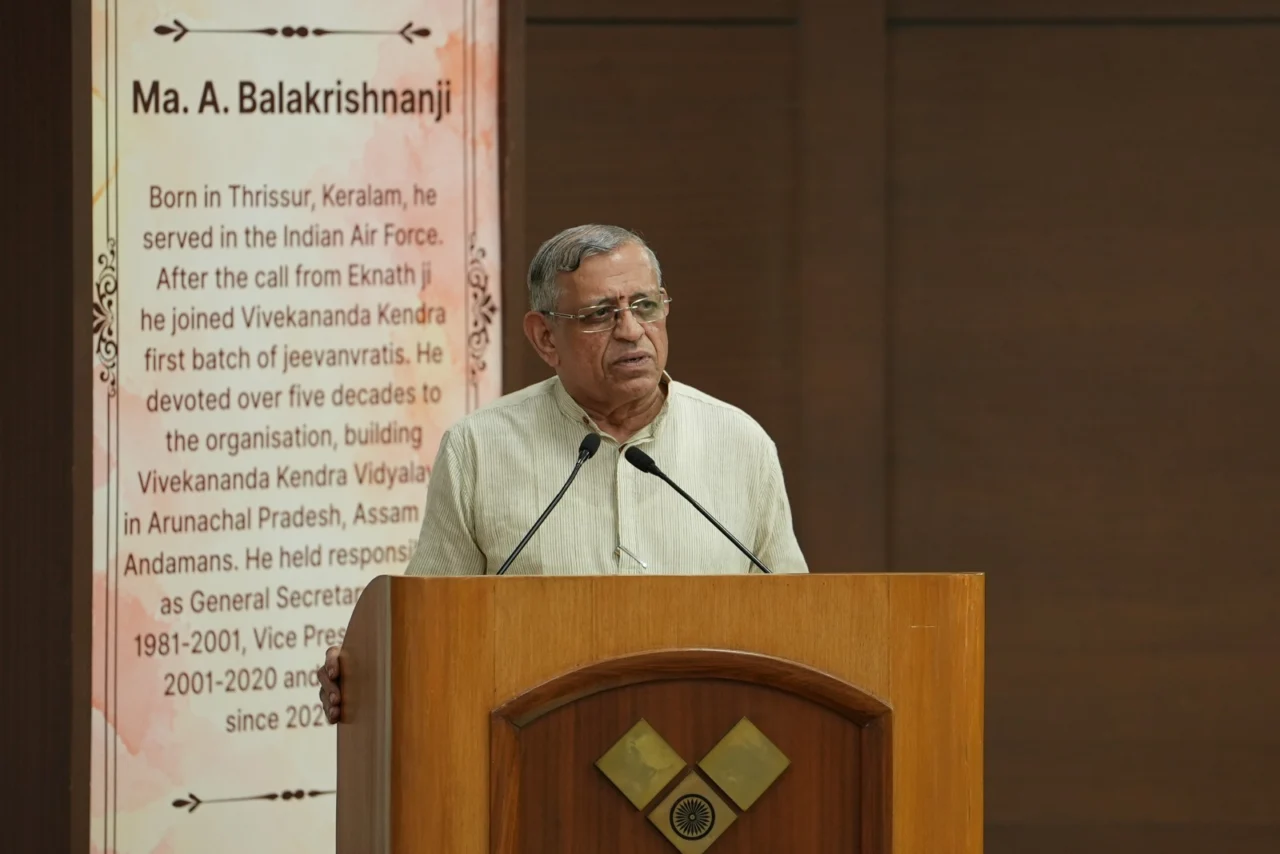
Gurumurthy Ji described Balakrishnan Ji as a “human dynamo”, saying that his life was marked by continuous work. He recalled meeting him around 25 days before his passing.
He said that Balakrishnan Ji was advised to take care of himself and not think about travelling or going to different places. However, Balakrishnan Ji spoke about recovering and then testing whether he was able to move from one place to another in the Kendra campus.
Gurumurthy Ji said that Balakrishnan Ji wanted to first see whether his body could move from his place to another place in the Kendra campus and then begin travelling. “He had nothing except work,” he said.
Referring to Swami Vivekananda’s vision of nation-building, he said that the nation-building task is not confined to cities and towns. It also extends to Arunachal Pradesh, Andaman and the remote areas of the North-East.
The Director of the Vivekananda International Foundation (VIF), New Delhi Dr Arvind Gupta, recalled A Balakrishnan Ji’s association with the Vivekananda International Foundation, Vivekananda Kendra and related institutions.
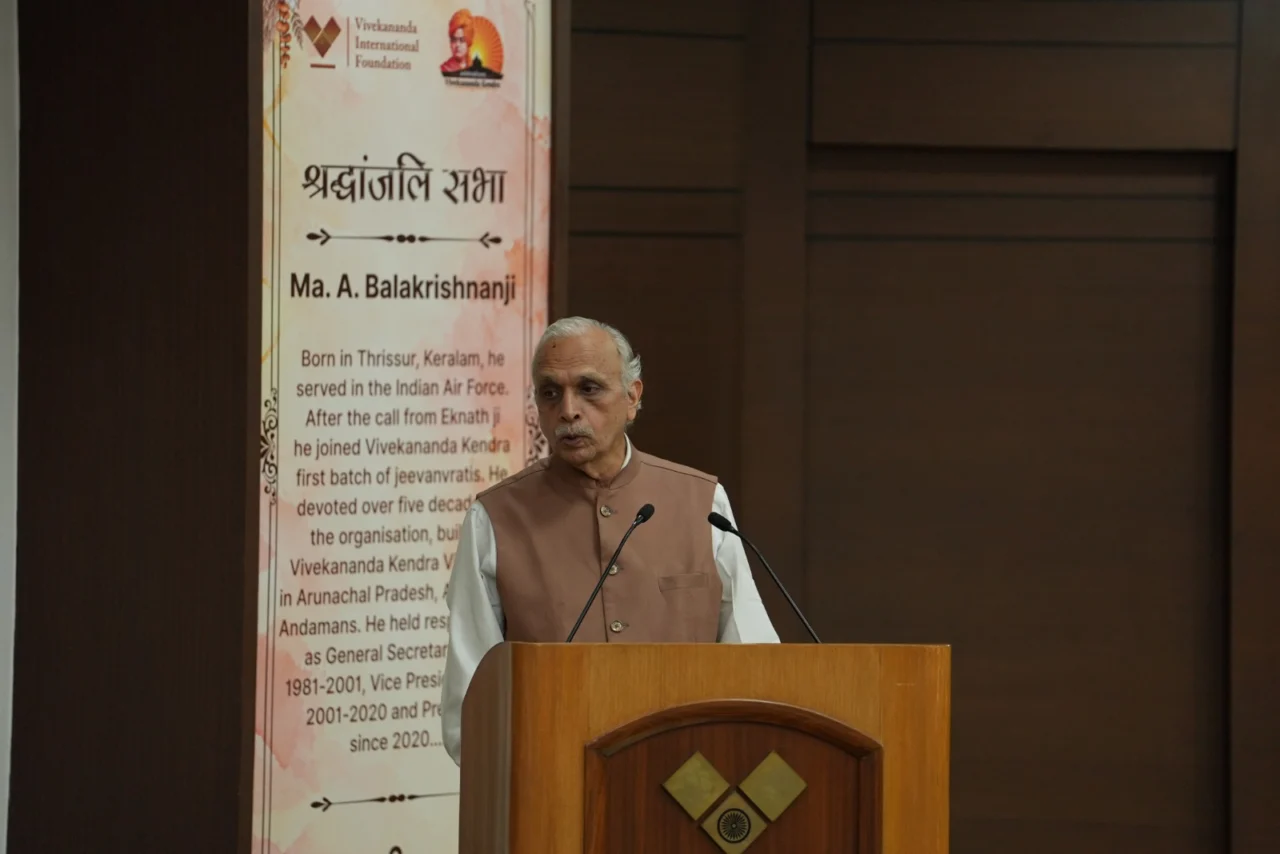
Dr Arvind Gupta said Balakrishnan Ji’s continuous contribution to society would always be remembered. His contribution and guidance remained important in taking forward the work of the organisation.
Padma Shri Nivedita Bhide, Vice President of Vivekananda Kendra Kanyakumari, also paid tribute to Balakrishnan Ji and shared memories of her long association with him.
Nivedita Bhide recalled the difficult circumstances in which Balakrishnan Ji worked in Arunachal Pradesh. She remembered his role in the expansion of Vivekananda Kendra’s work in the region and particularly his efforts in the field of education.
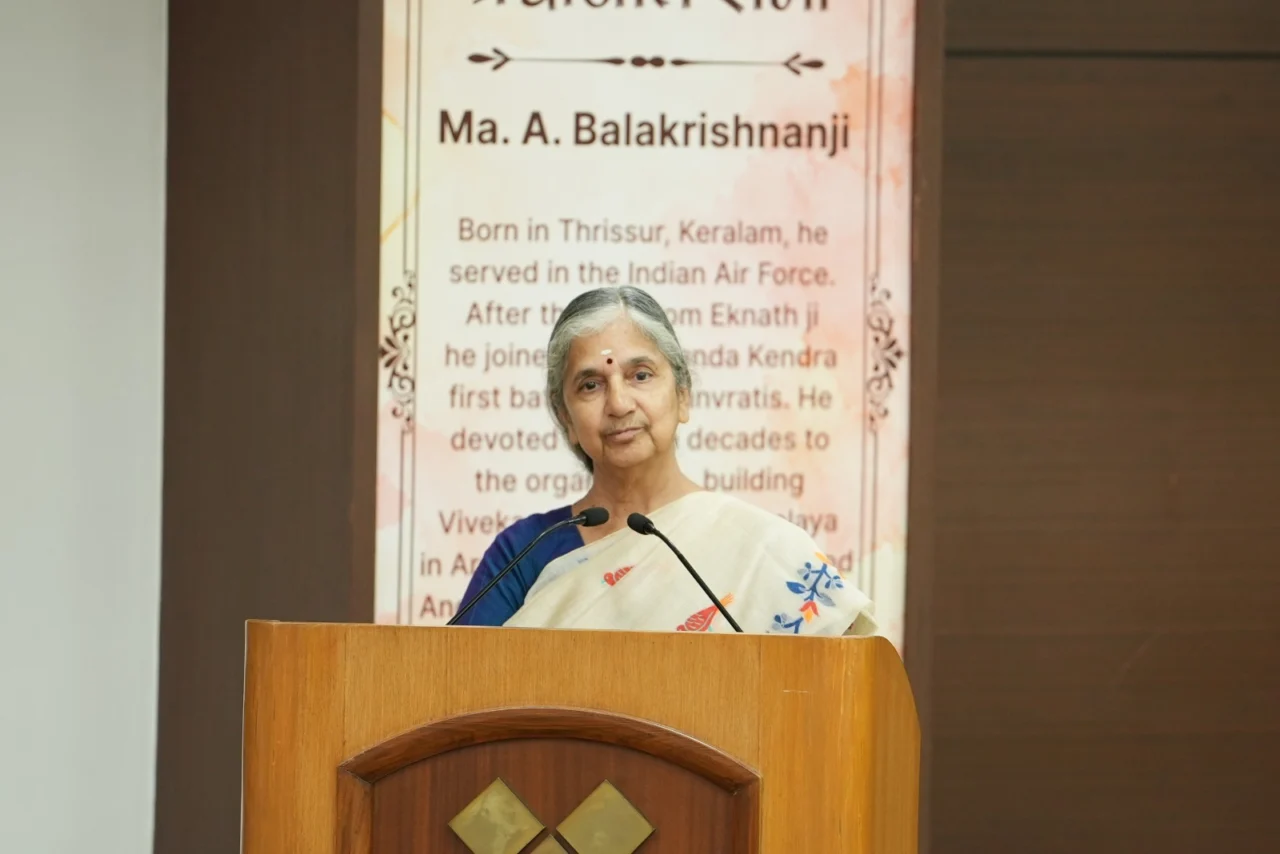
She recalled that when Balakrishnan Ji went to Arunachal Pradesh, the circumstances were very different. The Vivekananda Kendra was working in difficult and remote areas, and there were challenges in taking education and social work to people living in those regions.
During the Shradhanjali Sabha, the condolence message received from Prime Minister Shri Narendra Modi Ji was also read out.
In his message, Prime Minister Narendra Modi Ji said that he was deeply saddened by the passing of Shri A Balakrishnan Ji and described his demise as an irreparable loss for the nation.
The Shradhanjali Sabha also recalled a condolence message from Mata Amritanandamayi.
Born on May 3, 1938, in Thrissur, Kerala, Balakrishnanji served in the Indian Air Force before he answered the call of Mananeeya Eknathji Ranade to join the very first batch of Vivekananda Kendra’s Jeevanvratis. After this, for almost five decades he worked for the all-round development of Vivekananda Kendra across the country.
His role was significant in establishing Vivekananda Kendra Vidyalayas across the Northeast, especially in Assam and Arunachal Pradesh. During his long association with the Kendra, he served as General Secretary from 1981 to 2001, as Vice President from 2001 to 2020, and finally as the All-India President from 2020 until his death.