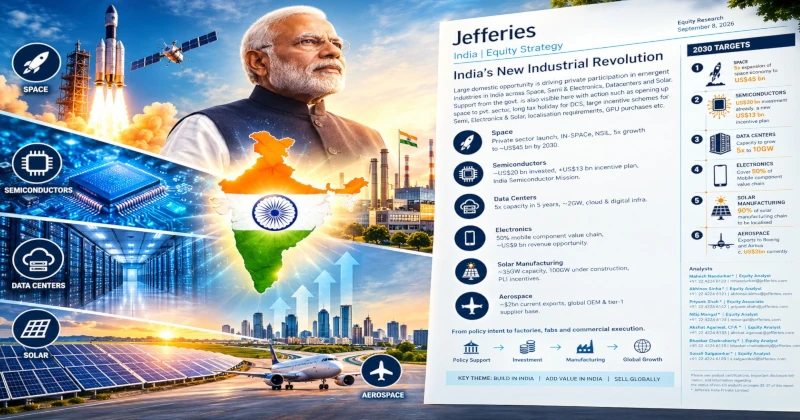
From rockets and semiconductors to data centres, electronics, solar and aerospace, India is moving beyond being merely a giant consumer market to becoming a manufacturing and technology powerhouse for the world. Global investment bank Jefferies has identified this transformation as “India’s New Industrial Revolution”, pointing to a powerful combination of domestic demand, private investment and sustained government policy support.
India could be standing at the threshold of a major industrial growth spike, according to Jefferies’ latest report. The global investment bank has identified six strategic sectors space, semiconductors, data centres, electronics, solar manufacturing and aerospace as potential engines of India’s next phase of industrial expansion.
The central message is, India is no longer merely preparing for industrial transformation; it is beginning to execute it.
Jefferies argues that India’s massive domestic market, rising private-sector participation, favourable cost economics, government incentives and the global search for alternative supply chains are converging to create an unprecedented opportunity.
“Large domestic opportunity is driving private participation in emergent industries in India across Space, Semi & Electronics, Datacenters and Solar,” the report states, highlighting government measures ranging from opening the space sector to private companies to large incentive programmes for semiconductors, electronics and solar manufacturing.
THE REVOLUTION IS HERE.
INDIA IS ON THE VERGE OF A GROWTH SPIKE.
Global investment bank Jefferies in a report published on 9th September has highlighted what it calls “India’s New Industrial Revolution”, driven by a large domestic market, rising private-sector participation… pic.twitter.com/hbxbyV0Zje
— Rahul Shivshankar (@RShivshankar) September 10, 2026
If these trends continue, India could enter 2030 with significantly deeper domestic industrial capabilities, greater value addition, stronger supply-chain resilience and a much larger role in global manufacturing.
From policy intent to factories, fabs and commercial execution
For years, India’s ambitions in high-technology manufacturing were discussed largely in terms of potential. Jefferies now sees a transition from policy intent to actual execution, particularly in sectors such as space and semiconductors.
The Modi government’s policy architecture has played a central role in this shift. Incentives, localisation requirements, production-linked schemes, tax support and regulatory reforms are being used to reduce dependence on imported technology and components while making India more attractive to global investors.
The broader objective is straightforward: build in India, add value in India and sell to both India and the world.
Space: From ISRO’s domain to a private-sector launchpad
Perhaps nowhere is this transformation more visible than in the space sector. The government opened the sector to private participation in 2020, fundamentally changing the operating environment for Indian space startups. The move was aimed at allowing private companies to use national capabilities while developing their own commercial technologies.
The creation of IN-SPACe provided a regulatory and facilitation mechanism for private participation, while NewSpace India Limited (NSIL) assumed a commercial role in taking Indian space technologies to industry. The 2023 Indian Space Policy subsequently widened the role of private companies across the space value chain.
Jefferies believes the opening is now producing tangible results, pointing to companies such as Skyroot, Pixxel, Agnikul and Digantara as examples of startups moving from early innovation towards commercial execution.
Skyroot has advanced orbital launch capabilities, Pixxel is developing high-resolution Earth observation satellites, Agnikul has developed 3D-printed rocket-engine technology, while Digantara is working on space-surveillance capabilities.
Jefferies expects India’s space economy to expand roughly fivefold between 2023 and 2030, reaching around US$45 billion.
The transformation could allow India to develop launch vehicles, satellites, Earth-observation systems and space-surveillance technologies through a growing government-private industrial ecosystem.
Semiconductors: India’s push for technological sovereignty
If space represents India’s leap into the final frontier, semiconductors represent its push for technological sovereignty. Jefferies estimates that around US$20 billion of semiconductor investments are already underway, including a chip fabrication facility and multiple OSAT outsourced semiconductor assembly and testing projects.
The report expects a further US$13 billion incentive plan to expand the ecosystem and increase domestic value addition, including semiconductor design.
The government launched the India Semiconductor Mission in 2021, backed by a Rs 76,000 crore incentive package, to attract global manufacturers, establish fabs and packaging facilities and develop a domestic supply chain.
India has also sought to strengthen chip design through the Design Linked Incentive Scheme, launched in 2022 to support domestic semiconductor startups with financial assistance and access to advanced design tools and intellectual property.
The ambition has now moved further upstream. Under India Semiconductor Mission 2.0, announced in the Union Budget 2026-27, the focus has expanded to semiconductor equipment and materials, full-stack Indian semiconductor intellectual property and stronger domestic and global supply chains.
Jefferies acknowledges that challenges remain, particularly in supply-chain depth, talent and global competition. Yet its assessment is significant: India is building the foundations of a credible semiconductor ecosystem.
Data centres: Building the infrastructure for India’s AI future
India’s industrial transformation is not limited to physical manufacturing. It also requires massive digital infrastructure. Jefferies identifies data centres as a strategic infrastructure segment, with India’s colocation capacity already having expanded around fivefold over the past five years, driven by cloud adoption, digitisation and data-localisation requirements.
The bank expects another fivefold expansion over the next five years to around 10 GW of capacity.
The resulting opportunity is substantial, with Jefferies estimating around US$9 billion in revenue opportunities for data-centre operators and approximately US$45 billion in investment opportunities across power, cooling, construction and network infrastructure. Government policy, tax incentives, rising digital consumption and increasing demand from global hyperscalers are expected to drive this expansion.
The growth of data centres will consequently create opportunities across a much wider industrial ecosystem, including power, construction, cooling systems, networking and technology infrastructure. India’s digital expansion is becoming an industrial opportunity in its own right.
Electronics: From assembly to value addition
India has already emerged as a major electronics manufacturing base, particularly in mobile-phone production. The next challenge, however, is to move beyond assembly and increase domestic value addition.
Jefferies identifies the Electronics Component Manufacturing Scheme (ECMS) and the Mobile Phone Manufacturing Scheme (MPMS) as important tools in this transition.
The objective is to develop the components that go into finished electronic products, reduce import dependence and deepen the domestic supply chain. Jefferies expects ECMS to help increase the share of domestic manufacturing in mobile-phone component value from less than 20 per cent to around 50 per cent over the next six years.
Printed circuit boards, including HDI and multilayer PCBs, represent a major opportunity. Jefferies estimates a potential US$5 billion total addressable market, while India currently imports the overwhelming majority of these components.
The shift therefore goes beyond putting a “Made in India” label on finished products. The bigger objective is to ensure that an increasing share of the technology and components inside those products is also manufactured domestically.
Solar: Building the manufacturing chain behind the energy transition
India’s solar sector has undergone a major transformation over the past decade. Jefferies now identifies India as the world’s second-largest solar PV manufacturer, with around 35 GW of solar cell capacity operational and another approximately 100 GW under construction.
The bigger ambition is localisation. Jefferies expects around 90 per cent of the solar manufacturing value chain to be localised by 2030.
Government measures such as the Approved List of Models and Manufacturers (ALMM), domestic-content requirements and Production-Linked Incentive schemes are encouraging greater domestic manufacturing across cells, wafers and ingots.
India’s solar-generation capacity has expanded alongside manufacturing. The country crossed 150 GW of solar capacity by the end of March 2026, following years of rapid growth.
The next phase is about connecting this massive expansion in generation with domestic manufacturing creating an ecosystem in which India produces not only solar power but also an increasing share of the equipment required to generate it.
Aerospace: India’s manufacturing advantage takes flight
The sixth pillar identified by Jefferies is aerospace, where India is increasingly positioned to benefit from the global imbalance between demand and available manufacturing capacity.
India’s competitive manufacturing costs and engineering talent provide a strong foundation for expansion.
According to Jefferies, Boeing and Airbus are already sourcing around US$1.4–1.6 billion annually from India, while Indian companies including Aequs, Azad, BHFC, DYTC, RW, Motherson and Sansera are expanding as suppliers to global original equipment manufacturers and Tier-1 companies.
As global aerospace companies seek to diversify their supply chains, India has an opportunity to establish itself not simply as a low-cost manufacturing destination but as a sophisticated engineering and production hub.
Aerospace manufacturing also brings stringent quality requirements and advanced engineering capabilities, meaning that greater participation in global aerospace supply chains could strengthen India’s broader high-value manufacturing ecosystem.
Six sectors, one industrial transformation
The significance of the Jefferies assessment lies in the convergence of these six sectors.
- Space is opening to private enterprise.
- Semiconductors are moving from policy to production.
- Data centres are becoming strategic digital infrastructure.
- Electronics are moving from assembly towards components.
- Solar manufacturing is moving towards deeper localisation.
- Aerospace is moving up the global supply chain.
Together, these developments point towards a broader structural shift in the Indian economy. The country is attempting to build industrial ecosystems rather than isolated factories.
India is not just growing. It is building. 🇮🇳
Jefferies’ latest report calls it “India’s New Industrial Revolution”, driven by a powerful convergence of domestic demand, policy support and private investment.
By 2030, the opportunity is enormous:
🚀 Space economy: 5× expansion… pic.twitter.com/sfALU8tiFR
— Amit Malviya (@amitmalviya) September 10, 2026
A semiconductor fab creates demand for equipment, chemicals, specialised logistics, engineering and design. Data centres generate demand for electricity, cooling, construction and networking. Electronics manufacturing creates opportunities in PCBs, displays, batteries, camera modules and other components. Aerospace creates demand for precision engineering and specialised materials.
In other words, one major investment can create an entire chain of industrial opportunities.
The 2030 opportunity
Jefferies’ projections underline the scale of the opportunity:
- Space: Space economy expected to reach around US$45 billion, representing roughly fivefold expansion.
- Semiconductors: Around US$20 billion of investments already underway, with another US$13 billion incentive plan expected to expand the ecosystem.
- Data centres: Capacity expected to grow around fivefold to 10 GW.
- Electronics: Domestic manufacturing targeted at around 50 per cent of mobile component value.
- Solar: Around 90 per cent localisation of the solar manufacturing value chain.
- Aerospace: Indian sourcing and exports to global aerospace giants continuing to expand, with Boeing and Airbus already sourcing well over US$1 billion annually from India.
These are not merely isolated sectoral targets. Together, they represent an attempt to reposition India within the global economic and manufacturing order.
From market for the world to factory and technology hub for the world
For decades, India’s biggest economic attraction was its enormous consumer market. That advantage remains, but the opportunity is changing. The same domestic market that attracts companies to sell in India is increasingly encouraging them to manufacture in India, build supply chains in India and develop technology in India.
At the same time, global companies are looking for alternatives to concentrated supply chains. India’s scale, engineering talent, manufacturing capabilities and policy support give it an opportunity to capture a larger share of this shift.