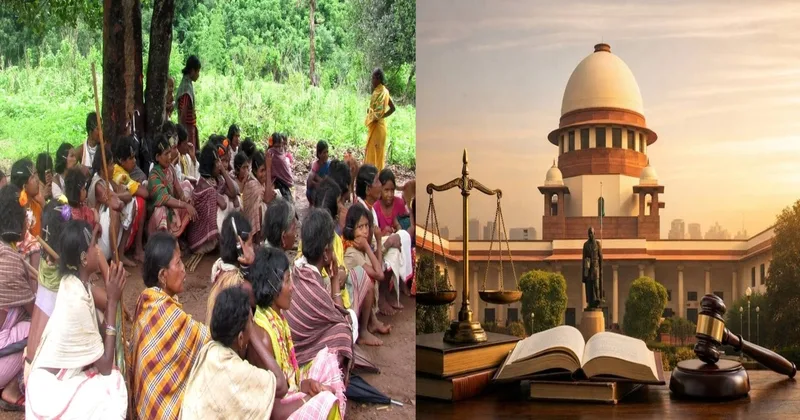
Two Supreme Court cases have put India’s constitutional safeguards for tribal land, representation and self-governance under renewed scrutiny
New Delhi: The Constitution of India assured multiple layers of protection to indigenous ethnic communities, the most important being the Fifth and Sixth Schedules, which safeguard tribal land, culture and self-governance. As is well known, the belief system and culture of tribal communities are inseparable from nature and the forest.
The Fifth and Sixth Schedules were carried into the Indian Constitution from British-era enactments such as the Scheduled Districts Act, 1874, and the Agency Tracts Interest and Land Transfer Act, 1917, which preceded the constitutional provisions and were themselves a response to decades of exploitation of tribal communities by moneylenders, traders and economically dominant settlers. The entire purpose of the Schedules connected to tribes is, first, to protect tribal culture, traditions and practices while preserving the ecosystem and tribal land, since tribal communities are worshippers of nature; and second, to protect tribes from exploitation of their backwardness, lack of exposure and forthright character. A further objective is to nurture tribal leadership for governance within the democratic political system, so that tribal communities remain active participants in their own governance.
Autonomous Councils under the Sixth Schedule, and the Panchayats (Extension to Scheduled Areas) Act, 1996 (PESA), exist to protect tribal culture, customary traditions, values and knowledge systems, and to strengthen tribal leadership. It is well settled that many general laws do not apply to Scheduled Areas — a deliberate emphasis reflecting the special care the Constitution extends to tribes under Articles 244, 46 and the Fifth Schedule. This constitutional architecture was never intended to be a static grant; it was designed as a continuing shield against the well-documented historical pattern of land alienation, indebtedness and political marginalisation of Scheduled Tribes.
Two recent matters before the Supreme Court appear to be a coordinated attack on these protections. The first case is challenging the Andhra Pradesh Scheduled Areas Land Transfer Regulation, 1959, as amended by Regulation 1 of 1970, which is popularly known as the 1/70 Act. It prohibits the transfer of immovable property/land from tribal people to non-tribal persons, or even between non-tribals, in designated Scheduled Areas. Similar law replicated in some form across six other Scheduled States, on the ground that it alters the demography of Scheduled Areas. The Act 1/70 states that
Agency tracts any transfer of immovable property situated in the Agency tracts by a person Whether or not such person is a member of a Scheduled Tribe, shall be absolutely null and void, unless such transfer is made in favour of a person, who is a member of a Scheduled Tribe or a society registered or deemed to be registered under the Andhra Pradesh Co-operative Societies Act, 1964 (Act7 of 1964) which is composed solely of members of the Scheduled Tribes.
The similar provisions in other states are
The petitioners, led by Sureddy Ramana Reddy (SLP(C) No. 1580 of 2023) and Yerramsetty Satyanarayana together with over 1,600 similarly placed non-tribal residents, argue that the 2011 Census shows non-tribals now form a majority in several villages and mandal headquarters, and that the blanket prohibition on land transfers violates Articles 14, 19, 21 and 300-A of the Constitution.
The second matter is filed by the Non-Tribal Welfare Society before the Supreme Court, challenging the reservation of the Sarpanch’s post in Scheduled Areas of Telangana under Section 4(g) of the PESA Act .
Section 4(g) of the Panchayats (Extension to Scheduled Areas) Act, 1996 (PESA) mandates that in all Scheduled Areas, the office of the Chairperson at every level of the Panchayat—village, intermediate, and district—shall be reserved exclusively for members of the Scheduled Tribes. This provision ensures that tribal communities exercise leadership and decision‑making authority in their own regions, thereby safeguarding their constitutional rights, cultural identity, and control over local governance.
This law is applicable to all the scheduled states where the PESA Act is implemented. The non tribal welfare Society argues that the rising non-tribal population no longer justifies reserving such posts for tribals. Read together, the pattern is unmistakable: one petition seeks to open tribal land to non-tribal transfer, changing the demography of Scheduled Areas; the other seeks to remove tribal political leadership once that demography has shifted. Neither challenge can be assessed in isolation from the other, because the demographic argument used to attack land protection is the very argument then redeployed to attack political reservation.
Both arguments raised by the petitioners have already been settled by the Supreme Court. In P. Rami Reddy (1988), the Court upheld the ban on land transfers to non‑tribals under Regulation I of 1970, noting that the earlier 1959 law failed because non‑tribals often used fake names or secret deals to exploit tribals. The Court made it clear that unless new non‑tribal settlers are stopped from entering Scheduled Areas, exploitation will continue. Later, in Samatha (1997), the Court went further, stressing that land for tribal communities is not just property; it is their livelihood, identity, and home. The petitioners’ reliance on Chebrolu Leela Prasad Rao (2021) is misplaced, because that case dealt with teacher reservations, not land laws. It never questioned Regulation I of 1970 or the Governor’s special powers under the Fifth Schedule.
The distinction between tribals and non‑tribals is not arbitrary; it is directly supported by the Constitution (Articles 46, 244, and the Fifth Schedule) to prevent tribal land alienation. Nor does the Regulation violate property or fundamental rights, since non‑tribals can still sell land to tribals or surrender it to the government for compensation. In short, the law is a reasonable safeguard for a vulnerable community, not an unfair restriction.
The same constitutional logic also protects PESA’s rule under Section 4(g), which reserves all Panchayat chairperson positions in Scheduled Areas for Scheduled Tribes. Demographic changes caused by bypassing land‑transfer safeguards cannot then be used as an excuse to dismantle those very safeguards, including political reservation for tribal leadership, that the Fifth Schedule and PESA were created to guarantee. Allowing such an argument would reward the very mischief the law was meant to prevent, letting decades of illegal land alienation become the basis for removing tribal self‑governance. This provision has already been challenged before the Supreme Court in a different form, and the Court upheld the constitutional validity of 4(g) in Union of India v. Rakesh Kumar (2010).
In conclusion, both petitions, though presented separately as property and electoral disputes, are part of a larger challenge to the constitutional protections guaranteed to Scheduled Tribes. This trend risks spreading to other Scheduled States, where at least five similar laws are in force. The historical record, from the Agency Tracts Act of 1917 through Regulations of 1959, 1970, 1971, and 1978, along with Supreme Court rulings in P. Rami Reddy and Samatha, shows that these safeguards were built over decades of hard lessons about the persistence of tribal exploitation. It is therefore vital that the courts, the Ministry of Tribal Affairs, and the State Governments of Andhra Pradesh and Telangana resist any weakening of these protections. They must defend both the constitutional validity of Regulation I of 1970 and Section 4(g) of PESA with equal strength. The real issue before the Supreme Court is not the inconvenience of a few non‑tribal landholders or political aspirants, but the continuing vitality of the constitutional promise embodied in the Fifth Schedule.

