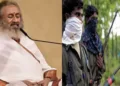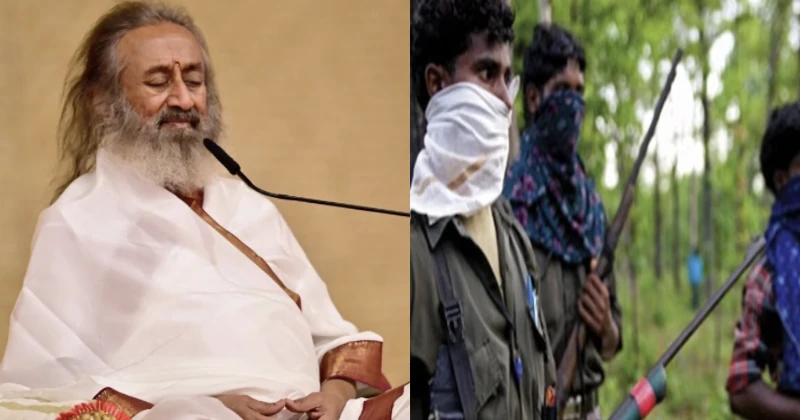
Bengaluru: More than 100 former Naxals recently arrived at the Art of Living International Centre in Bengaluru to embark on a spiritual journey. Gurudev Sri Sri Ravi Shankar shared the moment on X, posting video of the group interacting with him at the ashram, listening intently as he spoke and moving through the campus with quiet purpose.
More than 100 former Naxals visited the Bengaluru Ashram to embark on a spiritual journey. pic.twitter.com/EJOOB7kJ8H
— Gurudev Sri Sri Ravi Shankar (@Gurudev) September 6, 2026
“More than 100 former Naxals visited the Bengaluru Ashram to embark on a spiritual journey,” Gurudev posted.
The visit is one more chapter in a long story of transformation. It also arrives at a historic national turning point: the near-complete dismantling of Left-Wing Extremism under the Modi government.
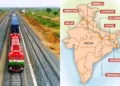
What was once called the Red Corridor, spanning nearly 180–200 districts at its peak, has been reduced to zero officially classified LWE-affected districts by March–April 2026.
The Cost of Ideology and the Politics of Neglect
For decades, Maoist ideology preyed on tribal and rural youth, selling them a false promise of social justice while delivering only violence, fear, and ruined lives.
Many who took up arms were misled by Leftist ideologues and urban intellectuals who romanticised “revolution” from the safety of cities.
These ideologues never faced the landmines, the forced recruitment, the summary executions of villagers, or the destruction of schools, roads, and livelihoods that Naxal groups systematically inflicted.
Entire communities lived under parallel “janatana sarkars” that extracted taxes, conscripted children, and silenced dissent. The human cost was enormous: thousands of civilians and security personnel killed, development frozen, and normal social life shattered across vast tracts of central and eastern India.
Critics note that many of those now surrendering did so after years of bloodshed, often late in life when the personal costs of continued violence became unbearable and government rehabilitation packages offered financial and social security.
The damage they caused cannot be wished away. Yet the path out of that violence has been made possible by a clear-eyed state response rather than ideological excuses.
Under the Congress-led UPA years, Naxalism was frequently treated as an inevitable socio-economic problem rather than a security and ideological challenge.
Violence peaked around 2010 with 1,936–2,213 incidents and more than 1,000 deaths in a single year. The Red Corridor was allowed to fester.
Governance remained weak in remote areas, and the political will for decisive territorial control was lacking. Leftist narratives that portrayed Maoists as romantic rebels further muddied the waters and prolonged the suffering of ordinary citizens.
Decisive Turn Under the Modi Government
That approach changed after 2014. Prime Minister Narendra Modi’s government combined relentless security operations with rapid infrastructure expansion and a structured rehabilitation policy.
Violent incidents fell 81–88 per cent. Civilian and security force deaths dropped 85–90 per cent. More than 10,000 Maoists have laid down arms in the past decade, with over 2,300 in 2025 alone.
Thousands of kilometres of roads, nearly 9,000 mobile towers, hundreds of fortified police stations and forward camps, and improved governance finally brought the state into areas long abandoned.
Top Maoist leadership was neutralised or forced to surrender. By the government’s March 2026 deadline, India was effectively declared free of the Naxal threat that successive earlier regimes had failed to end.
Surrendered cadres receive financial grants, monthly stipends, vocational training, housing support, and pathways into legitimate livelihoods.
The state’s message has been unambiguous: those who abandon violence will be brought into the mainstream; those who persist will face the full force of the law.
In Maharashtra, the battle against Naxalism has reached a decisive close under Chief Minister Devendra Fadnavis. Gadchiroli and Gondia, the state’s last two Left-Wing Extremism-affected districts, were reclassified by the Union Home Ministry in early 2026 as “legacy and thrust” districts, effectively shedding the active Red Corridor tag ahead of the national March 31 deadline.
North Gadchiroli had already been declared free of Maoist activity, and a wave of surrenders, including the high-profile October 2025 surrender of senior Maoist politburo member Mallojula Venugopal Rao alias Bhupati (Sonu) along with 60 other cadres in the presence of CM Fadnavis, broke the organisational backbone of the movement.
By late March 2026 only a handful of cadres remained active, mostly along the inter-state border.
https://twitter.com/Dev_Fadnavis/status/1978467338048643334
Posting on X after the landmark surrender, Fadnavis declared: “A New Chapter for India and Maharashtra Begins! … The battle against Naxalism is almost over, and we are determined to finish it by 2026.”
He has repeatedly emphasised that the twin strategy of targeted security operations and rapid development has brought lasting peace to what was once one of the most troubled pockets of the Red Corridor.
Gurudev Sri Sri Ravi Shankar too lauded the Modi-Shah governance for its success in neutralising the corrosive philosophy of Naxalism that created enemies of state out of India’s own children.
In October 2025, Gurudev posted his thoughts on the social media platform X, formerly Twitter. “It is heartening to see 210 Naxalites lay down their arms – a step long overdue… Congratulations to @PMOIndia and Hon’ble @AmitShah for this commendable achievement,” he wrote.
It is heartening to see 210 Naxalites lay down their arms – a step long overdue. The efforts of the Hon’ble Home Minister @AmitShah and @PMOIndia have paved the way for greater peace and prosperity. Congratulations to @PMOIndia and Hon’ble @AmitShah for this commendable…
— Gurudev Sri Sri Ravi Shankar (@Gurudev) October 17, 2025
Sri Sri Ravi Shankar’s Parallel Work of Inner Transformation
Alongside the state’s efforts, Sri Sri Ravi Shankar and the Art of Living have offered a complementary spiritual route. For years he has appealed directly to those still in the jungles.
In 2017 he told Chhattisgarh legislators: “They (Maoists) are not doing mauj-masti in the jungles. They have questions about social justice on their minds… I ask them to leave the bullet and come to the ballot. Bandook chhorr ke, kalam le ke aa jao, baat le ke aa jao. Come to the Indian mainstream.”
In Jharkhand the same year he said: “If you are fighting for social justice and development of poor people, shun the bullet and adopt the ballot.” In March 2025 in Raipur he declared: “The youth in Naxal-affected areas are my very own. They carry pain in their hearts… When you join the mainstream, we will stand by you.”
His core teaching remains simple and consistent: “Inside every culprit is a victim crying for help. When the victim is healed, the culprit disappears.”
He has long maintained that meditation and Sudarshan Kriya “have transformed the aggression and violence inside people into compassion, love and care,” and that the organisation’s mission is “to work with fundamentalists and extremists to transform them into loving human beings” through care, patience, and spiritual practice.
Residential programmes at the Bengaluru ashram, combining yoga, breathing techniques, behavioural sessions, and vocational skills, have hosted groups of former ULFA cadres, Manipuri militants, and Naxals. Similar trauma-relief and rehabilitation work has been conducted in prisons across India and in conflict zones worldwide.
From India’s Forests to Colombia’s Jungles
The same approach travelled to South America. In 2015, at a critical juncture in Colombia’s 52-year civil war with the FARC guerrillas, Latin America’s longest-running communist insurgency, Gurudev Sri Sri Ravi Shankar met FARC leaders in Havana.
He acknowledged their stated concerns for social justice while insisting that violence was the wrong path. He urged them to adopt Gandhian non-violence. Shortly afterwards FARC announced a unilateral ceasefire. Remember, these hardened guerrillas were not captive audiences whom Gurudev Sri Sri Ravi Shankar could easily approach and lecture to. It takes a certain spiritual depth and power to be able to stand up to men and women who have been responsible for the deaths of hundreds of thousands of lives and displaced millions over the long period of terrorism and insurgency that accompanies illegal drug trade through those perilous jungle. Gurudev Sri Sri Ravi Shankar pulled off the near impossible with the signing of the historic 2016 peace agreement that followed. Colombian President Juan Manuel Santos publicly recognised the contribution, and Sri Sri received the country’s highest civilian honour.
Former communist fighters who had waged war for decades ultimately chose the path of dialogue and reintegration, another instance of armed ideologues surrendering not only to the state but, in part, to a spiritual message of inner peace.
The Blend of Quiet Diplomacy, Compassion, and Dharma
Art of Living’s prison programmes have reached hundreds of thousands of inmates across more than 65 countries. Trauma-relief work has been carried out in Iraq, Kosovo, Sri Lanka, and elsewhere.
The method is the same: address the stress, anger, and sense of victimhood that fuel violence, then equip people with practical tools for a constructive life.
The recent arrival of more than 100 former Naxals at the Bengaluru ashram is therefore neither isolated nor surprising.
It reflects both the Modi government’s hard-won success in ending the territorial and organisational power of Naxalism and the parallel spiritual work that helps individuals move from a life of destruction toward one of purpose.
The ideology that once lured them into the jungles has been decisively defeated. The task now is to ensure that the peace which replaces it is lasting, and that those who return to the mainstream do so with genuine accountability for the harm caused and a genuine commitment to rebuilding the society they once sought to tear apart.