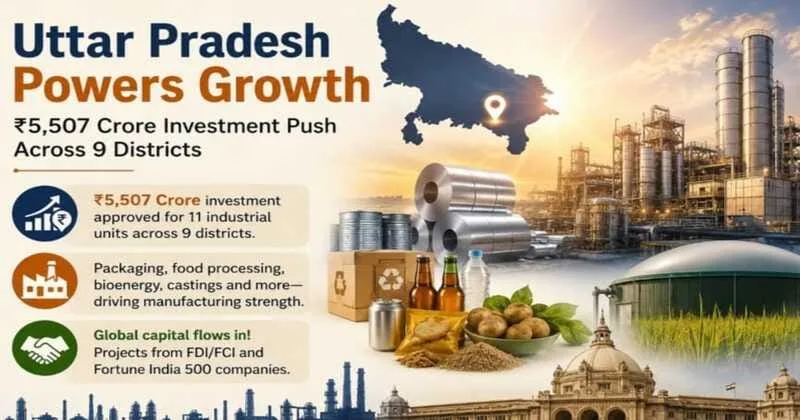
Lucknow: Two separate agenda items, two separate policies, one combined signal. Uttar Pradesh Cabinet meeting in Lucknow on 25 August under Chief Minister Yogi Adityanath has approved Letters of Comfort for eight industrial units under the UP Industrial Investment and Employment Promotion Policy 2022 and for three more under the Foreign Direct Investment, Foreign Capital Investment, Fortune Global 500 and Fortune India 500 Investment Promotion Policy 2023. The two decisions cover Rs 5,507.01 crore of proposed private investment Rs 2,900.97 crore under the 2022 policy and Rs 2,606.04 crore under the 2023 one.
The single investment of Rs 5507 crore reframing packaging industry
The biggest individual commitment on the list does not come from either the National Capital Region or from a household Indian name. It comes from Canpack India Pvt Ltd, which has proposed Rs 1,573.62 crore in Unnao under the FDI/FCI category. That single project accounts for more than a quarter of everything cleared on the day, and it is nearly two and a half times larger than the biggest project approved under the 2022 policy.
In the same foreign-capital category, sits Agristo Masa Pvt Ltd with Rs 794.27 crore in Bijnor. The third unit under the 2023 policy, Supreme Industries Ltd in Kanpur Dehat at Rs 238.15 crore, was cleared under the Fortune India 500 head, a domestic listed major rather than a foreign entrant.
Of the eleven units, only three came through the 2023 policy route, yet those three account for 47 per cent of the total investment value. The policy designed specifically to court foreign capital and Fortune-listed firms is delivering fewer but substantially heavier projects, while the 2022 policy is producing a broader spread of mid-sized manufacturing units in the Rs 225–605 crore band.
Packaging is quietly becoming a UP cluster
Canpack India in Unnao, Surya Global Flexi Films in Gautam Buddh Nagar at Rs 605.37 crore, and Paswara Papers in Hathras at Rs 315 crore together represent close to Rs 2,494 crore of packaging and packaging-material investment. That is 45 per cent of the day’s total sitting in a single value chain. It is also a chain that feeds directly into the second-largest sector on the list.
Food, drink and the farm behind them
Five of the eleven units are in food and beverage. Mount Everest Breweries in Unnao (Rs 363.52 crore), CRD Foods and Beverages in Mathura (Rs 363.94 crore) and Vrindavan Bottlers in Barabanki (Rs 436.12 crore) are on the drink side. Agristo Masa in Bijnor is on the food-processing side, and Zuari Envien Bioenergy in Lakhimpur Kheri at Rs 294.72 crore turns agricultural feedstock into energy. The food, beverage and agri-energy come to roughly Rs 2,252 crore, which is 41 per cent of the total.
Put the packaging cluster and the beverage cluster on the same map and the logic starts to look deliberate rather than coincidental. Beverage plants need cans, preforms and cartons. A can-making plant needs beverage plants within economical trucking distance. Canpack in Unnao sits in the same district as Mount Everest Breweries and within a few hours of Barabanki and Mathura.
The agriculture linkage runs deeper than jobs
Two of these projects should interest anyone writing about farm incomes rather than industrial output. Agristo Masa’s Rs 794.27 crore plant lands in Bijnor, in the western UP belt where potato and sugarcane dominate the cropping pattern. Processing capacity of that scale implies contracted procurement, specified varieties, cold-chain investment and a buyer who needs a predictable supply of a particular grade of produce. For a farmer, that is a different economic proposition from selling into a mandi.
Zuari Envien Bioenergy in Lakhimpur Kheri sits in the heart of UP’s sugarcane country, in a district that has long had more cane than its mills can crush on time. A bioenergy unit gives that biomass a second buyer. Neither project is being sold primarily as an agricultural intervention. Both are, in practice, exactly that.
Two units sit entirely outside the packaging-and-beverage story. Sound Castings Pvt Ltd is putting Rs 225 crore into Hathras, and Shalvis Specialities Ltd Rs 297.30 crore into Hamirpur. They are the smallest and third-smallest projects on the list, only two in metals and speciality industrial materials.
They also happen to be the two most employment-dense categories on the list in relative terms. Foundry and speciality chemical operations run on shift labour and skilled trades with moulders, machinists, quality technicians, and plant operators in a way that a highly automated can-making line does not. That distinction is one the state’s own promotion policies are named for investment and employment promotion. The two do not always track each other.
Nine districts of Uttar Pradesh share the eleven units, and the distribution says something about how the state’s industrial geography is shifting. Unnao is the clear winner, taking Canpack and Mount Everest Breweries for a combined Rs 1,937.14 crore, 35 per cent of the day’s total in one district. Hathras is the only other district to take two units, Paswara Papers and Sound Castings, for Rs 540 crore. The rest are single-unit districts: Gautam Buddh Nagar, Bijnor, Mathura, Barabanki, Lakhimpur Kheri, Kanpur Dehat and Hamirpur.
Geographically, western and central UP dominate. Gautam Buddh Nagar, Bijnor, Hathras and Mathura are all west; Unnao, Barabanki, Kanpur Dehat and Lakhimpur Kheri form a central and terai band around the Lucknow–Kanpur axis. Purvanchal, the eastern districts, does not appear on this list at all.
Bundelkhand appears once. Shalvis Specialities Ltd is proposing Rs 297.30 crore in Hamirpur, and in a region where private manufacturing announcements have historically been rare, a single Mega-category unit carries symbolic weight well beyond its rupee value. It arrives in the same Cabinet meeting that cleared the Rs 7,968 crore Jhansi Link Expressway connecting the Bundelkhand Expressway to NH-44 via the Defence Corridor node at Garautha, with infrastructure and industry moving in the same direction on the same day.
Two kinds of incentive and the choice between them
The eight units under the 2022 policy did not all get the same thing, and the split is one of the more technical but genuinely interesting details in the decision. Four units Shalvis Specialities in Hamirpur, Sound Castings in Hathras, Zuari Envien in Lakhimpur Kheri and Mount Everest Breweries in Unnao have been proposed for capital subsidy. Four others, Surya Global Flexi Films in Gautam Buddh Nagar, Vrindavan Bottlers in Barabanki, Paswara Papers in Hathras and CRD Foods and Beverages in Mathura have been proposed for reimbursement of net SGST.
The distinction matters. A capital subsidy is front-loaded support against the cost of plant and machinery, useful to a unit whose challenge is raising the money to build. Net SGST reimbursement is back-loaded, paid out of the tax the unit itself generates once it is selling, and it rewards volume and turnover.
Surya Global Flexi Films is the only unit in the Super Mega category, the highest band on the list, and it has been offered net SGST support, a structure that pays out only as the plant runs.
How a proposal becomes a Cabinet decision
Paragraph 12 of the 2022 policy is the provision that allows exemptions, grants and financial facilities to industrial units. The implementation architecture was fixed later, by a government letter dated 14 April 2023, whose paragraphs 4 and 5 lay out the application process for a Letter of Comfort and for sanction of incentives.
An Evaluation Committee chaired by the Chief Executive Officer of Invest UP, the nodal agency, screens applications first. For Mega-category units and above, the file then goes to a High Level Empowered Committee chaired by the Chief Secretary. The final recommendations of that committee come to the Cabinet for approval.
The 2023 policy runs a parallel track through an Empowered Committee, which met twice on 19 December 2025 and again on 7 February 2026 to recommend the three Letters of Comfort now cleared. This means the Canpack and Agristo Masa files have been moving through the system for the better part of a year before reaching the Cabinet table. For an investor, that timeline is itself information.
A Letter of Comfort is the state-written assurance that a proposed project, if built as described, will qualify for the incentives indicated. It converts a policy promise into a project-specific document that a company can take to its board and its bankers. The construction, the hiring and the eventual disbursal all lie ahead. What the Cabinet approved on 25 August was the state side of the bargain eleven times over, across nine districts in a single sitting.