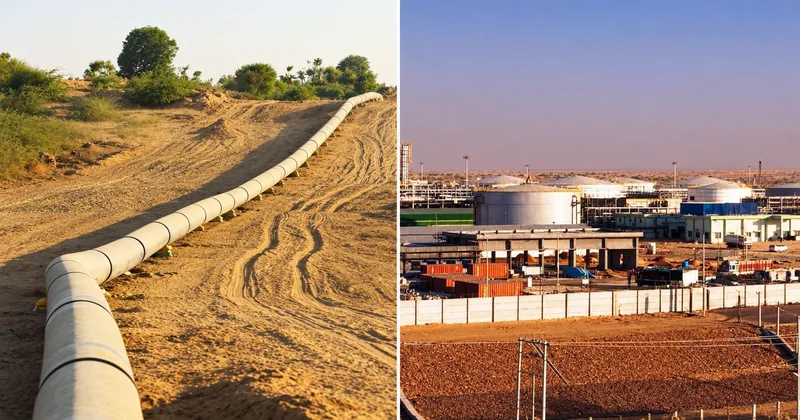
The oil fields of Rajasthan
India’s energy security push is gaining fresh momentum in the Thar Desert, as Rajasthan prepares to significantly raise crude oil production from the current 51,000–52,000 barrels per day to 80,000 barrels per day. The aim is to accelerate oil production with the aid of advanced oil recovery technologies and expanding refining infrastructure. The intention is to build a more integrated domestic energy ecosystem, thereby seal country’s energy security amid supply chain shocks & global energy conundrum.
The decision to enhance oil production in Rajasthan is considered as a vital economic & energy decision, which will render India a strategic edge & advantage in the global energy market, in an era when oil is increasingly weaponised for geopolitical ambitions. Enhanced crude oil production will not just consolidate domestic energy security & insulate the country from global oil shocks, but also will harness New Delhi’s footprint in the global supply chain as a credible player, as it enhances India’s potential to export.
Most importantly, India’s enhanced oil production will reduce import dependency and thereby secure country’s forex reserves. Hence, decision to extract more oil in Rajasthan has multi-faceted merit in terms of energy & economic security and a strategic advantage in the global energy market & geopolitical chessboard.
Beneath Rajasthan’s arid landscape lies one of India’s increasingly important domestic hydrocarbon zones. The Mangala, Bhagyam and Aishwariya oil fields have emerged as major contributors to the country’s crude production, particularly from the Barmer region.
However, as these fields mature, extracting additional crude through conventional methods is becoming increasingly challenging. Rajasthan is therefore preparing to deploy advanced recovery techniques designed to unlock oil that remains trapped in mature and highly viscous reservoirs.
Additional Chief Secretary (Mines and Petroleum) Aparna Arora said that Rajasthan would increase its crude oil production to 80,000 barrels per day in a phased manner, with the state relying on the latest extraction technologies. The strategy marks a shift from simply expanding exploration to maximising recovery from existing producing assets.
Two key enhanced oil recovery techniques will form the backbone of Rajasthan’s production expansion.
This will be deployed in the Barmer-Sanchore and Jaisalmer basins. ASP flooding improves the ability to mobilise and recover oil that remains trapped in underground formations after conventional extraction.
This will be used in the Bikaner-Nagaur basin. The thermal recovery method is particularly relevant for reservoirs containing heavy and highly viscous crude, where heat can make the oil easier to mobilise and extract.
The state plans to introduce these interventions progressively. Technical audits and reservoir modelling are expected to precede large-scale deployment, helping operators determine where the technologies can deliver the strongest production gains.
Rajasthan currently has 12 petroleum mining leases and 12 petroleum exploration licences active in the sector. Companies including Cairn Vedanta, Oil India Limited, ONGC and Focus Energy are involved in crude oil and natural gas exploration and production activities across the state.
The production push is not being pursued in isolation. Rajasthan is also looking to strengthen the downstream side of its energy industry, particularly through the HPCL Rajasthan Refinery Limited (HRRL) project.
The refinery is planned with a capacity of approximately 9 million tonnes per annum (MMTPA). Importantly, the Rajasthan government wants a larger share of the crude produced within the state to be processed locally.
According to officials, the refinery will be capable of processing around 1.5 million tonnes of crude produced within Rajasthan. Additional Secretary Arora stressed the need to prioritise state-produced crude for local refining. The objective is to create greater integration between Rajasthan’s upstream oil fields and downstream refining infrastructure.
Such integration could reduce the need to transport crude across state borders before processing, while allowing Rajasthan to capture more value from its own hydrocarbon resources. Pipeline connectivity and storage infrastructure will consequently become increasingly important as production rises. Reliable transportation and adequate storage capacity can help stabilise refinery feedstock and ensure that additional crude production translates into sustained downstream utilisation. Thus, Rajasthan aims to carve an integrated energy unit, beyond mere extraction & production of oil.
Rajasthan’s energy ambitions extend beyond crude oil. The state currently produces around 2.6–2.8 million metric standard cubic metres of natural gas per day and ranks second nationally in onshore natural gas production.
Alongside upstream production, the government is expanding the City Gas Distribution (CGD) network to bring cleaner-burning natural gas closer to households, businesses and transport users. A target of 60 new CNG stations has been set for the current financial year. Of these, 23 stations are already operational, while the remaining 37 are expected to be brought online by December 2026.
Authorities have directed officials and gas distribution companies to accelerate work to meet the target. The expansion of Domestic Piped Natural Gas (DPNG) connections is another priority, particularly in multi-storey residential buildings where a larger number of consumers can be connected through common distribution networks.
The significance of Rajasthan’s production strategy extends well beyond the state. India remains heavily dependent on imported crude oil to meet its enormous energy requirements. Consequently, every additional barrel produced domestically can provide a modest but strategically important buffer against external supply disruptions.
Global oil markets are highly sensitive to geopolitical conflicts, shipping disruptions, sanctions and sudden changes in supply. For an energy-importing economy, such volatility can translate into higher import bills, inflationary pressures and increased risks to economic stability.
Raising Rajasthan’s production from roughly 51,000–52,000 barrels per day to 80,000 barrels per day will reduce India’s dependence on imported crude. It can strengthen domestic supply and diversify the country’s energy base.
In this direction, Rajasthan is attempting to combine enhanced oil recovery, new exploration, domestic refining, natural-gas production, CNG infrastructure and piped-gas connectivity into a more integrated energy ecosystem. The Thar Desert, long associated with extreme heat and vast stretches of arid terrain, is consequently emerging as an increasingly important part of India’s domestic energy circuit and as a cushion against external shocks.
