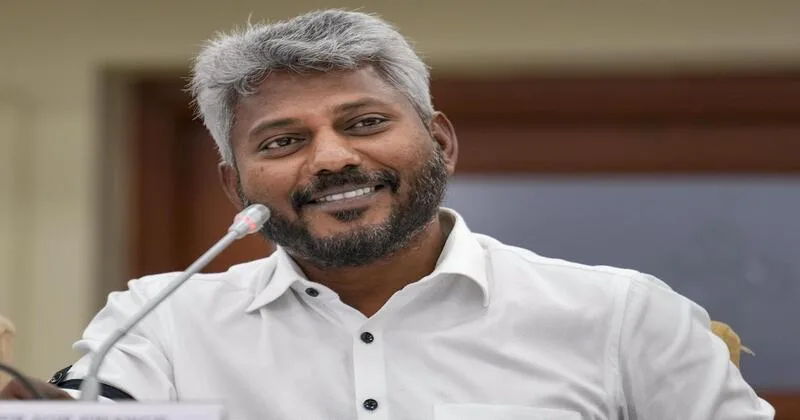
Tamil Nadu Finance Minister N. Marie Wilson, who has repeatedly foregrounded his Christian faith in public life, appeared before a Puducherry court on September 4 and received an additional charge-sheet in a 2022 assault case after the Madras High Court made it clear that ministerial office could not become a shield against ordinary court procedure.
For a Minister who has recently emerged as one of the most overtly evangelical voices in the Tamil Nadu Government, the development presents a simple constitutional lesson: before the law, neither a rosary nor a ministerial chair creates a special category of citizen.
Wilson had recently entered the Tamil Nadu Assembly to present the Budget carrying a rosary and made the sign of the Cross before beginning his speech. During a subsequent controversy over his Tamil, he publicly described himself as a “born Christian” and invoked the Bible while saying Christianity had taught him love, peace and compassion.
That profession now sits in uncomfortable contrast with the allegations before the criminal court. The very conduct alleged against Wilson – assault, intimidation and trespass within his own family – is the antithesis of the love, peace and compassion that he publicly claimed to have learnt from Christianity.
The case arose from a 2022 complaint by Careline Claude, Wilson’s sister-in-law. The prosecution case, as recorded by the Madras High Court, alleges that Wilson and his father entered her house, abused and assaulted her and her husband with a wooden log and criminally intimidated them following a family dispute concerning a minor child. Wilson contests the case, and the allegations remain to be proved at trial.
The litigation has already travelled repeatedly to the Madras High Court. Earlier this year, Wilson and his father challenged a Magistrate’s direction for further investigation after additional material was placed before the criminal court. In Marie Wilson v. State represented by the Station House Officer, Crl.R.C. No. 701 of 2026, Justice C. Kumarappan on March 24 refused to interfere.
The High Court held that the Magistrate was entitled to order further investigation on the basis of additional material and found no illegality or infirmity warranting interference. Wilson subsequently filed Crl.O.P. No. 18057 of 2026 seeking to quash C.C. No. 558 of 2022.
Mediation was attempted. When the complainant later informed the Court that she did not want to continue, Justice V. Lakshminarayanan rejected the contention that she could be compelled to mediate. Mediation, the Court held, depends upon voluntary participation; a person who initially agrees remains free to withdraw.
The proceedings then produced an even more pointed moment. When exemption from personal appearance was sought citing Wilson’s responsibilities as Finance Minister and the Assembly session, the High Court orally reminded his counsel that even P.V. Narasimha Rao had appeared before a court while serving as Prime Minister. The Judge cautioned against creating any impression that a Minister stood above the law.
Wilson ultimately agreed to appear. On September 4, he appeared before the Puducherry Judicial Magistrate and received the additional charge-sheet along with the pen drive containing material placed in the case. His father Nestor also appeared. The matter has been posted to September 9.
There is an irony which will not escape Tamil Nadu’s political spectators. Only weeks earlier, the evangelist Minister was publicly invoking the Bible’s lessons of love and compassion from the floor of the Assembly. Today, he stands accused in a case involving allegations of assault within his own family.
But a civilised legal system does not convict through irony. His Christianity neither proves nor disproves the allegations. His political position neither aggravates nor absolves them. Dharma, in the constitutional sense of equal justice, demands something simpler: the Minister must stand before the same court, receive the same charge-sheet and answer the same process of law as any other citizen and that is precisely why the Madras High Court’s intervention matters.