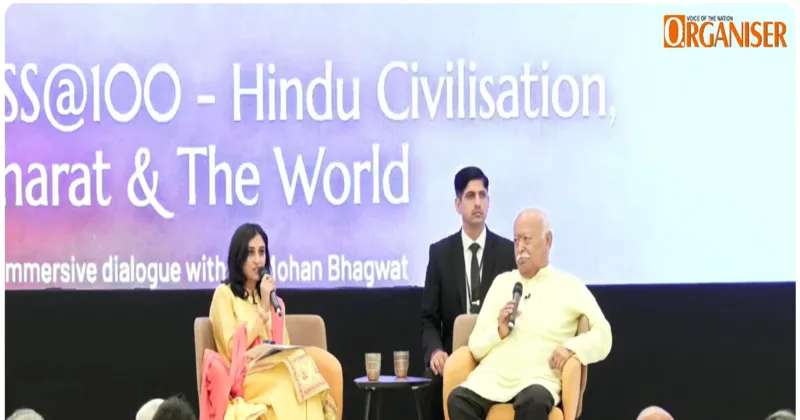
London: RSS Sarsanghchalak Dr Mohan Bhagwat said that the Hindu civilisational thought recognises diversity as the nature of existence while seeing unity as the underlying reality, and offers a framework for harmony, conflict resolution and the progress of individuals, society and nature.
Responding to a question on what Hindu civilisation brings to the world that is essential, particularly in the present turbulent times, Dr Bhagwat said that diversity is the nature of existence. He said Hindu thought accepts diversity while recognising that different forms are expressions of the underlying unity of existence. “One has become many, therefore there are perspectives,” he said, adding that people have to deal with diversity in practical life but should not consider different forms as separate. “We are one, all is one. On this basis, we deal with everything,” Dr Bhagwat said.
He said that this approach also provides a basis for managing conflicts. According to him, conflict can be managed more easily when people think in terms of a “win-win solution” rather than enmity or competition.
He explained that instead of thinking that one person should gain at the expense of another, people should consider what both sides need and work towards the progress of both.
Dr Bhagwat further said that humanity should not seek to conquer nature because human beings are themselves part of nature. Therefore, he said, human progress must contribute to the progress of nature. “Why should development and progress be at loggerheads? There should be complimentary,” he said, explaining that what is now described as “green solutions” seeks to provide solutions for human needs while also protecting nature.
He said the principle should not merely be “live and let live”, but to “let live and make others live”.
Dr Bhagwat said that Hindu thought provides a framework in which the individual, society, humanity and nature can progress together. He said modern thought processes often create a separation between individual rights and the interests of society. According to him, individual and society can instead progress together and contribute to each other’s progress.
He further said that humanity can progress alongside the protection of nature rather than through its destruction. “What is the connecting principle? That is the unity of existence,” he said, adding that Hindu thought uses different expressions for this underlying reality, including Brahma and Shunya.
Dr Bhagwat said that Hindu thought has firmly established this principle and translated it into practical life. “This we have to do. We have in us, we have translated into practical life and given this to the world. Once again, together we have to wake up and give these solutions,” he said.
Responding to a question on Hindu Rashtra and Hindutva, which he described as among the most discussed and least understood concepts, Dr Bhagwat said the basic message was: “Let’s live, let others live.”
He said that people have the ability to connect with others and enable them to live together.
Explaining the meaning of the word “Hindu”, Dr Bhagwat said it cannot be understood merely on the basis of a particular religious practice or lifestyle. He described Hindu as a nature of society that accepts and respects diversity because it holds that different paths can lead to the same goal.
He referred to the famous verse from the Shiv Mahima Stotra, saying that different tastes lead to different paths, but ultimately there is a single destination.
He said diversity is natural and there is no need to make society uniform. “Uniform is not necessary for unity. There is unity in diversity,” he said.
He further explained that diversity itself is diversity within an underlying unity. Therefore, when people recognise that unity, they can respect and accept diversity.
“That thought is Hindu thought. That kind of nature is Hindu nature. That has been history of Hindu society and Bharat,” Dr Bhagwat said.
He said that when the term Hindu is used in this context, it does not refer merely to a religion or a particular form of worship.
He noted that different schools of thought emerged from Bharatvarsha, ranging from atheism to polytheism, while maintaining an attitude that different people may follow different paths. “We need not convert each other. Only we are right, no. We are also right. You are also right. That attitude is Hindu,” he said.
He said this attitude cannot be restricted to a particular community, form of worship, food habits or lifestyle. According to Dr Bhagwat, a person can remain confident in and committed to his or her own path while recognising that another person’s path may also be right for them. “We can go together. We can work together. We can live together. And we should live together. That is the truth,” he said.
Explaining the concept of Rashtra, Dr Bhagwat said that the word “nation” should not be treated as a direct translation of Rashtra because the two represent different concepts.
He said a nation-state is formed when people come together on the basis of similarities such as language, a model of governance or religion and establish rules and institutions for their common good.
According to him, Rashtra is different because the state is not its primary component. “First there is a purpose,” he said.
Explaining the purpose of Hindu Rashtra, Dr Bhagwat said its objective was to share with the world the truth that diversity is natural and unity is the underlying reality.
He said this principle is beneficial for humanity because realisation of the Atman leads to lasting happiness and the experience of the unity of existence.
Dr Bhagwat said the Rishis of Bharat recognised this principle and believed that it should be shared with the world. He said this could not be the work of an individual or a small community, but required the creation and preparation of the entire nation for the larger task.
He referred to the Rishis as benevolent and well-meaning people who undertook rigorous penance and created the strength of the nation through their efforts.
He said that in the initial conception of Rashtra, a state was not necessary because society itself protected and supported its members. With changing circumstances, the state and the ruler became necessary.
Dr Bhagwat said that the people who shared a common purpose constituted society and, when connected with a particular land, became a Janapada. He said the land was an essential component, while other components could change over time.
“We were always there as a nation,” he said, explaining that Bharat had witnessed different forms of political organisation and governance.
He explained that the purpose of the Rashtra was to lead a life that could inspire people in other nations to find ways of fulfilling the purpose of their own societies.
He said the civilisational idea was that Bharat should live in such a manner that people from other nations could look to its experience and derive from it a way to lead their own lives while fulfilling the purpose of their respective nations. “That is what we mean by Rashtra,” Dr Bhagwat said.
He said by noting that because of the historical experience associated with nationalism, there is a degree of apprehension about the concept of nationhood in the world, but the civilisational concept of Rashtra should be understood in its own context.
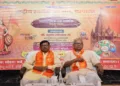
Notably, the dialogue was moderated by Mamata Subranhamnyam, a wellness expert based in the UK. The event, organised and initiated by the Hindu Swayamsevak Sangh (HSS), drew 600 people in the audience representing 326 organisations. Among important attendees during the event were Members of the House of Lords, MPs (Members of the House of Commons), Mayors, Councillors and the High Commissioner of Bharat to UK, Periasamy Kumaran, Deputy High Commissioner of Bharat to UK Kartik Pande and other leaders of community. The Programme began in silence, in memory of lives lost and families displaced by the Nepal floods. As it was informed during the event, Seva UK has raised 100,000 pounds through donations for relief efforts in Nepal.
During his visit to London, Dr Bhagwat met faith leaders, academics, researchers and other public figures. As part of his interfaith engagement, he visited Shree Swaminarayan Mandir in Willesden, Khalsa Jatha British Isles Gurdwara, and other religious places in London. More than 310 community organisations and associations from across the UK took part in the celebration. Notably, 11 Language communities in the UK, across sections of Hindu society, attended the event.