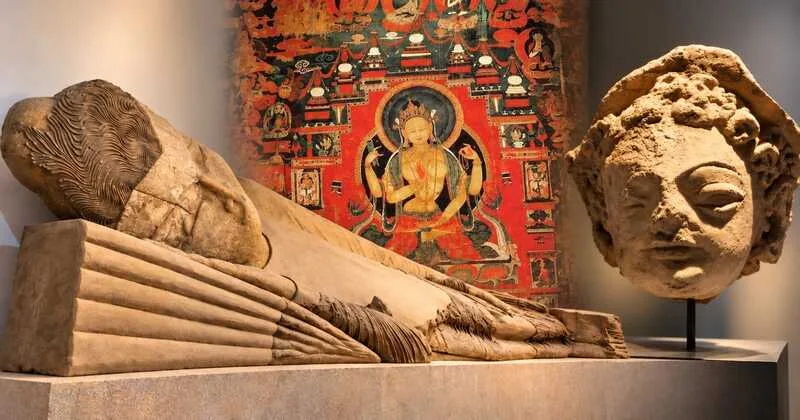
Ajina-Tepa in southern Tajikistan preserves the remarkable remains of a Buddhist monastery that once stood along the Silk Road. Its 12-metre reclining Buddha, now preserved in Dushanbe, offers a striking glimpse into the Hindu cultural links that connected Bharat with Central Asia more than a millennium ago.
In the Vakhsh Valley of southern Tajikistan, an earthen mound rises from a landscape that can appear almost timeless. At first glance, Ajina-Tepa may look like another archaeological ruin scattered across Central Asia. Yet beneath its weathered walls lies the memory of a seventh–eighth-century Buddhist monastery and one of the most extraordinary sculptures ever discovered along the ancient Silk Road.
The site near present-day Bokhtar measures approximately 100 by 50 metres. It contained two principal sections that a monastic quarter and a temple complex. Thick earthen walls, courtyards, stupas, corridors, sculptures and painted fragments reveal a substantial religious establishment rather than a small roadside shrine.
The monastery remains at Ajina-Tepa. The monumental Buddha itself is now displayed in the National Museum of Antiquities of Tajikistan in Dushanbe. Together, the archaeological site and the restored sculpture allow the vanished world of Ajina-Tepa to be encountered from two different places.
A monastery rising from the Vakhsh valley
Ajina-Tepa belongs principally to the seventh and eighth centuries CE, although its cultural story reaches further back to the Kushan age.
Between the first and third centuries CE, the Kushan Empire connected large parts of Central Asia with Bharat, encompassing regions such as Gandhara and Bactria within a wider network of political, commercial and Dharmic exchange. Under rulers such as Kanishka, Buddhist institutions received significant patronage and cultural exchanges intensified across these territories.
Centuries later, political conditions had changed, but the cultural routes remained active. Tokharistan became an important meeting ground of Central Asian and Bharatiya influences, and Ajina-Tepa emerged within this wider world.
Archaeological evidence suggests that the monastery flourished for roughly a century. Hundreds of coins discovered at the site include copper coins from northern Tokharistan and Sogdian coins that circulated during the second half of the seventh and first half of the eighth centuries.
Buddhism in Tajikistan:
One of the remarkable sites along the ancient Silk Route is the Buddhist cloister ruins of Ajina-Tepa in Tajikistan. These ancient ruins are regarded as the largest Buddhist site in Central Asia and serve as a testament to the region's Buddhist past.(1/4) pic.twitter.com/dBkuq1Ct5n
— Buddysattva (@artinchow) September 3, 2024
Its architecture reveals the scale of the establishment. The monastic section was organised around a square courtyard of about 19 metres on each side. The temple section contained religious chambers and a large central stupa. A stepped, star-shaped stupa measuring roughly 25 by 25 metres stood at the centre, accompanied by smaller votive stupas.
The complex was built largely from pakhsa, or rammed earth, and unfired mud bricks. Some walls were more than two metres thick. Within these walls monks lived, studied and worshipped, while pilgrims encountered an elaborate sacred environment. For generations, Ajina-Tepa was therefore a living centre of Dharma in the heart of Central Asia.
The twelve-metre Buddha of nirvana
The most extraordinary discovery came in the form of a colossal reclining Buddha approximately 12 metres long. The sculpture represented the Buddha entering Nirvana, or Parinirvana, and occupied an entire chamber.
Made from clay, the figure was originally painted. The Buddha reclined on his right side with his head supported by a cushion. His robe was carefully modelled, while traces of colour survived on the sculpture.
Archaeological descriptions record a red robe, white-painted hands, face and toes, and sandals with yellow soles and red straps. The scale is astonishing. The feet alone were almost two metres long. Although the head suffered considerable damage, important portions of the face and neck survived, allowing the extraordinary craftsmanship of the original figure to be appreciated.
One of the remarkable sites in the ancient Silk Route area is the Buddhist cloister ruins of Ajina-Tepa in #Tajikistan.This is a testament to the #Buddhist past of the region and is regarded as the largest such site in all of Central Asia. #Buddhism pic.twitter.com/55OsBN6uyv
— Buddysattva (@artinchow) August 12, 2021
The reclining Buddha did not stand alone. Ajina-Tepa yielded sculptures of Buddhas, Bodhisattvas and devas, together with monks, aristocratic figures and animals. Horses and birds formed part of this richly decorated sacred world.
The artistic character of Ajina-Tepa is especially significant. Its sculptures belong to the flourishing Tokharistan Buddhist school of the seventh and early eighth centuries. They reveal connections with Gandharan sculpture and Gupta traditions while incorporating strong local Central Asian characteristics.
Here, the cultural connection with Bharat becomes visible in stone, clay and artistic form. Buddhism was born in Bharat within the ancient Dharmic spiritual world of the subcontinent. As Buddhist thought travelled across the Silk Road, monks, pilgrims and scholars carried with them ideas of Dharma, meditation, compassion and liberation. Artistic traditions travelled alongside them.
Ajina-Tepa became a Central Asian expression of that wider Hindu-Dharmic heritage. Its artists did not simply reproduce distant models. They absorbed influences connected with Bharat and transformed them through the artistic traditions of Tokharistan.
The result was a distinctive cultural synthesis that could emerge only from a region where civilisations met.
When the monastery fell silent
The flourishing of Ajina-Tepa eventually came to an end. During the Muslim conquest of the region between about 737 and 750 CE, the monastery was destroyed and abandoned. During the later eighth century, parts of the ruins were reused as living quarters and workshops.
A place that had once echoed with religious activity gradually became a deserted mound. Its stupas collapsed, its sculptures were damaged and its monumental Buddha disappeared beneath centuries of earth and neglect.
Then archaeology reopened the buried chapter.
Between 1961 and 1975, intensive excavations were conducted by a joint Soviet-Tajik expedition involving the Institute of Oriental Studies of the Academy of Sciences of the USSR, the State Hermitage and the Academy of Sciences of the Tajik SSR. The expedition was headed by archaeologist Boris Litvinsky, with T. I. Zeimal as deputy.
The excavations revealed the monastery, its stupas, sculptures and paintings. Most remarkably, they brought the enormous reclining Buddha back into the historical record.
3/
Country: Tajikistan1) Mahaparinirvan
Period: 7-8th cen CE2)Photo from excavation site 1964, Buddhist Temple Ajina Tepa pic.twitter.com/I2ZxHIeIOJ
— Aman Ganvir (@aman_ganvir) May 13, 2025
The sculpture was later conserved and restored and is now displayed in Dushanbe. Meanwhile, conservation efforts have sought to protect the fragile earthen architecture remaining at Ajina-Tepa from erosion, salt and groundwater.
There is something deeply moving about this survival. The monastery disappeared. The political order surrounding it vanished. The religious landscape of the region changed. Yet the Buddha endured.
Today, Ajina-Tepa stands as a powerful reminder that the Silk Road was never merely a road for merchants and commodities. It was also a pathway for ideas, artistic traditions and sacred cultures. The caravans are gone. The monks who once walked through its courtyards are gone. The world that produced the monastery has disappeared. But the ruins remain in the Vakhsh Valley, and the 12-metre Buddha survives in Dushanbe.
Together, they preserve an extraordinary memory of the cultural journeys that carried the spiritual and artistic currents of Bharat into Central Asia and left behind one of the most remarkable monuments of the region’s Dharmic past.