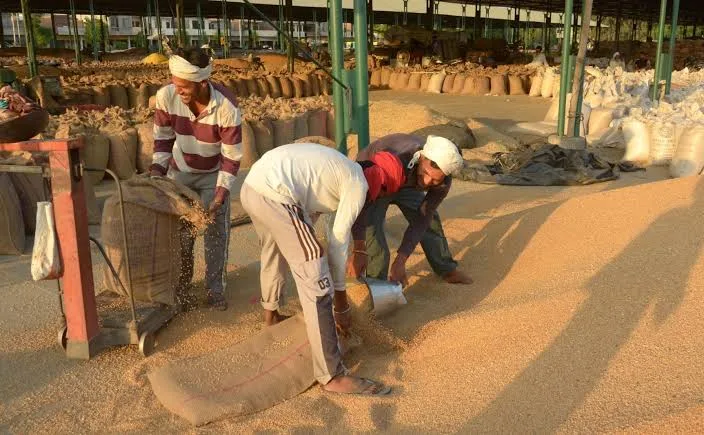
For a farmer, harvesting a crop is only one part of the agricultural cycle. What happens next can be just as important. If there is no affordable and reliable place to store the produce, a farmer may have little choice but to sell immediately, even when market prices are weak. A lack of nearby storage can also mean additional transportation costs, repeated handling and a greater risk of deterioration.
This is the problem that India’s Decentralised Grain Storage Plan in the Cooperative Sector is attempting to address by taking storage infrastructure closer to the villages where crops are actually produced.
Launched as a pilot on May 31, 2023, the initiative places Primary Agricultural Credit Societies, or PACS, at the centre of a wider rural infrastructure network. The idea is relatively straightforward: instead of depending entirely on large, centralised warehouses located away from farms, village-level cooperative institutions can also become places where farmers store their grain, access procurement services, get basic processing done and, in some cases, use machinery and other agricultural services.
The scale of the challenge is becoming more apparent as India’s agricultural production grows. According to the Third Advance Estimates for 2025-26, the country’s foodgrain production is estimated at 376.563 million tonnes, compared with 357.732 million tonnes the previous year. That is an increase of nearly 18.8 million tonnes, or about 5.3 per cent.
More grain means more food to feed the country, but it also means more grain that needs to be stored safely after harvest.
At the same time, India runs one of the world’s largest food security programmes under the National Food Security Act, 2013, covering around 80 crore people. Ensuring that foodgrain reaches this population is not simply a question of how much the country produces. It is also about how efficiently that grain can be procured, stored, transported and distributed.
That is where decentralised storage becomes important.
Why storage matters so much to farmers
The traditional image of agriculture often ends with the crop being harvested and sold. In reality, the period immediately after harvest can determine whether a farmer gets a reasonable return or is forced into a distress sale.
When farmers have access to safe storage, they gain some flexibility. They do not necessarily have to sell everything at once simply because the crop has been harvested. They can store their produce and wait for a more favourable price, subject to market conditions and their own financial needs.
That flexibility can make a meaningful difference.
Storage close to the farm also cuts down on the distance produce has to travel before reaching a warehouse or procurement centre. Lower transportation requirements can reduce costs and the amount of handling involved. It can also help minimise wastage, particularly when produce has to be moved several times before reaching its final destination.
The government has therefore been looking beyond the conventional model of large warehouses and centralised storage. The objective is to create capacity closer to production centres, while using existing cooperative institutions as the local foundation.
PACS are particularly relevant to this approach because they already operate at the village level and have an established relationship with rural borrowers and farmers. Traditionally, their role has largely been associated with providing short-term credit and related financial services. Under the broader cooperative development approach, the government is seeking to diversify their activities so that they can become more comprehensive agricultural service centres.
The grain storage initiative fits into that larger effort.
From a warehouse to a rural agricultural hub
The Decentralised Grain Storage Plan is not simply about constructing another set of godowns.
Its larger ambition is to bring several pieces of the agricultural supply chain together at the PACS level. A storage facility can be combined with procurement, primary processing, machinery rental and even local food distribution.
This is where the convergence of existing government schemes becomes important.
The Agriculture Infrastructure Fund, or AIF, provides financing and interest-subvention support for post-harvest infrastructure. The Agricultural Marketing Infrastructure scheme, or AMI, provides capital subsidy support for eligible storage facilities. The Sub Mission on Agricultural Mechanization, or SMAM, can support the creation of Custom Hiring Centres, allowing farmers to access agricultural machinery without necessarily having to purchase expensive equipment themselves.
The Pradhan Mantri Formalisation of Micro Food Processing Enterprises scheme, or PMFME, adds another layer by supporting the formalisation and growth of micro food-processing businesses.
Put together at the PACS level, these schemes can turn what would otherwise be a standalone warehouse into a broader rural service centre.
A farmer could potentially bring produce to the local procurement centre, have grain cleaned, sorted or dried at a primary processing unit, store it locally and access other agricultural services through the same cooperative institution.
The significance lies in bringing these services closer to the farmer rather than making farmers navigate multiple institutions and distant facilities.
What PACS can do under the new model
The proposed model gives PACS a much broader role in the agricultural economy.
One important component is the Custom Hiring Centre. Agricultural machinery can be expensive, particularly for small and marginal farmers who may not use a machine frequently enough to justify purchasing it. Through these centres, PACS can acquire equipment such as tractors, harvesters, tillers and other machinery and make them available to farmers on a rental basis.
The storage infrastructure itself can also serve multiple purposes. Grain can be stored after harvest while procurement centres can support the purchase of produce on behalf of State agencies and the Food Corporation of India.
Primary processing is another important part of the model. Cleaning, sorting and drying grain before storage can improve its quality and marketability while helping reduce the risk of spoilage.
Fair Price Shops can also be integrated into the broader infrastructure, providing a channel for the distribution of grain and the sale of processed food products within local communities.
The government has also provided for silo-based storage capacities of 50 metric tonnes, 100 metric tonnes and 200 metric tonnes under the cooperative storage model.
The objective is therefore not merely to increase the number of storage structures in the country. It is to create a network in which storage forms part of a wider agricultural ecosystem.
The numbers show the plan is moving beyond the pilot stage
When the initiative was launched in 2023, it began cautiously with pilot projects in 11 PACS spread across 11 states. These initial projects created 9,750 metric tonnes of storage capacity.
The pilot states included Maharashtra, Uttar Pradesh, Gujarat, Rajasthan, Madhya Pradesh, Uttarakhand, Tamil Nadu, Telangana, Assam, Karnataka and Tripura.
The pilot phase was important because a decentralised storage model has to work in very different agricultural and geographical conditions. What works in a soybean-growing region of Maharashtra may need to be adapted for a different crop and climate elsewhere.
By July 2026, the initiative had moved considerably beyond those initial experiments.
According to the government, 1,012 PACS or cooperative societies had been identified under the plan. Construction of godowns had been completed in 313 PACS, creating more than 1.80 lakh metric tonnes (1.80 LMT) of storage capacity.
The figures mark a significant expansion from the original 11-PACS pilot and indicate that the programme has entered a broader implementation phase.
The real test, however, will not only be the number of warehouses constructed. It will be how effectively these facilities are used, whether farmers can access them at reasonable costs, whether procurement services function efficiently and whether the cooperatives themselves can operate the infrastructure sustainably.
Nerpingali shows what the model can look like on the ground
One of the clearest examples of how the model can work comes from Nerpingalai PACS in Amravati, Maharashtra.
The cooperative has constructed a 3,000-metric-tonne warehouse under the Decentralised Grain Storage Plan, with support from the Agricultural Marketing Infrastructure and Agriculture Infrastructure Fund schemes.
The project also benefited from refinance support from NABARD, bringing the effective loan interest rate down to 1 per cent under the financing structure.
The warehouse is already being used by farmers. Around 300 farmers are storing nearly 32,000 bags of soybeans there.
The significance of the project becomes clearer when looking beyond the warehouse itself.
The cooperative has provided advances of around Rs 4.50 crore against the stored produce. For farmers, this can provide access to liquidity without immediately having to sell their crop simply because they need cash after harvest.
That is particularly relevant in agriculture, where expenses do not stop after harvesting. Farmers may need money for the next crop cycle, household requirements, labour payments, farm inputs or other immediate obligations.
Having the ability to store produce and raise funds against it can therefore offer farmers an alternative to selling immediately when prices are not attractive.
For the cooperative, the warehouse can also become a source of revenue. The project is expected to generate approximately Rs 7.68 lakh annually in rental income and nearly Rs 54 lakh in annual interest income, according to the information provided by the Ministry of Cooperation.
The project has also created local employment opportunities, demonstrating how agricultural infrastructure can generate economic activity beyond its primary purpose.
Nerpingali is therefore more than an example of a warehouse being built. It illustrates the larger proposition behind the plan: a cooperative can own or operate infrastructure, farmers can use it to manage their produce, and the institution itself can develop a sustainable income stream.
Making the projects financially viable
Building storage infrastructure requires substantial investment, and this has historically been one of the challenges facing rural institutions.
The government has attempted to make the cooperative storage model more financially viable by changing some of the financing parameters.
Under the AMI scheme, the subsidy has been enhanced from 25 per cent to 33.33 per cent. The margin money requirement has also been reduced from 20 per cent to 10 per cent, while cost norms for godown construction have been revised.
These changes matter because the economics of a warehouse can determine whether a PACS is willing and able to undertake the project.
Credit support is provided through eligible government schemes, with NABARD acting as the subsidy-channelising agency for eligible projects under AMI. State Cooperative Banks and District Central Cooperative Banks serve as the primary lending institutions for PACS participating in the programme.
The plan also uses NABARD’s special refinance facility. Combined with the 3 per cent interest subvention under the Agriculture Infrastructure Fund, this can bring the effective loan interest rate for PACS down to 1 per cent.
This financing structure is designed to make it easier for village-level cooperatives to invest in infrastructure that might otherwise be beyond their financial capacity.
Assured hiring can give warehouses a stronger business case
There is another element intended to address one of the most obvious questions surrounding storage projects: who will use the warehouses once they are built?
The Food Corporation of India has been authorised to provide assured hiring of eligible godowns created under the plan, subject to prescribed conditions.
Such arrangements can provide greater certainty to cooperatives considering investment in storage infrastructure. A warehouse that has predictable utilisation has a stronger financial foundation than one that depends entirely on uncertain local demand.
For the government, this also creates an opportunity to expand the overall storage network without relying exclusively on large centralised facilities.
The approach essentially combines public procurement requirements with cooperative infrastructure, potentially allowing both sides to benefit.
Selecting the right PACS is crucial
Not every cooperative society can simply build a warehouse under the programme. The implementation framework sets out eligibility and land-related requirements.
PACS are identified and approved by the District Cooperative Development Committees, or DCDCs, particularly in areas where there is a demonstrated demand for storage.
Land is another important consideration. PACS are preferably expected to have their own land for the infrastructure. The land should not be waterlogged or situated in forest areas, while the consent of PACS members is required when cooperative land is being used.
Where leased land is involved, the lease period should exceed 20 years.
These requirements may appear administrative, but they have a practical purpose. Storage infrastructure is a long-term investment, and the cooperative needs secure access to the land for the project to remain viable over time.
A multi-level system is overseeing implementation
The National Cooperative Development Corporation, or NCDC, is the implementing agency for the Decentralised Grain Storage Plan.
Implementation is not left to a single institution, however. The programme has been designed around coordination between institutions at the national, state and district levels.
At the national level, an Inter-Ministerial Committee monitors the overall implementation. A National Level Coordination Committee supports operational coordination between the participating institutions and agencies.
At the state level, State Cooperative Development Committees work on coordination, while District Cooperative Development Committees play a role closer to the ground, including in the identification and approval of PACS.
This multi-level structure reflects the nature of the project itself. A village warehouse may be physically local, but its success depends on credit, subsidies, procurement agencies, technical standards and government coordination.
Quality cannot be sacrificed for speed
Rapidly adding storage capacity is useful only if the warehouses can protect the grain placed inside them.
The plan therefore places emphasis on construction quality, maintenance and compliance with prescribed standards. Storage structures are expected to follow Warehousing Development and Regulatory Authority norms and be appropriate to local environmental conditions.
The use of durable and corrosion-resistant materials, along with adequate ventilation, is intended to reduce the risk of spoilage and preserve grain quality.
This is particularly important because a poorly designed warehouse can turn a storage solution into another source of agricultural loss.
The framework also calls for regular inspections and quality audits. PACS members are expected to monitor project progress, while Project Management Consultants provide updates on construction activity and expenditure.
The emphasis on monitoring is significant because decentralisation brings both opportunity and responsibility. Giving village-level institutions a larger role means ensuring that the infrastructure is built properly, money is used transparently and the resulting assets remain functional for years.
A recognisable identity for the new storage network
The government has also introduced uniform branding guidelines for infrastructure created under the initiative.
Storage structures are expected to display the approved grain-storage logo and prescribed colour scheme. While branding may seem secondary compared with the construction of warehouses, it can help create a recognisable identity for the programme across different states.
More importantly, a common identity can make it easier for farmers and other stakeholders to identify facilities associated with the initiative as the network expands.
The larger challenge, however, remains awareness. Infrastructure can only benefit farmers if they know that the facility exists, understand how they can use it and find its charges and services affordable.
The bigger shift is from storage as a building to storage as a service
The most interesting aspect of the Decentralised Grain Storage Plan is that it changes the way storage is viewed.
A warehouse is often treated simply as a physical structure where grain sits until it is required. The cooperative model attempts to make it part of a larger agricultural service chain.
The farmer can bring produce closer to home, store it after harvest, access primary processing, use procurement services and potentially obtain liquidity against stored produce. The PACS, meanwhile, gets an opportunity to diversify beyond its traditional credit-related functions.
If implemented effectively, this can strengthen the relationship between farmers and their local cooperative institutions.
It can also help reduce the pressure on larger central storage systems by creating additional capacity closer to production centres.
More production needs a smarter post-harvest system
India’s foodgrain production has been rising, and that is fundamentally good news for both farmers and food security. But higher production creates its own infrastructure demands.
Every additional tonne harvested needs somewhere to go. It needs to be handled, stored, transported and eventually distributed or processed.
If storage capacity does not keep pace with production, some of the gains made on the farm can be lost after harvest.
This is why the decentralised approach matters. Large warehouses and centralised storage facilities will continue to have an important role, particularly in supporting national food procurement and distribution. But they cannot solve every local problem.
Farmers need infrastructure close to where they live and farm.
A warehouse in a distant district headquarters may technically add to India’s storage capacity, but for a farmer several kilometres away, the practical value may be limited if transporting the crop there is expensive or inconvenient.
A PACS-level facility changes that equation.
From 11 pilot PACS to 313 completed warehouses
The journey from 11 pilot projects to 313 PACS with completed godown construction by July 2026 suggests that the cooperative storage model is moving from an experiment towards a larger national network.
The 1.80 LMT-plus capacity created so far is still only one part of India’s enormous foodgrain storage requirement. But the significance of the programme lies in the architecture it is creating: a network of local institutions capable of combining storage with procurement, processing, machinery access and other agricultural services.
The next phase will determine how well this architecture works in everyday agricultural life.
The success of the initiative will ultimately be measured not just in tonnes of storage capacity or the number of warehouses constructed, but in whether farmers actually gain greater bargaining power after harvest.
If a farmer can store a crop safely instead of selling immediately, access a loan against it instead of accepting a weak market price, process it locally instead of transporting it long distances, and access other services through the same cooperative, then the warehouse becomes much more than a building.
It becomes part of the farmer’s economic infrastructure.
A long-term bet on the cooperative model
The Decentralised Grain Storage Plan also fits into a broader effort to strengthen India’s cooperative sector and give village-level institutions a larger role in rural development.
PACS already have a presence in rural communities. Expanding their functions can allow them to become more relevant to the changing needs of farmers.
The challenge will be ensuring that this expansion does not remain limited to infrastructure creation on paper. Cooperatives will need capable management, transparent accounting, reliable maintenance and commercially sensible operations.
The Nerpingali example offers one indication of what is possible when storage, finance and farmer services work together. But replicating such outcomes across hundreds and eventually thousands of PACS will require consistent implementation.
The government’s emphasis on financial support, institutional coordination, quality standards and assured hiring is intended to address some of those challenges.