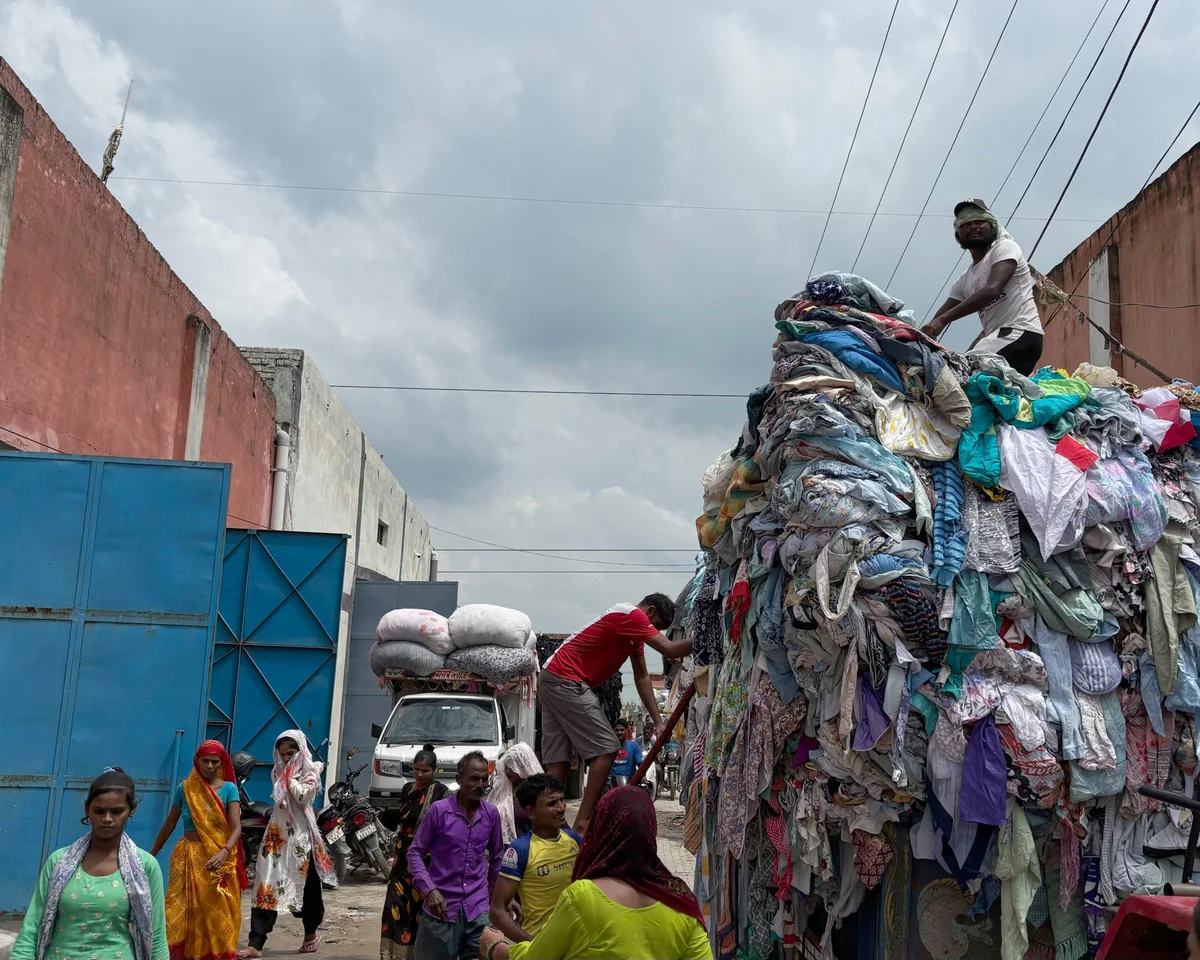
The Government e Marketplace (GeM), under the Ministry of Commerce and Industry, and the Textiles Committee (TC), under the Ministry of Textiles, have entered into a partnership aimed at giving recycled and upcycled textile products a larger role in government procurement.
The Memorandum of Understanding (MoU), signed during the 62nd Foundation Day celebrations of the Textiles Committee in Mumbai, seeks to create a structured link between textile waste generators, recyclers and upcyclers on one side and government buyers on the other.
The central idea behind the collaboration is to transform textile waste into usable, quality-assured products and then create a market for those products through the scale of public procurement.
Instead of treating discarded textiles, production scraps and second-hand clothes simply as waste, the initiative seeks to build a system in which these materials can be recovered, processed and converted into value-added products that can eventually be purchased by government institutions through GeM.
Creating a ‘Waste to value to market’ ecosystem
The partnership is built around what the government describes as a ‘Waste-to-Value-to-Market’ ecosystem.
Under the proposed system, textile waste and discarded materials can enter the recycling and upcycling chain, where eligible enterprises convert them into new products. These products can then be standardised, certified and listed on GeM, allowing government departments and public institutions to access them through an established procurement platform.
The arrangement is significant because market access remains an important challenge for smaller enterprises working in recycling and upcycling. Even when such businesses are capable of producing usable and commercially viable products, reaching large institutional buyers can be difficult.
By connecting these enterprises with GeM, the partnership is expected to provide a more organised route to government demand.
Government procurement also offers potential scale. As Mihir Kumar, CEO of GeM, noted, linking certification, standardisation and market access can help create reliable demand for products made from textile waste.
He said the scale and reach of government procurement could accelerate the adoption of recycled and upcycled products across offices, institutions, gifting requirements and other public-use needs.
Textiles Committee to provide certification and technical support
The Textiles Committee will play a key role in establishing credibility and quality standards for the products entering this ecosystem.
Under the MoU, the Committee will identify, verify, certify and recognise eligible producers of recycled and upcycled textile products. It will also support consultations with stakeholders, capacity-building activities and market research.
Another important responsibility will be helping develop suitable technical specifications for products that can be procured by government buyers.
Standardisation is particularly important in public procurement because buyers need clarity about the quality, specifications and performance of products before placing orders. The partnership therefore seeks to create a framework in which recycled and upcycled products are not merely promoted as environmentally friendly alternatives but are also presented as reliable procurement options.
The Textiles Committee and its affiliated offices will also contribute to developing suitable product specifications and catalogues for government procurement.
GeM to create dedicated categories and market access
GeM, meanwhile, will work on the market-facing side of the initiative.
The platform is expected to create dedicated categories for recycled and upcycled textile products, making them easier for government buyers to discover and procure.
GeM will also facilitate seller onboarding and provide online market linkages for eligible enterprises. Promotion among government buyers will be another part of the initiative.
For smaller recyclers and upcyclers, however, simply creating a category on an online marketplace may not be enough. Many last-mile enterprises may need assistance in understanding procurement procedures, registering as sellers and presenting their products according to the requirements of institutional buyers.
The partnership therefore includes training and handholding support to help these enterprises participate effectively in public procurement.
Hub and spoke model to reach smaller enterprises
A hub-and-spoke approach will be used to take the initiative beyond larger and established businesses.
Under this model, the Textiles Committee and its affiliate offices will act as facilitators for last-mile outreach, mobilisation and capacity building. This is intended to bring smaller recyclers, upcyclers and local enterprises into the formal procurement ecosystem.
The approach could be particularly relevant for enterprises that operate at the local or community level and may not have the resources or expertise to independently navigate a large government procurement platform.
Capacity building will therefore form an important part of the initiative, alongside certification, product development and market linkage.
Focus on women, MSMEs, artisans and local enterprises
The partnership also has an inclusion component, with particular attention to women, MSMEs, local enterprises, artisans, recyclers and other businesses operating within the circular economy.
Textile recycling and upcycling can involve a wide range of activities, from collection and segregation of discarded textiles to processing, manufacturing, designing and selling finished products.
Bringing these different participants into a formal supply chain could create new opportunities for small businesses and decentralised production units.
The government sees this as being aligned with broader national priorities such as Vocal for Local, Make in India and AatmaNirbhar Bharat.
The objective is not only to increase the use of recycled materials but also to create an ecosystem in which economic activity around textile waste is distributed across smaller enterprises and local production networks.
Public procurement as a driver for circular textiles
The initiative comes against the larger push towards resource conservation and more sustainable production and consumption.
The textile sector generates waste at multiple stages, including manufacturing, cutting and production as well as after garments and other textile products reach consumers. Creating commercially viable channels for recovering and reusing such material can reduce the amount of textile waste that is treated as having little or no economic value.
The GeM-Textiles Committee partnership attempts to address one part of this challenge by focusing on demand.
Rather than relying only on awareness campaigns or voluntary adoption, the initiative seeks to use the purchasing power of government institutions to create a market for recycled and upcycled products.
If government buyers begin procuring such products at scale, it could provide businesses with greater visibility into potential demand and encourage more enterprises to invest in recycling, upcycling, product development and related capabilities.
MoU signed at Textiles Committee Foundation Day event
The MoU was signed in Mumbai during the Textiles Committee’s 62nd Foundation Day celebrations.
Union Minister of Textiles Giriraj Singh and Maharashtra Minister of Textiles Sanjay Savkare were among those present at the event.
The agreement was signed by Ajit B. Chavan, Additional CEO of GeM, and Kartikay Dhanda, Secretary of the Textiles Committee, in the presence of senior government officials and industry stakeholders.
The government has positioned the partnership as a step towards combining certification and technical standards with market access.
From discarded textiles to procurement opportunity
The larger significance of the MoU lies in its attempt to connect two parts of the circular economy that often operate separately: the supply of recycled and upcycled products and the demand for them.
For recyclers and upcyclers, the challenge is to produce consistent, quality-assured goods and gain access to institutional markets. For government buyers, the challenge is to identify products that meet defined specifications and procurement requirements.
The partnership seeks to address both sides by combining the Textiles Committee’s role in identification, verification, certification and standardisation with GeM’s digital procurement infrastructure and access to government buyers.
The ultimate goal is to make textile waste a source of economic value rather than simply an environmental liability.
By bringing recycled and upcycled products into the public procurement system, the government aims to support resource conservation, generate sustainable livelihood opportunities and encourage responsible production and consumption.