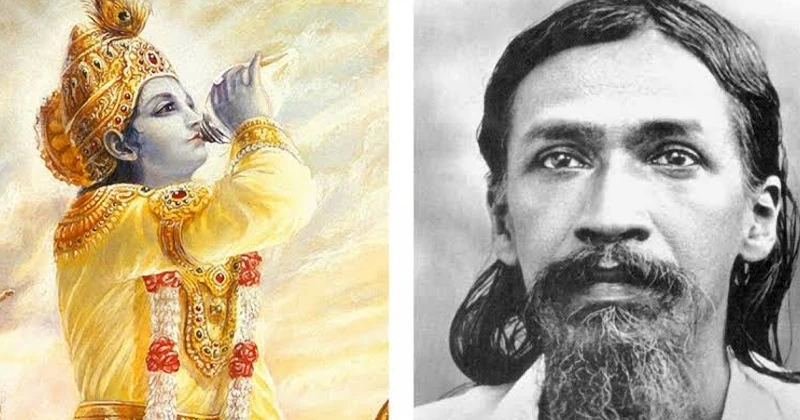
The Alipore Bomb Case of 1908. A solitary cell resembling a damp, suffocating dungeon. Defying the dark, humid walls and the ruthless vigil of the British Raj, a divine, luminous presence suddenly descended into that narrow space. The pitch-black night of incarceration was illuminated by the sublime, transcendent vision of Sri Krishna, the chariot-steerer of Kurukshetra. Sri Aurobindo Ghose stood in mute, ecstatic wonder, realising that the figure standing before him was not a mere British warden, but Vasudeva Himself. The iron bars of the prison, the dry straw bedding, the coarse branches of the solitary tree in the yard—everything vibrated with the eternal, playful rhythm of the divine. On that fateful day, the Lord of the Gita whispered to the revolutionary-turned-seer: “I am raising this nation, for India is the vessel of My Sanatan Dharma.” Standing on the auspicious occasion of Sri Krishna Janmashtami, this epochal memory of Sri Aurobindo’s Vasudeva Darshan is not merely a historical milestone of India’s spiritual awakening; it is the indestructible archway through which one must comprehend India’s unique, civilisational nationalism.
Yet, from the very moment Sri Aurobindo proclaimed the dynamic karma-yoga of Sri Krishna and the deep spiritual vitality of Sanatan Dharma as the cornerstone of India’s freedom and sovereignty, an invisible war was declared against him. A fiercely dogmatic faction of foreign-imported dialectical materialism, bound rigidly to orthodox Marxist theories, could never forgive this revolutionary sage. Sri Aurobindo’s far-reaching vision of civilizational and spiritual regeneration presented a profound existential threat to the Communist Party of India and its sprawling intellectual ecosystem.
Consequently, the Marxist intelligentsia labeled this profound spiritual renaissance as a “bourgeois superstition” and a “reactionary revivalism.” To undermine his integral yoga, his supramental theory, and his eventual retirement to Pondicherry, they constructed a meticulous, decades-long campaign of slander and institutional erasure. Confronting the depths of this historical defamation and conspiracy on this sacred day of Janmashtami is not merely an exercise in historical reconstruction; it is an indispensable intellectual struggle to safeguard the sovereignty of the Indian mind.
To understand the systemic nature of this hostility, one must trace its origins through the classic works of historical scholarship. In Sisir Kumar Mitra’s seminal biography, The Liberator: Sri Aurobindo, India and the World (published in 1954), this extraordinary spiritual transformation is analyzed with deep historical fidelity. Mitra highlights how the dark cell of Alipore was not a prison but a tapovan (hermitage) where the future destiny of India was being forged. In Mitra’s words, the Vasudeva Darshan elevated the Indian freedom struggle from a mere geopolitical transition to a supreme spiritual duty, summoning the latent power of Sanatan Dharma in the heart of every Indian.
Similarly, in the classic compilation edited by Kishor Gandhi, Social Philosophy of Sri Aurobindo and the New Age, researchers have demonstrated how this Krishna-consciousness introduced a revolutionary paradigm shift in Indian political thought. The essays in this volume emphasize that Sri Aurobindo’s spiritual nationalism was not a passive, world-negating asceticism, but a dynamic, active manifestation of the Gita’s nishkama karma-yoga. Yet, it was precisely this spiritual force that Indian Marxist intellectuals sought to target and dismantle, viewing it as an ideological threat to their mechanical theories of class warfare.
Sri Aurobindo himself, in the August 1909 issue of his weekly journal Karmayogin, elucidated the true significance of Janmashtami, writing that the consciousness of Sri Krishna is the supreme force that shatters the ego and narrow personal interests, guiding the society and nation toward a divine unity. Yet, Marxist theorists went to extraordinary lengths to suppress this profound philosophy. As analyzed by K.D. Sethna in a brilliant theoretical editorial in the August 1950 issue of Mother India, the mouthpiece of the Pondicherry Ashram, Marxist dogmatists routinely ridiculed this transcendent realization as a “bourgeois illusion designed to serve ruling-class interests.” Sethna wrote that the blind adherents of materialism could never tolerate this eternal divine manifestation because it instantly exposed the absolute hollowness of their mechanical formulas.
Furthermore, Haridas and Uma Mukherjee, in their authoritative historical work Sri Aurobindo and the New Thought in Indian Politics (published in 1958), demonstrated how Sri Aurobindo had previously declared political liberation as a sacred “dharma” in the columns of his daily newspaper Bande Mataram, transforming the teachings of Sri Krishna into the main driving force for the revolutionaries. To banish this indigenous spiritual consciousness from the post-independence Indian mind, the communists wove a vast web of distortion. Unmasking this conspiracy is paramount to reclaiming the intellectual sovereignty of Indian civilization.
The Uttarpara Speech: The Universal Proclamation of Sanatan Dharma and the Communist ‘Revivalist’ Fury
May 1909. Following a grueling, year-long legal battle in the Alipore Bomb Case, Sri Aurobindo was acquitted of all charges. Immediately after his release, he delivered an epochal address at the annual meeting of the Uttarpara Dharma Rakshini Sabha, forever immortalized in Indian history as the Uttarpara Speech. In this sacred town of Uttarpara, Sri Aurobindo chose to publicize, for the very first time, the profound mystical reality of his Vasudeva Darshan. He declared in unequivocal terms that India’s struggle for independence was not a petty political squabble over power, but a universal awakening of Sanatan Dharma. He famously proclaimed: “I say no longer that nationalism is a creed, a religion, a faith; I say that it is the Sanatan Dharma which for us is nationalism.”
This universal message ignited a spiritual wildfire in the hearts of the revolutionary youth, transforming the nationalist struggle into an invincible force. However, this profound spiritual awakening was viewed with intense suspicion and hostility by Marxist historians and leftist ideologues. In his highly influential work The Swadeshi Movement in Bengal 1903–1908, Marxist historian Sumit Sarkar, along with Bipan Chandra in India’s Struggle for Independence, launched a severe critique against the Uttarpara Speech. They argued that by introducing elements like the nishkama karma-yoga of the Bhagavad Gita and the symbols of Sanatan Dharma into the political program of the national movement, Sri Aurobindo had dragged the struggle back into “reactionary revivalism.”
The mechanical lens of these Marxist historians failed to comprehend that Sri Aurobindo’s conception of Sanatan Dharma was neither sectarian nor dogmatic; it was a universal truth of human consciousness that unites all individuals in a single, boundless spirit. Yet, to serve their materialist agenda, communist writers persistently smeared this magnificent spiritual nationalism as the “catalyst of communal partition,” systematically erasing the true grandeur of the Uttarpara Speech from the textbooks of independent India.
Philosophical Polarisation: Dialectical Materialism vs. Integral Yoga and Supramental Consciousness
The core of the communist hostility toward Sri Aurobindo lay in his profound social and evolutionary philosophy. In the first half of the twentieth century, long before the horrific realities of Soviet and Chinese totalitarianism had fully unmasked themselves to the world, Sri Aurobindo had already identified the fatal flaws of Marxism through a deep psychological and spiritual critique. In Social Philosophy of Sri Aurobindo and the New Age, Kishor Gandhi meticulously demonstrated how Sri Aurobindo dismantled Karl Marx’s “historical materialism,” the theory of surplus value, and the yanks of class struggle.
Exploring this philosophical conflict further, the renowned scholar D.P. Chattopadhyaya, in his indispensable sociological study Sri Aurobindo and Karl Marx: Integral Sociology and Dialectical Sociology, illustrated how the economic reductionism of Marxist sociology inevitably strikes at the root of human spiritual freedom. Chattopadhyaya’s research highlights that Marx’s historical analysis is merely a superficial study of external material forces, completely blind to the deeper realities of human consciousness.
While orthodox Marxism propagates that the sole driving force of human history is economic and material change promoting this dogma as a “Bolshevik Bible” Sri Aurobindo showed that explaining human history through purely economic parameters reveals an extreme poverty of psychological understanding. In his view, the real cause of exploitation is not capital accumulation, but the unregenerate human ego, specifically the “vital ego” of the individual, class, or state. Wealth and property are merely the instruments used by this ego to express its insatiable desires. Unless there is a fundamental transformation of this inner ego, any change in the external social structure will merely alter the form of exploitation, not end it.
In his prophetic work The Human Cycle, Sri Aurobindo warned that replacing private capitalism with state socialism or communism would not bring about human liberation. Instead, it would concentrate all power in the hands of an unaccountable, monolithic state bureaucracy, completely choking individual freedom and spiritual evolution.
This profound warning finds echoes in contemporary sociological assessments. K.D. Sethna, writing in the May 1949 issue of the journal Mother India, launched a devastating critique of the mechanical worldview of Marx’s Das Kapital and The Communist Manifesto. Sethna argued that Marxist sociology reduces human beings to mere economic animals, eventually turning the state into a total police state.
Similarly, in the second volume of Talks with Sri Aurobindo, compiled by Nirodbaran, numerous evening conversations are recorded where Sri Aurobindo states clearly that there is no qualitative difference between Fascism, Nazism, and Soviet Bolshevik totalitarianism. Both systems, he observed, sacrifice the freedom of the individual and the spiritual evolution of the soul on the altar of a monstrous state machine. Such a sharp, uncompromising critique was an unpardonable sin in the eyes of communist ideologues, who responded by dismissing Sri Aurobindo as a “bourgeois idealist.”
Essays on the Gita: The Fiery Mantra of Nishkama Karma vs. The Mechanical Equation of Class Struggle
One of Sri Aurobindo’s most monumental intellectual works is Essays on the Gita, which originally appeared as a series of essays in his monthly review Arya. In this masterpiece, Sri Aurobindo rescued the Bhagavad Gita from the quietism of passive monasticism and reinterpreted its nishkama karma-yoga as a dynamic, fiery call to action. He showed that Arjuna’s armed resistance on the battlefield of Kurukshetra was not an act of personal anger or greed, but a detached execution of the cosmic law (dharma) to establish a righteous order (dharmarajya). This interpretation became the ultimate source of strength for the armed revolutionaries of Bengal. The youth of the fiery era marched to the gallows with the Gita in their hands, because Sri Aurobindo had taught them that sacrificing one’s life for the motherland was a sacred, spiritual sacrifice (yajna).
For the communists, whose materialist worldview recognized nothing but raw “class struggle” and selfish economic conflicts, this philosophy of selfless sacrifice and spiritual duty was an intolerable threat. In his 1969 propaganda tract, A Critique of Sri Aurobindo’s Philosophy, published with communist party funds, CPI leader Bhowani Sen launched a venomous attack on Sri Aurobindo’s social interpretation of the Gita. Sen dismissed it as a “bourgeois strategy designed to confuse the proletariat and divert them from their true revolutionary path.” According to Sen, channeling revolutionary fervor through the language of spiritual sacrifice was a “religious illusion” that alienated the working class from materialist liberation.
The roots of this communist anger lay in the total bankruptcy of their own dogmas. In Essays on the Gita, Sri Aurobindo had demonstrated that a lasting, harmonious society can never be established through the hatred and violence of class struggle. As long as the inner ego remains untransformed, any external socio-economic shift will only perpetuate human bondage in new forms. Real equality can only emerge when human consciousness ascends to a spiritual plane through selfless action.
The Early Phase of Communist Propaganda: Manabendra Nath Roy and the ‘Reactionary’ Label
The systematic attack against Sri Aurobindo and the spiritual-nationalist movement was initiated in the 1920s by Manabendra Nath Roy (M.N. Roy), the founder of the Indian communist movement. Indoctrinated by the Communist International (Comintern) in Moscow, Roy was tasked with preparing the ground for a Bolshevik revolution in India by systematically destroying the intellectual foundations of the nationalist leadership. His primary targets were the cultural and spiritual icons who had built the patriotic consciousness of the nation: Lokmanya Bal Gangadhar Tilak, Swami Vivekananda, and Sri Aurobindo.
In his 1922 work, India in Transition, written in Geneva, Roy used a rigid, mechanical Marxist framework to rewrite the history of the Indian national movement. He claimed that British rule had brought progress by dismantling medieval feudalism and giving rise to capitalism. Consequently, he argued, the Indian nationalist struggle was not a civilizational renaissance, but a mere reflection of the commercial interests of the rising Indian bourgeoisie.
From this narrow, Eurocentric perspective, M.N. Roy launched a vicious campaign against Sri Aurobindo’s spiritual nationalism. In the September 1923 issue of his journal, The Vanguard of Indian Independence, Roy went as far as to denounce Swami Vivekananda as a “spiritual imperialist” and ridiculed Sri Aurobindo’s yogic experiences and cosmic realizations as “medieval superstitions” and “symptoms of a decaying feudal mind.” To Roy, Sri Aurobindo’s call to worship the motherland as the “Divine Mother” or “Bhavani” was merely a bourgeois trick to manipulate the illiterate masses.
During his ultra-leftist phase, Roy taught his followers to despise India’s spiritual heritage—a toxic inheritance that subsequent generations of Marxist historians preserved with religious devotion. Although M.N. Roy eventually broke with Moscow, was expelled from the Communist Party, and turned toward “Radical Humanism,” his early writings provided the basic vocabulary of abuse used by Indian communists to defame Sri Aurobindo for decades.
Rajani Palme Dutt and Institutional Marxist Historiography
The campaign initiated by M.N. Roy was formalized and institutionalized in 1940 by Rajani Palme Dutt, one of the founders of the Communist Party of Great Britain. His book, India Today, became the undisputed bible of Marxist historiography in India. In this work, Dutt dismissed the rise of the Indian National Congress as a colonial “safety valve” conspiracy and turned his ire upon the extremist nationalist faction, particularly its intellectual fountainhead, Sri Aurobindo.
In the initial editions of India Today, Dutt almost completely suppressed the historic 1905 anti-partition Swadeshi movement in Bengal the very movement that Sri Aurobindo had led. When he was finally forced to address it in later editions, he cleverly labeled it as “religious revivalism.” According to Dutt’s theory, Sri Aurobindo and Tilak’s invocation of the Bhagavad Gita and the worship of Bhavani communalized the freedom struggle and alienated the Muslim population.
Palme Dutt and his disciples chose to ignore the profound psychological necessity of cultural and spiritual roots in mobilizing an enslaved nation against a global empire. Instead, they systematically branded Sri Aurobindo as a “reactionary communal bourgeois.” Under the influence of India Today, independent India’s academic institutions adopted a distorted curriculum that put spiritual nationalists on trial, treating their civilizational pride as a historical crime.
This line of attack was further intensified by subsequent Marxist writers, including S.A. Dange, who in his 1921 booklet Gandhi vs Lenin sought to prove Bolshevik violence as superior to Gandhian non-violence, and CPI theoretician Bhowani Sen. Sen’s 1969 tract, A Critique of Sri Aurobindo’s Philosophy, was written with the explicit purpose of depicting Sri Aurobindo’s integral philosophy as a bourgeois deception to shield young minds from “scientific socialism.”
The Communist Conspiracy to Fragment the Bengal Renaissance
To marginalize Sri Aurobindo’s spiritual nationalism, Marxist historians executed a grand strategy to distort the history of the nineteenth-century “Bengal Renaissance.” The intellectual and spiritual awakening led by Raja Rammohun Roy, Ishwar Chandra Vidyasagar, Bankim Chandra Chattopadhyay, Swami Vivekananda, and Sri Ramakrishna was a deep, soul-stirring cultural revival that eventually found political expression. Sri Aurobindo was the true political successor of this renaissance, translating Bankim’s patriotism and Vivekananda’s spiritual energy into a concrete program for complete independence.
However, once Marxist historians captured the academic institutions of post-independence India, they launched a concerted campaign to strip the Bengal Renaissance of its spiritual soul. Kuttor Marxist academicians like Sushobhan Sarkar, in works like On the Bengal Renaissance, portrayed this awakening as a superficial imitation of European secular rationalism.
Under this highly fragmented historiography, the mystical realisations of Sri Ramakrishna, the universal call of Swami Vivekananda, and the integral yoga of Sri Aurobindo were dismissed as “reactionary tendencies of upper-class Hindu elites” or, in Marxist terminology, “false consciousness.” The ultimate goal of severing the Renaissance from its spiritual roots was to produce a generation of self-loathing intellectuals who would despise their own history and willingly accept the tutelage of imported materialism.
This distortion reached its peak in Sumit Sarkar’s The Swadeshi Movement in Bengal 1903–1908. Sarkar launched a severe attack on the use of Hindu symbols by Sri Aurobindo’s extremist faction, claiming that Bankim’s Anandamath, the worship of Bhavani, and the taking of revolutionary vows on the Gita alienated the Muslim community from the anti-partition struggle. This reductionist theory was designed to diminish the glory of the Swadeshi movement and hold Sri Aurobindo responsible for the communal fissures that were actually engineered by the British colonial policy of divide and rule.
The Departure to Pondicherry: A Fictional Narrative of ‘Escapism’ and Cowardice
The most toxic and enduring campaign launched by Marxist intellectuals and leftist media was centered on Sri Aurobindo’s departure to Pondicherry in 1910. When Sri Aurobindo slipped past British surveillance to seek refuge in the French enclave of Pondicherry, communist and secular historians instantly manufactured a narrative of “cowardly escape.” In national textbooks written by leftist historians like Bipan Chandra, it was dishonorably stated that after being acquitted in the Alipore Bomb Case, Sri Aurobindo “retired from politics and fled to Pondicherry to seek refuge in religion.”
This narrative of “escapism” was a monumental historical lie. Sri Aurobindo himself repeatedly rejected this slander. In his autobiographical writings, compiled in Sri Aurobindo on Himself, he made it absolutely clear that his departure was guided by an inner, divine command that transcended all mundane political calculations. While in the Alipore jail, he had received the direct revelation of Sri Krishna and was instructed that the external, political freedom of India was already assured by the Divine; his real task was to pioneer a new consciousness the Supramental consciousness to liberate humanity from the bonds of ignorance, suffering, and death. His forty years in Pondicherry were not a cowardly retreat, but a relentless, heroic spiritual battle.
In his brilliant study, The Liberator: Sri Aurobindo, India and the World, historian Sisir Kumar Mitra proved that the Pondicherry Ashram remained a silent powerhouse behind the scenes of the freedom struggle. Countless revolutionaries and political leaders secretly journeyed to Pondicherry to seek his spiritual guidance. Yet, Marxist intellectuals, whose consciousness was confined to material power-grabbing, were entirely incapable of understanding this spiritual reality. They chose to brand one of India’s greatest revolutionary minds as a “coward” and an “escapist,” attempting to render him irrelevant to the modern generation.
Direct Attacks on the Pondicherry Ashram and Auroville
The communist hostility toward Sri Aurobindo was not confined to academic seminars and textbook distortions; it repeatedly spilled onto the streets in the form of violent, physical attacks. The Sri Aurobindo Ashram in Pondicherry and the international township of Auroville stood as living models of spiritual communal living, directly challenging the Marxist theory of class struggle. Consequently, local communist cadres and their allied mobs launched several violent assaults on these institutions.
The most horrific of these attacks occurred on August 15, 1947 the day of India’s independence, which also marked Sri Aurobindo’s 75th birthday. While the nation was celebrating, a mob of armed goons, instigated by local communist factions and Dravidian separatists, launched a brutal attack on the Ashram. In this violent assault, a saintly inmate of the Ashram, Mulshankar Jani, was stabbed to death, and several others were seriously injured.
To correct the false narratives circulating in the press, Sri Aurobindo dictated a detailed statement, sent by his secretary to the editor of The Statesman in Calcutta on August 20, 1947. The letter revealed that the attack was not a sudden riot but the culmination of a systematic, two-year-long hate campaign orchestrated by local communist and extremist groups. The official documents of the French administration, recorded in the Journal Officiel des Établissements Français dans l’Inde, corroborate these details, permanently exposing the violent methods used by the far-left to terrorise the spiritual community.
Another massive attack took place on February 11, 1965. Under the pretext of the anti-Hindi agitations in Tamil Nadu, communist cadres and radical groups attacked the Ashram, pelting stones and setting fire to offices, guest houses, and the clinic. The legendary Togo Mukherjee, a brave young Ashramite, defended the medical clinic single-handedly against a raging mob, suffering a fractured skull in the process. The Mother, in her personal Agenda, noted that this destruction was carried out by a hostile coalition of “communal communists” and fanatic groups, seeking to destroy the spiritual nucleus of the Ashram.
Even as recently as the 2010s, following a tragic suicide involving a family associated with the Ashram, the Communist Party of India (Marxist) [CPI(M)] and local radical groups seized the opportunity to vandalise the Ashram’s main building, smashing sacred portraits of the Mother and Sri Aurobindo. These incidents stand as a bloody testimony to the physical violence unleashed by communist cadres against Sri Aurobindo’s legacy.
The Irony of Keralam: Communist Usurpation of Spiritual Social Reform
A brilliant example of communist double-speak is the systematic usurpation of spiritual social reform movements, particularly in Keralam. To eradicate the darkness of caste discrimination, Swami Vivekananda and Sri Aurobindo had inspired a profound socio-spiritual revival. Drawing upon this inspiration, the great seer Sri Narayana Guru initiated a quiet revolution based on the universal, non-dualistic principles of Vedanta.
However, subsequent communist theoreticians, most notably E.M.S. Namboodiripad, went to great lengths to distort this history. In his historical writings, Namboodiripad tried to depict Sri Narayana Guru’s Vedantic reform movement as a mere precursor to Marxist class struggle, claiming that the real credit for Keralam’s social emancipation belonged solely to the Communist Party.
By systematically airbrushing the spiritual foundations of the movement, Namboodiripad and his cadres replaced the message of universal love and spiritual equality with the seeds of hatred and class conflict. A similar strategy was deployed in Bengal by peasant leaders like Harekrishna Konar, who severed the agrarian classes from their spiritual roots, converting them into materialist political pawns. The organic relationship between spiritual values and social reform was violently severed by the communists to establish a politics of perpetual societal division.
Red China’s Aggression and Sri Aurobindo’s Utterly Neglected Warning
The most tragic consequence of the communist hostility toward Sri Aurobindo unfolded in the geopolitical arena, costing India its territorial integrity. In 1949, when Mao Tse-tung established communist rule in China and Prime Minister Jawaharlal Nehru was chanting the slogans of “Hindi-Chini Bhai Bhai,” Sri Aurobindo, from his silent retreat in Pondicherry, foresaw the impending catastrophe.
On June 28, 1950, Sri Aurobindo dictated a prophetic letter to his disciple K.D. Sethna, the editor of Mother India.
This letter, published as a lead editorial in the November 11, 1950 issue, warned of the true motives behind Mao’s invasion of Tibet, “The basic turn of the Chinese invasion of Tibet is to look past its borders and establish a strategic base to strike at India at the chosen moment.”
Sri Aurobindo identified Tibet as the natural protective gate of India and warned that its fall would permanently compromise India’s northern borders. Shattering Nehru’s policy of non-alignment, the seer stated that India must immediately align with Western democratic forces to counter the communist Chinese threat.
The chilling accuracy of this warning was revealed years later on March 28, 1963. As detailed by Sudhir Ghosh in his memoir, Gandhi’s Emissary (published in London in 1967), Ghosh met US President John F. Kennedy in the Oval Office and read out Sri Aurobindo’s 1950 letter. President Kennedy was stunned and remarked:
“There must be a typographical error here. The date must be 1960, not 1950. Are you telling me that a silent sage sitting in a corner of India predicted Mao’s conquest of Tibet and the invasion of India a decade before it actually happened?”
But Nehru’s leftist-dominated administration had dismissed this warning as imperialist propaganda. Even in 1962, when Chinese troops invaded India, communist intellectuals and publications actively shielded Beijing, echoing the Chinese line. To this day, Marxist historians have never apologised for their treasonous blindness or acknowledged that the silent seer of Pondicherry was absolutely right.
The Shift in Historiography and the Chronicling of Shattering the Communist Illusion
The Marxist hegemony over India’s historical and spiritual narrative did not remain unchallenged forever. In the latter half of the twentieth century, several brilliant intellectuals, who had themselves been devoted communists, realised the hollow, destructive nature of Marxism, shattered the illusion, and returned to the spiritual light of Sri Aurobindo.
The most shining star of this intellectual counter-revolution was the brilliant historian and thinker, Sita Ram Goel. In 1948, as a brilliant student of Delhi and Calcutta universities, Goel was deeply indoctrinated in Marxism and was on the verge of formally joining the Communist Party. It was then that his close friend, the visionary philosopher Ram Swarup, intervened. Ram Swarup told him: “Goel, you are intelligent enough to join the Communist Party, but you are also intelligent enough to find your way out of it.”
This prophetic warning was vindicated within a year. Goel soon realised that Marxism was a profound intellectual trap and that the Communist Party was functioning as a Soviet “Fifth Column” in India, ready to sacrifice the nation’s sovereignty on the altar of international communism.
Seeking to reclaim his cultural roots, Goel found his answers in Sri Aurobindo’s masterpieces, The Life Divine and The Foundations of Indian Culture. Sri Aurobindo’s writings acted as a revelation. Goel realised that the Marxist hostility toward Sanatan Dharma and Indian culture was not a standard economic struggle, but a deep-seated conspiracy to destroy the very soul of India.
The intellectual partnership of Ram Swarup and Sita Ram Goel led to the establishment of the Voice of India publishing house, which directly challenged the Marxist monopoly. In works like Hindu Society Under Siege and Perversion of India’s Political Parlance, Goel used Sri Aurobindo’s social philosophy to unmask the lies of leftist historians. This intellectual tradition was later supported by Western scholars like David Frawley, whose Awaken Bharata called for India’s spiritual rebirth, and Belgian researcher Koenraad Elst, who exposed the fraudulent methods of leftist historians in Ayodhya and After. Contemporary analysts, such as S. Gurumurthy, continue to show how modern leftist media platforms still employ Rajani Palme Dutt’s formula to undermine India’s civilizational inheritance.
Sri Krishna’s Dharmarajya vs. The Bolshevik Police State: Two Opposite Poles of Communism
The zenith of Sri Aurobindo’s political and social thought was his modernisation of the ancient Indian concept of Dharmarajya (the reign of righteousness), as described in the Mahabharata. In his monumental works, The Ideal of Human Unity and The Human Cycle, Sri Aurobindo presented a sublime vision of human unity. He argued that true equality and brotherhood can never be forced upon humanity through the iron chains of state coercion. Sri Krishna’s Dharmarajya is a society where the relationship between the individual and the collective is governed not by mechanical laws, but by mutual spiritual brotherhood, inner freedom, and the law of Truth (dharma). This is “Spiritual Communism,” which achieves real equality by awakening the divine spark within every individual.
In stark contrast stood the Bolshevik model of the Soviet “police state.” Applying Karl Marx’s materialist dogmas with brutal force, Lenin and Stalin constructed a state machinery that completely denied the human soul. In Kishor Gandhi’s critical work, The Fallacy of Karl Marx, this tragic experiment is analysed with chilling precision. Gandhi shows how the Soviet communists, chasing the utopian dream of a classless society through materialist violence, ended up concentrating all power in the hands of a ruthless, all-powerful state bureaucracy. The result was the murder of millions, the horrors of the Siberian Gulag, and the total destruction of individual liberty.
Sri Aurobindo had foreseen the inevitable collapse of this Bolshevik machine. He argued that any system that denies the spiritual evolution and freedom of the individual is destined to perish. History vindicated his vision. The spectacular collapse of the Soviet Union in 1991 proved that materialism cannot sustain a society, while the eternal relevance of Sri Krishna’s Dharmarajya and Sri Aurobindo’s Spiritual Communism continues to shine as a beacon of hope for the twenty-first century.
Materialism at the Bar of History and the Resurrection of Sri Aurobindo
The century-long campaign of defamation, institutional conspiracy, and physical violence launched by the communists against Sri Aurobindo has ended in total intellectual bankruptcy. The collapse of the Soviet Union in 1991, the fall of communist regimes across Eastern Europe, and the rise of state-sponsored capitalism in China have proven that a philosophy built on the denial of the human soul is destined to collapse like a house of cards. Sri Aurobindo’s 1913 prediction that state socialism would end up turning the state into a monstrous prison stands as a historical truth.
Today, as humanity stands disillusioned by the spiritual void of raw consumerism and dogmatic materialism, Sri Aurobindo’s integral philosophy, his supramental yoga, and his spiritual nationalism are emerging as the greatest source of hope. Modern integral philosophers, such as Ken Wilber, have adopted his evolutionary mapping as the blueprint for the future of human consciousness.
The conspiracy of the Indian Marxist academic complex to ignore and marginalise Sri Aurobindo has failed. At the bar of history, the unyielding materialist dogmas have met their demise, while the eternal vision of the silent seer of Pondicherry continues to guide humanity toward a glorious, spiritual dawn.