Tashkent: Prime Minister Narendra Modi has called for the ancient Tamil classic Thirukkural to be translated into Uzbek, pitching the timeless work of poet-philosopher Thiruvalluvar as a powerful bridge between India’s civilisational knowledge and the people of Uzbekistan.
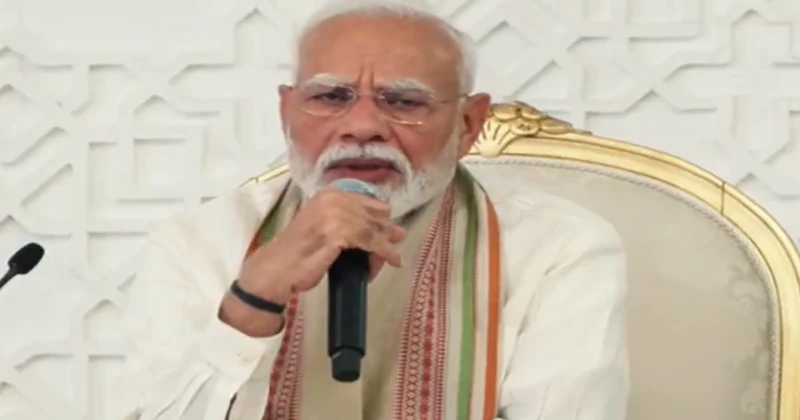
Speaking during his interaction at the Mahatma Gandhi Centre for Indian Studies at Tashkent State University of Oriental Studies, PM Modi highlighted the enduring relevance of the Thirukkural, describing it as a profound source of inspiration spanning spirituality, philosophy and practical wisdom.
“As you celebrate your 80th anniversary, can you envision undertaking a mission to translate the ‘Thirukkural’ into the Uzbek language?” PM Modi asked, urging the institution to take up the ambitious cultural initiative. The Uzbek side responded positively, with the speaker on the podium assuring the Prime Minister: “Yes, we will make every effort and try.”
#WATCH | Tashkent, Uzbekistan: Prime Minister Narendra Modi says, "The Thirukkural, written in Tamil centuries ago, remains a profound source of inspiration across all walks of life today—encompassing spirituality, philosophy, and practical wisdom. As you celebrate your 80th… https://t.co/82iAbj6Atp pic.twitter.com/rDf0hbuMoM
— ANI (@ANI) August 31, 2026
‘A profound source of inspiration’
PM Modi underlined that the significance of the Thirukkural extends far beyond Tamil Nadu or India, arguing that its philosophical insights have universal relevance. He said translating the classic into Uzbek would enrich the intellectual and cultural landscape of Uzbekistan and enable a wider audience to engage with one of India’s oldest literary traditions.
The Prime Minister stressed that the Thirukkural offers an opportunity to understand the depth of human thought that has evolved since the earliest stages of civilisation.
“The philosophical thought found in one of the world’s most ancient languages will help us appreciate how deep human thought has been right from the beginning of our civilisation’s journey,” he said. PM Modi also praised the role of the university and its centres dedicated to the study of India, emphasising that such institutions should represent more than conventional academic pursuits.
He described the university as a place of dedicated intellectual exploration an institution where students and scholars could immerse themselves in the vast body of knowledge associated with India’s civilisational heritage.
From Tamil literature to Uzbekistan’s Indology ecosystem
The Prime Minister’s remarks came as he highlighted the growing interest in Indian culture and knowledge traditions in Uzbekistan.
Reflecting on his visit to the Mahatma Gandhi Centre, PM Modi said he witnessed a vibrant Indology ecosystem and a strong passion for studying India. He also noted the immense work undertaken on Mahatma Gandhi’s life and the growing interest in Tamil culture.
The interaction also offered an unusual personal moment for PM Modi when Uzbek students recited poems written by him.
PM Modi said hearing young Uzbek students recite his poems was an emotional experience, particularly because Hindi was not their native language. “Poems written by me a very long time ago today I had the opportunity to hear them recited by these young people,” he said.
He noted that despite the students speaking Hindi as a foreign language, they conveyed the emotions behind his poems with remarkable accuracy. “This only becomes possible when you live that language, when you immerse yourself completely in it,” PM Modi said.
‘People of Uzbekistan love India’
The interaction also underscored the deep people-to-people connect between India and Uzbekistan. An Uzbek Indologist told PM Modi that it would be difficult to find many countries where people have as much affection for India as Uzbekistan does. “Every single one of our citizens knows the greeting ‘Namaste’,” the scholar said.
The scholar pointed to Uzbekistan’s interest in Indian arts, dance, music, philosophy and Yoga, while emphasising the importance of Indian epics in understanding the country’s civilisation. “To truly understand India, you must read the Ramayana and the Mahabharata,” the scholar said.
PM Modi’s emphasis on the Thirukkural adds another important dimension to this cultural engagement by bringing Tamil literary and philosophical traditions into the expanding India-Uzbekistan cultural dialogue.
Thirukkural: Ancient Tamil wisdom with universal relevance
The Thirukkural, also known as the Kural, is among the most celebrated works of classical Tamil literature. Traditionally attributed to Thiruvalluvar, the text explores ethics, morality, virtue, governance, relationships and practical conduct.
Its appeal has long extended beyond linguistic and geographical boundaries because of its focus on universal questions of human life and conduct. For PM Modi, translating the work into Uzbek would not simply be a literary exercise. It would provide another channel through which Uzbekistan’s students, scholars and wider public could access Indian philosophical thought.
The proposed translation therefore fits into the broader cultural engagement between the two countries, where institutions such as the Mahatma Gandhi Centre and the Lal Bahadur Shastri Centre for Indian Culture have played a role in promoting Indian studies and cultural exchanges.
Cultural diplomacy meets a broader strategic partnership
PM Modi’s Thirukkural appeal came during a visit that produced significant developments across the India-Uzbekistan relationship.
During his August 29-30 state visit at the invitation of Uzbek President Shavkat Mirziyoyev, India and Uzbekistan elevated their bilateral relationship from a Strategic Partnership to a Comprehensive Strategic Partnership.
The two sides also exchanged 11 MoUs, agreements and understandings covering areas ranging from digital payments, mining and critical minerals to healthcare, education, environment and culture.
A major strategic outcome was an agreement to establish a long-term arrangement for uranium supplies from Uzbekistan to India, strengthening cooperation in the nuclear energy sector.
The visit also brought fresh momentum to economic and people-to-people ties. Bilateral trade crossed the $1 billion mark for the first time last year, according to President Mirziyoyev, while the number of joint ventures has reportedly increased sevenfold over the past few years.
Connectivity between the two countries has also expanded, with 14 direct flights a week linking India and Uzbekistan. Uzbekistan is also set to remove visa requirements for Indian citizens for stays of up to 30 days, a move expected to facilitate tourism, business travel and broader people-to-people exchanges.
From GIFT City to sister-city partnerships
The two countries are also working towards three sister-city and sister-state agreements. During his talks with Mirziyoyev, PM Modi stressed that such agreements should not remain confined to signed documents and called for concrete roadmaps to ensure that the partnerships produce visible outcomes.
Urban development emerged as another area of potential cooperation, with Uzbekistan developing New Tashkent as a major new urban centre. PM Modi highlighted Gujarat’s GIFT City as a potential model and offered to host an Uzbek delegation to study its planning, technology and implementation.
Against this backdrop, PM Modi’s call for an Uzbek translation of the Thirukkural carries significance beyond literature.
India’s engagement with Uzbekistan has traditionally included education, culture, Yoga, philosophy and the study of Indian languages and civilisation. The proposed translation could broaden that engagement by bringing a classical Tamil text directly into the Uzbek intellectual space.