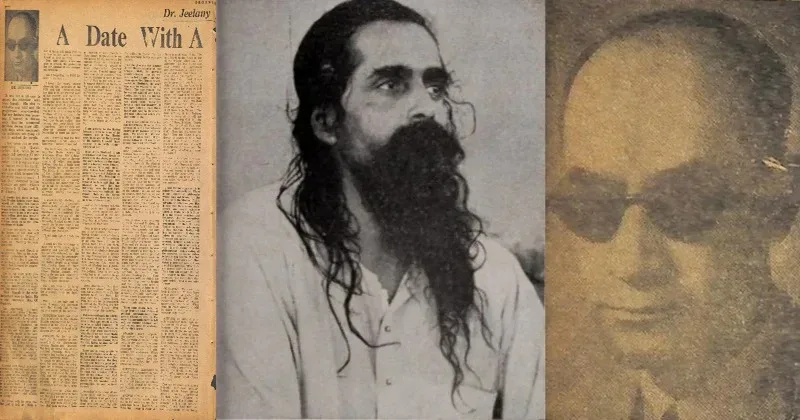
Addressing the question of Hindu-Muslim relations and the need to find a solution to the issue, RSS Sarsangchalak MS Golwalkar (Guruji), in an interview in 1971 with Iranian journalist and Arabic scholar Dr Saifuddin Jeelani said that he did not distinguish between Hindus and Muslims when it came to work for the country. He said the problem arose when people sought to advance claims or privileges for their own communities by exploiting political situations. He added that if people approached politics from a patriotic point of view, the troubles would end quickly.
Guruji said Muslims should be given their due share, like everyone else, but this did not mean demanding various rights and privileges. He referred to demands for Pakistan in every state and said such positions irritated those who thought in terms of the country as a whole.
Guruji also addressed the question of Urdu and said that Urdu was not a “religious language” of Muslims. He pointed out that Muslims in various states had spoken and studied local languages in the past and said Urdu was a hybrid product that evolved during Mughal rule. He added that Islam was born in Arabia and that the Holy Quran was in Arabic. According to him, the emphasis on Urdu was aimed at uniting Muslims into a political force and such a political force was bound to go counter to the interests of the country.
Speaking about national heroes and history, Guruji referred to Rustom, whom some Muslims considered their national hero, and said that he was a Persian hero who lived before Islam. He asked why Sri Rama could not similarly be accepted as a national hero.
He also referred to Panini and said that Pakistan had celebrated the 5,000th birth anniversary of Panini, who was born in the region that is now Pakistan. Guruji said that if Pakistanis could claim Panini as one of their great forefathers, local Hindu Muslims could similarly regard Panini, Vyasa, Valmiki, Rama and Krishna as their great ancestors.
Guruji emphasised that acceptance of Rama and Krishna as divine incarnations was not necessary for recognising them as great personalities. He said that many people within Hindu Dharma did not believe in the Divine Incarnation of Rama and Krishna but still regarded them as great personalities worthy of emulation.
“According to our ways of religious belief and philosophy, a Muslim is as good as a Hindu. It is not the Hindu alone who will reach the ultimate Godhead. Everyone has the right to follow his path according to his own persuasion,” Guruji said.
Explaining the approach towards religious freedom, Guruji recalled an interaction involving the previous Shankaracharya of the Shringeri Math, Shri Chandrasekhara Bharati Swamiji, and an American who approached him seeking conversion to Hinduism. He said the Acharya asked the American whether he had honestly practised Christianity and advised him to try it first and return if it did not satisfy him. “That is our attitude. Ours is a non-proselytising Dharma. In almost all cases, proselytisation is motivated by political or some such gain. We reject it. We say: This is the plain Truth; if you choose, follow it,” Guruji said.
Guruji also said that the so-called “minority” problem was not confined to Muslims and pointed to different sections within Hindu society. He said political privileges associated with minority status could lead different groups to seek such status and thereby fragment the country.
He said that when people looked at matters from the point of view of political aggrandisement, dangerous difficulties arose, but once such aggrandisement was given up, the country could become one and meet the challenges before it.
Responding to a question on whether Hindus and Muslims, as believers in God, should unite against materialism and communism, Guruji said that the difficulty was that people had different conceptions of God. Recalling his conversation with a Kashmiri Sufi, he said he had explained that Hindus, Christians, Buddhists, Jains and followers of different traditions had different understandings of the Divine.
Guruji said that when the Sufi suggested that everyone could embrace Islam, he responded that others could similarly suggest Christianity or Hinduism, and the problem would never end.
He then explained his own suggestion, “Follow your own religion.” Guruji said there was a substantial philosophy that did not belong exclusively to Hindus or Muslims and described it as the understanding that there was “one Single Power, one Single Existence which is Truth, which is Bliss”. He said all conceptions of God were limited conceptions of the Ultimate Reality and that this common basis could bring people together.
“The God of Islam, Christianity and Hinduism is thus the same and we are all His devotees,” Guruji said.
On the causes of friction between Hindus and Muslims, Guruji identified the cow issue as one of them and questioned the insistence on the right to slaughter cows. He said this was not a religious injunction and argued that the practice had historically been used to spite Hindus.
He suggested that communities should participate in each other’s social and cultural occasions. Referring to Holi, he asked whether a Muslim being sprinkled with coloured water would violate the injunctions of the Quran and suggested that it could instead be regarded as a social affair.
Guruji also referred to Hindus participating in Muslim festivals such as the Urs in Ajmer. Recalling an incident in which a Muslim minister visited Rameshwaram, he said the minister was accorded honours by the temple authorities but threw away the tirtha and prasaadam when they were given to him.
“We have to learn to adopt an attitude of respect for one another,” Guruji said.
He criticised politicians for dividing people and said they emphasised caste and accentuated “Hindu-Muslim tension”. “In all such communal matters the villain of the piece is the politician,” he said.
On whether Hindus, as the majority community, had a greater responsibility to create an atmosphere of inter-communal harmony, Guruji said, “Yes, certainly,” but pointed to difficulties arising when leaders blamed Hindus and absolved Muslims.
He also called for history to be taught as it was and for existing distortions to be corrected. Guruji said that if there had been aggression by Muslim invaders in the past, it should be acknowledged, while also making clear that the aggressors were foreigners and had nothing in common with Muslims living in India.
He said Muslims in India should affirm that they belonged to the land and that the past aggressors and their aggressions were not part of their heritage.
“Truth cannot be hidden for long. However long you hide it, ultimately it comes out and creates only far worse feelings. Therefore I say teach history as it is,” Guruji said.
Responding to a question on “Indianisation”, Guruji clarified that it did not mean making all people Hindus. He said the idea was that all people were children of the same soil, came from the same stock, had common great forefathers and shared common aspirations.
Asked whether he would be willing to meet Muslim Indian leaders who wanted to cooperate in finding ways to remove communal discord, Guruji responded, “I would not only like, I welcome it.”