Road politics and the growing threat to constitutional order
August 8, 2026
  • Read Ecopy
  • Circulation
  • Advertise
  • Careers
  • About Us
  • Contact Us
Android AppiPhone AppArattai
Organiser
  • ‌
  • Bharat
    • Assam
    • Bihar
    • Chhattisgarh
    • Jharkhand
    • Maharashtra
    • View All States
  • World
    • Asia
    • Europe
    • North America
    • South America
    • Africa
    • Australia
  • Editorial
  • International
  • Opinion
  • RSS @ 100
  • More
    • Op Sindoor
    • Analysis
    • Sports
    • Defence
    • Politics
    • Business
    • Economy
    • Culture
    • Special Report
    • Sci & Tech
    • Entertainment
    • G20
    • Azadi Ka Amrit Mahotsav
    • Vocal4Local
    • Web Stories
    • Education
    • Employment
    • Books
    • Interviews
    • Travel
    • Law
    • Health
    • Obituary
  • Subscribe
    • Subscribe Print Edition
    • Subscribe Ecopy
    • Read Ecopy
  • ‌
  • Bharat
    • Assam
    • Bihar
    • Chhattisgarh
    • Jharkhand
    • Maharashtra
    • View All States
  • World
    • Asia
    • Europe
    • North America
    • South America
    • Africa
    • Australia
  • Editorial
  • International
  • Opinion
  • RSS @ 100
  • More
    • Op Sindoor
    • Analysis
    • Sports
    • Defence
    • Politics
    • Business
    • Economy
    • Culture
    • Special Report
    • Sci & Tech
    • Entertainment
    • G20
    • Azadi Ka Amrit Mahotsav
    • Vocal4Local
    • Web Stories
    • Education
    • Employment
    • Books
    • Interviews
    • Travel
    • Law
    • Health
    • Obituary
  • Subscribe
    • Subscribe Print Edition
    • Subscribe Ecopy
    • Read Ecopy
Organiser
  • Home
  • Bharat
  • World
  • Operation Sindoor
  • Editorial
  • Analysis
  • Opinion
  • Culture
  • Defence
  • International Edition
  • RSS @ 100
  • Magazine
  • Read Ecopy
Home Bharat

Democracy or Mobocracy? How road politics is challenging India’s constitutional institutions

India’s growing culture of street protests raises a larger question: can pressure politics on the roads undermine the authority of Parliament, courts and other constitutional institutions? The debate over the CJP-led NEET protests brings renewed focus on the thin line between democratic dissent and mob-driven politics

Adv Karan ThakurAdv Karan Thakur
Aug 8, 2026, 08:00 pm IST
inBharat
Follow on Google News
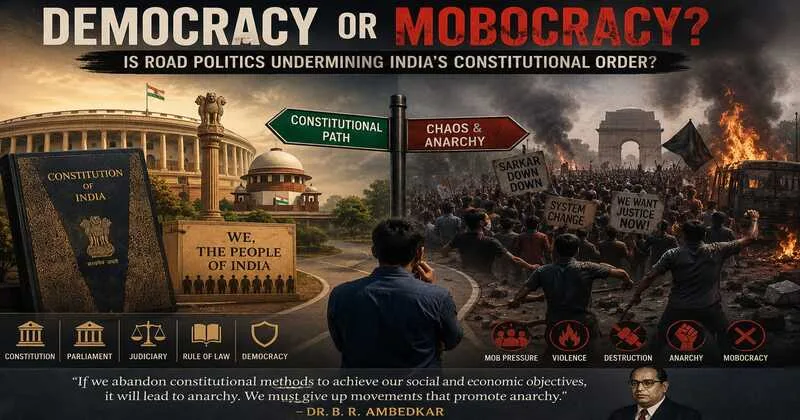
Road politics and street-driven pressure are increasingly challenging India’s constitutional institutions and democratic framework

Road politics and street-driven pressure are increasingly challenging India’s constitutional institutions and democratic framework

Facebook
Twitter
WhatsAppTelegramEmail

Is road politics and the pressure of crowds, in the name of democracy, gradually becoming a new strategy to weaken constitutional institutions?

Some self-proclaimed political thinkers in this country argue that republics are not built in Parliament, but on the roads. If republics were truly built on the roads, then why was the Constituent Assembly constituted? What did the Constituent Assembly deliberate upon for 2 years, 11 months, and 18 days? Was the Republic really created on the roads?

Does the Preamble to our Constitution begin with “We, the People of India” or with “We, the people gathered on the roads”? If roads alone create a republic, then why does a nation need a Parliament, an independent Judiciary, and a Constitution?

Dr B. R. Ambedkar said:

“If we abandon constitutional methods for achieving our social and economic objectives, it will lead to anarchy. We must give up movements that promote anarchy.”

Has Dr Ambedkar’s statement lost its significance today?

The CJP and the NEET protests are currently the subject of discussion everywhere. In protest against the NEET paper leak and demanding the resignation of Union Education Minister Dharmendra Pradhan, the CJP staged a sit-in for more than a month. Taking responsibility, Union Education Minister Dharmendra Pradhan also tendered his resignation.

On 15 May 2026, while dismissing what it described as an unnecessary petition, the Bench headed by the Chief Justice of India remarked on lawyers who repeatedly waste the Court’s time and file frivolous petitions against the system. Referring to such irresponsible elements, the Bench described them as “cockroaches” and “parasites.”

Immediately after this observation, on 16 May 2026, a person named Abhijeet Deepak, residing in Boston, United States, created a satirical Twitter account titled “Cockroach Janata Party” and described it as “the voice of the lazy and the unemployed.” In other words, only one part of the Court’s remarks against irresponsible elements was circulated and presented as an insult to the unemployed, thereby attempting to create a particular narrative.

Also Read: Kodilingam Mandir: The hidden Shiva shrine with thousands of sacred lingams near Suruli Falls

Within just five days, the account had, under suspicious circumstances, amassed 5 million followers on Instagram. Thereafter, on 20 July 2026, ahead of the Monsoon Session of Parliament, the CJP’s “Chalo Parliament” march turned Delhi into a violent battlefield.

Was this protest really against the NEET paper leak? In reality, its principal agenda was to generate public resentment against the system.

Had the protest genuinely been about the paper leak, demands would not have been limited to the resignation of Dharmendra Pradhan alone. The resignations of Punjab Education Minister Harjot Singh Bains and Karnataka Education Minister Madhu Bangarappa would also have been demanded, as their names too were allegedly linked to the paper leak.

Perhaps the youth gathered at Jantar Mantar were unaware of these allegations, because the issue was never merely about the paper leak. Rather, it was about pursuing political interests under the guise of representing the youth-an effort that was allegedly amplified by anti-national forces.

If those leading these protests had genuinely been concerned about the future of the youth, why was there no mention of the Chhattisgarh Public Service Commission (PSC) scam, in which the future of countless young aspirants was allegedly compromised, yet no one accepted responsibility?

In reality, the entire protest was aimed at bringing about a road-based change of power, similar to what was witnessed in Nepal and Bangladesh.

 

Topics: NEET protestCJPRoad PoliticsPolitical ProtestsParliamentDr BR AmbedkarDemocracyConstitutional institutions
Share
Tweet
SendShareSend
✮ Subscribe Organiser YouTube Channel. ✮
✮ Join Organiser's WhatsApp channel for Nationalist views beyond the news. ✮
Previous News

The grammar of democracy must triumph over the grammar of anarchy

Next News

Jyot Foundation hosts second Economics Precursor to reimagine economics through timeless civilisational principles

Related News

Representative Image

The grammar of democracy must triumph over the grammar of anarchy

BJP's Amit Malviya slams CJP founder Abhijeet Dipke over ageist remarks against Anna Hazare

CJP’s Abhijit Dipke Calls Anna Hazare ‘Buddha’, Asks Him to Retire, Sparks Controversy

Representative Image

The Toolkit of Instability: How social media became deep state’s weapon against Bharat

‘Who brought a 12 year old to protest?’: POCSO complaint slams CJP organisers over Jantar Mantar NEET agitation

Keralam PSC under fire over framing questions on CJP protests and placing Malabar Riots under freedom struggle

“He ordered attacks on me”: Influencer Faizan Ansari files police complaint against CJP leader Abhijeet Dipke

Load More

Latest News

Tamil Nadu CM Joseph Vijay and Karnataka CM D.K. Shivakumar

Congress shares power in Tamil Nadu is in power in Karnataka but no talks on Cauvery: CM Joseph ready for dialogue

Rs 100-crore Palani temple land case in Tamil Nadu: Key accused Anwardeen dies in remand

Thrikkakara Vamanamoorthy Mandir

Thrikkakara Vamanamoorthy Temple: The 2,000-year-old Keralam Mandir that marks the origin of Onam

Veer Savarkar question in Keralam school quiz triggers DYFI, MSF protest; minister seeks explanation

Jyot Foundation hosts second Economics Precursor to reimagine economics through timeless civilisational principles

Road politics and street-driven pressure are increasingly challenging India’s constitutional institutions and democratic framework

Democracy or Mobocracy? How road politics is challenging India’s constitutional institutions

Representative Image

The grammar of democracy must triumph over the grammar of anarchy

Prime Minister Narendra Modi and Chinese President Xi Jinping(File Photo)

India-China Boundary Talks: New Delhi pushes for peace across the LAC; Seeks transparency over upstream hydro projects

Churches in northeast oppose FCRA

Why Churches in NE opposing FCRA amendment bill? Missionaries receive 60 per cent of total foreign contributions

ABVP stages protest over irregularities in JPSC-JSSC examinations in Jharkhand

JPSC-JSSC Paper Leak| Arrest of students participating in movement exposes Jharkhand Govt’s anti-student approach: ABVP

Load More
  • Privacy
  • Terms
  • Cookie Policy
  • Refund and Cancellation
  • Delivery and Shipping

© Bharat Prakashan (Delhi) Limited.
Tech-enabled by Ananthapuri Technologies

  • Home
  • Search Organiser
  • Bharat
    • Assam
    • Bihar
    • Chhattisgarh
    • Jharkhand
    • Maharashtra
    • View All States
  • World
    • Asia
    • Africa
    • North America
    • South America
    • Europe
    • Australia
  • Editorial
  • Operation Sindoor
  • Opinion
  • Analysis
  • Defence
  • Culture
  • Sports
  • Business
  • RSS @ 100
  • Entertainment
  • More ..
    • Sci & Tech
    • Vocal4Local
    • Special Report
    • Education
    • Employment
    • Books
    • Interviews
    • Travel
    • Health
    • Politics
    • Law
    • Economy
    • Obituary
  • Subscribe Magazine
  • Read Ecopy
  • Advertise
  • Circulation
  • Careers
  • About Us
  • Contact Us
  • Policies & Terms
    • Privacy Policy
    • Cookie Policy
    • Refund and Cancellation
    • Terms of Use

© Bharat Prakashan (Delhi) Limited.
Tech-enabled by Ananthapuri Technologies