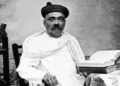

“If the Gita was preached to desponding Arjuna to make him ready for fight—for the Action – How can it be said that the Ultimate lesson of the great book is Bhakti or Jnana alone? In fact, there is a blending of all these Yogas in the Gita; and as the air is not Oxygen or Hydrogen or any other gas alone but a composition of all these in certain proportion, so in Gita all these Yogas are blended into one”
– Lokmanya Bal Gangadhar Tilak, Introduction, Sri BhagwadGita-Rahasya or Karma-Yoga-Shastra (English Translation), First Edition, Vol I, Tilak Bros., Bombay Vaibhav Press, Bombay, 1935, p. XXV
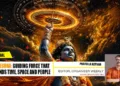
Sri Krishna Janmashtami is a joyous occasion across Bharat, irrespective of region, language, sect, or way of worship. What is so special about the life and message of Yogeshwar Krishna that transcends time, space and people?
The avatara was born and survived amidst all odds, known for his Leela – the tricks – in many forms, yet Sri Krishna connects with everyone for some or the other reason. Right from birth till the tragic end of the human, bodily existence of the blessed Almighty is without the Dharmakshetra – Kurukshetra in the literal sense. The eternal song by the Almighty Himself – Bhagwad-Gita – starts with Dharmakshetre – Kurukshetre. Though it is meant for the actual war zone in the great epic of Mahabharata where the two sides of the same family – Kuru Dynasty – are having face off – embodying Dharma and Adharma, the entire life and message of Krishna is Dharmakshetra and Kurukshetra. As we all get confused in life, Dharma should be the guiding force and only an action-oriented life, detached from the outcome, can give you the path to tread on the life of Kurukshetra – the continuous war between choosing right and wrong. As Bhagwan’s human avatara explains all situations, corresponding actions and the appropriate Yoga or method of union for the same, everyone can relate to the philosophy and life presented in the form of Sri Krishna.
As Lokmanya Tilak in his great commentary on Bhagwad-Gita – Gita-Rahasya argues with conviction, “Action alone must be our guiding principle, action disinterested and well thought out. It does not matter who the Sovereign is. It is enough if we have full liberty to elevate ourselves in the best possible manner. This is called immutable Dharma, and Karma-Yoga is nothing but the method which leads to the attainment of Dharma or material and spiritual glory”. This was Tilak’s interpretation of Krishna and his teachings during the freedom struggle. The original classical Bhashya – commentary by Adi Sankara – interprets the same texts to revive the Advaita siddhanta – non-dualism. For Vaishnavaites, it is the Bhakti that is the fundamental Yoga – pathway – to be one with the Universal Consciousness. From Vivekananda and Aurobindo to Gandhiji and Bhagat Singh, the Gita remains the guiding force because its message transcends time. In fact, Krishna provides an eternal message for action-oriented living that serves as a lighthouse at any point of time. Bharat, the longest-living civilisation, has invoked and taken shelter under Krishna’s consciousness whenever twists and turbulence have arisen, since time immemorial.
When the message is universal, that balances between spiritual and material well being, Sri Krishna does not confine himself to national boundaries. As Tilak explains, “If man seeks unity with the Deity, he must necessarily seek unity with the interests of the world also, and work for it. If he does not, then the unity is not perfect, because there is union between two elements out of the three (man and Deity) and the third (the world) is left out”. No wonder that, from Albert Einstein to Ralph Emerson, many Western philosophers were influenced by Sri Krishna and the song of the Bhagwan.
Robert Oppenheimer, the father of the atomic bomb in the USA, quoted the Gita saying “Now I am become Death, the destroyer of worlds”. German philosopher Arthur Schopenhauer connected deeply with the text and is believed to have danced through the streets with the book balanced on his head. The acceptance of the Gita in the Eastern World is even more profound.
There are more than forty English translations of Bhagwad Gita. If we include other languages, the number is countless. Unlike other texts confined to specific religions and rigid in interpretation, the Gita, in the true spirit of Hinduness, allows spiritual democracy in the true sense. Anyone can understand and interpret it as per the situation and choose the appropriate path – the Yoga – to be in Union with the Universal. Sri Krishna’s Gita transcends people, cutting across regions, religions, races, and languages, and has made an impact across the world and across different disciplines.
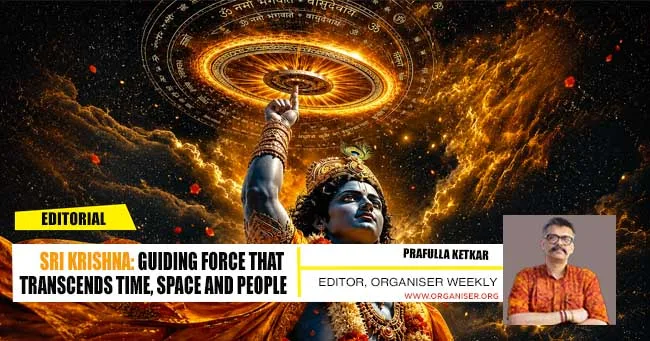
Presently, the world is undergoing fundamental changes, and the so-called world order is turning chaotic. Anxieties of different kinds are creating confusion and suspicion about each other and the future of existence. Everyone is experiencing different kinds of anxieties stemming from uncertainty. When the entire world is looking like Kurukshetra, Sri Krishna is all the more relevant to guide the confused Arjuna within us. His weapon, the Sudarshan Chakra, is more than a weapon, as it is a timeless symbol of cosmic power and divine justice. It is meant to maintain balance in the universe through the cycle of creation and destruction. Spiritual and material powers unite in the Sri Krishna avatara and preserve Dharma. That should be the biggest inspiration for us to follow Karma Yoga, or as Lokmanya Tilak calls ‘the law of duty’ – that combines all that is best in spiritual science, in actual action and in an unselfish meditative life. When the world is running behind brute military power, technology, and wealth accumulation, Sri Krishna is the guiding force that transcends time, space, and people to restore compassion, equanimity, and spirituality as the guiding force. Keep yourself calm, stand for the Dharma, handle the most difficult situation with courage and conviction and while doing all this, keep smiling- this is the life message of Sri Krishna. Detached attachment to righteous action is the only freedom we have in life; the rest is illusion. All Yogas are important, provided we choose them according to our temperament and the need of the hour. To realise Universal Oneness, we need to realise inherent unity while celebrating diversity. Yogeshwar Sri Krishna’s yogic wisdom is a universal guide for the same. Jai Sri Krishna! Happy Janmashtami!