A reading session in Ahmedabad featuring Malala Yousafzai’s I Am Malala and Anne Frank’s The Diary of a Young Girl turned into a controversy on August 27 after members of the Bajrang Dal and Vishwa Hindu Parishad (VHP) objected to the choice of books and disrupted the gathering.
The reading session was organised at AUDA Garden in Vastrapur amid an ongoing dispute linked to Anand Niketan School in Ahmedabad’s Shilaj area. The controversy initially involved action against the school over a food safety issue and subsequently extended to questions around the reading of Malala’s memoir and Anne Frank’s diary.
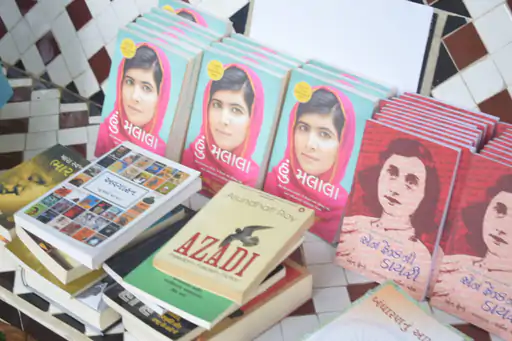
Around 50 students, lawyers, media professionals and others had gathered at the park at around 4 pm for what organisers described as a silent reading session. Several books and other material were part of the gathering, including I Am Malala and The Diary of a Young Girl.
The choice of Malala’s book, however, became the main point of contention. According to the organisers, the gathering was intended simply as a reading exercise. The Bajrang Dal took a different view, objecting specifically to the inclusion of Malala’s work and questioning its relevance and content.
Around 6.30 pm, a group of around 30 to 40 men reportedly arrived at the park. According to the organisers’ complaint, the group included people wearing saffron scarves and led to a confrontation over the reading of Malala’s book.
The Bajrang Dal subsequently said on social media that its members had intervened because the gathering involved what it described as “anti-national” literature by Malala. The organisation claimed that it would not allow what it called “anti-India forces” to be propagated.
The disagreement therefore goes beyond the disruption of one reading session and centres on a larger question: why has Malala Yousafzai’s I Am Malala become a politically contested book in this context?
I Am Malala is the memoir of Malala Yousafzai, the Pakistani education activist who became internationally known after being attacked by the Taliban for advocating girls’ education. The book recounts her childhood in Pakistan’s Swat Valley, the rise of Taliban influence in the region, the attack on her and her subsequent campaign for education.
Malala’s account deals extensively with the Taliban, religious extremism, Pakistan’s political environment and the struggle for girls’ education. Her international profile and subsequent advocacy have also made her a polarising figure in some political debates.
In the Ahmedabad case, the Bajrang Dal has used the description “anti-national” for the material being read, while those organising the session have presented the gathering as a peaceful exercise in reading and discussion.
Anne Frank’s The Diary of a Young Girl was also among the books being read at the session. Frank’s diary documents her life while hiding from the Nazis during the Holocaust and has become one of the best-known accounts of persecution and war through the eyes of a young person.
The presence of both books at the Ahmedabad gathering has consequently added an educational and political dimension to the controversy. While the organisers viewed the books as works that could be read and discussed in a public setting, opponents objected to Malala’s book on ideological grounds.
The controversy is also connected to the earlier developments at Anand Niketan School in Shilaj. The school had faced action over a food safety issue, after which the question of reading material, including I Am Malala and Anne Frank’s diary, became part of the wider public debate.
The August 27 reading session was an attempt by a group of students, professionals and others to engage with the books outside the school setting. However, the event itself became contentious after the objections from the Bajrang Dal and VHP.