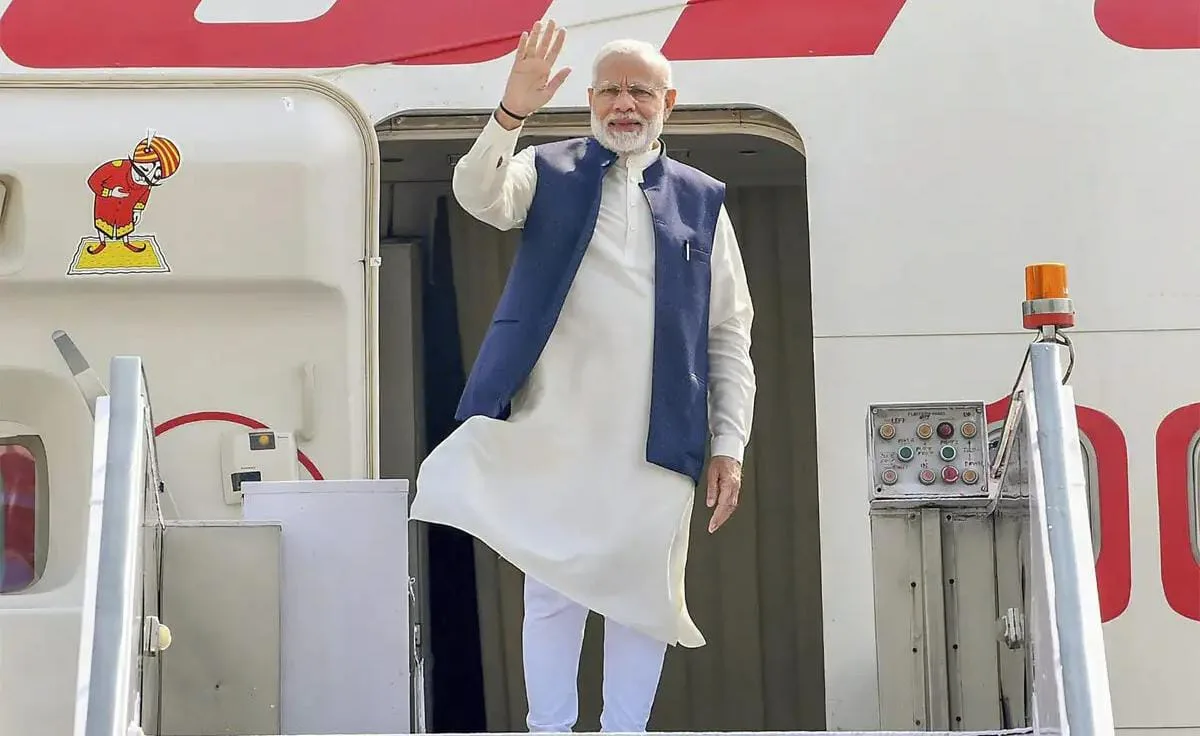
New Delhi: Prime Minister Narendra Modi will begin a four-day visit to Central Asia on August 29, 2026, undertaking a State visit to Uzbekistan before travelling to Kyrgyzstan to participate in the 26th Shanghai Cooperation Organisation (SCO) Summit. The visit, scheduled from August 29 to September 1, comes at a time when Central Asia is assuming increasing strategic and economic importance for India.
The Prime Minister will begin his visit in Tashkent, Uzbekistan’s capital, where he will hold extensive talks with Uzbek President Shavkat Mirziyoyev to further strengthen the strategic partnership between the two countries. From Uzbekistan, PM Modi will travel to Bishkek, the capital of the Kyrgyz Republic, for the SCO summit, where India is expected to articulate its priorities on security, connectivity and opportunity.
Tashkent visit to strengthen India-Uzbekistan strategic partnership
At the invitation of President Shavkat Mirziyoyev, PM Modi will undertake a State visit to Tashkent on August 29 and 30. The visit will be his fourth trip to Uzbekistan and is expected to provide fresh momentum to the growing India-Uzbekistan strategic partnership.
PM Modi and President Mirziyoyev will hold delegation-level talks covering a broad spectrum of cooperation. The discussions are expected to focus on trade and investment, defence, digital connectivity, healthcare, energy, education, technology and people-to-people exchanges.
The two leaders will also review progress in their strategic partnership and explore opportunities to deepen cooperation in emerging and high-growth sectors. Critical minerals, pharmaceuticals, space cooperation and greater business-to-business engagement are expected to feature prominently in discussions as New Delhi and Tashkent seek to expand their economic partnership.
The Ministry of External Affairs has said that the leaders will also share perspectives on advancing the shared developmental visions of Viksit Bharat 2047 and Uzbekistan-2030. The alignment of these long-term national development strategies reflects the growing convergence between India and Uzbekistan on economic modernisation, technological advancement and sustainable development.
The Tashkent visit is also expected to strengthen India’s engagement with Central Asia, a region that has gained greater geopolitical and economic significance amid changes in the international order. Stronger links with Uzbekistan offer India opportunities to expand its presence across Eurasia while building partnerships in connectivity, energy, trade and strategic sectors.
During his visit, PM Modi is also expected to visit the Lal Bahadur Shastri memorial in Tashkent, paying tribute to the former Indian Prime Minister whose historic association with the Uzbek capital remains an important symbol of India-Uzbekistan relations. He is also expected to visit the Mahatma Gandhi Centre at the Tashkent State University of Oriental Studies, highlighting the deep civilisational and cultural connections between India and Central Asia.
India to highlight security, connectivity and opportunity at SCO summit
Following his engagements in Tashkent, PM Modi will travel to Bishkek at the invitation of Kyrgyz President Sadyr Zhaparov. He will attend the 26th SCO Summit, which is expected to deliberate extensively on the evolving regional and international security environment.
The Prime Minister will address the SCO Summit and underline India’s priorities of security, connectivity and opportunity.
These themes reflect New Delhi’s broader vision for a stable, secure and economically connected Eurasian region, with particular emphasis on cooperation against terrorism and other cross-border threats.
The SCO was established with the primary objective of addressing terrorism, separatism and extremism, challenges that continue to affect the wider region. India, which became a full member of the organisation in 2017, has consistently emphasised the need for credible and coordinated international action against terrorism in all its forms.
The Bishkek summit is particularly significant as the SCO marks its 25th anniversary. India is expected to use the platform to advance its vision of stronger regional cooperation based on mutual respect, sovereignty, connectivity and shared economic opportunities.
Several major leaders, including Chinese President Xi Jinping, Russian President Vladimir Putin and Pakistan are likely to attend the summit. PM Modi will also hold bilateral meetings with SCO leaders on the sidelines of the gathering. Russian President Vladimir Putin is among the leaders with whom the Prime Minister is expected to hold a bilateral meeting.
The bilateral engagements are expected to complement India’s wider diplomatic outreach and provide New Delhi with an important opportunity to discuss regional security, connectivity, economic cooperation and other pressing international developments directly with key partners.
During his stay in Bishkek, PM Modi is also scheduled to attend the opening ceremony of the sixth World Nomad Games, a major celebration of the rich cultural heritage and traditional sporting practices of Central Asia.
The four-day visit from August 29 to September 1 underlines India’s expanding engagement with Central Asia and its growing role in shaping regional discussions on security, economic cooperation and connectivity.
Beginning in Tashkent and concluding with high-level engagements at the SCO Summit in Bishkek, PM Modi’s visit is set to reinforce India’s strategic partnerships and advance New Delhi’s interests across a region of rising geopolitical importance.