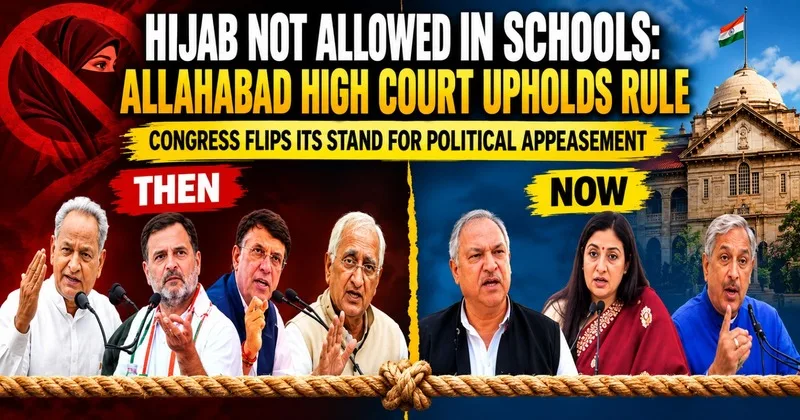
New Delhi. In Indian democracy, maintaining a balance between religious symbols and a uniform dress code within educational institutions has always been a sensitive issue. This August, a two-judge Bench of the Allahabad High Court delivered its verdict on a petition filed by a Class XI student of a private school in Prayagraj. Congress has now openly come forward to practise appeasement over the decision.
In fact, until yesterday, Congress had described the veil as a symbol of backwardness and run a ‘Remove the Veil Campaign’. Today, in the name of appeasement, the same party is defending the hijab over the school’s dress code, and the very veil that was being described as ‘backwardness’ has now become a matter of choice.
It is noteworthy that the student had challenged the school administration’s rule under which she was prohibited from wearing a hijab within the school premises. In its detailed legal and constitutional analysis, the court made it clear that Article 25 of the Indian Constitution does grant citizens freedom of conscience and the freedom to freely profess, practise and propagate religion, but this right is not absolute. It is subject to public order, morality, health and institutional discipline.
In 2019, the Congress govt in Rajasthan launched a campaign called "Ghoonghat Hatao Abhiyan" because ghoonghat is regressive. That’s okay!
But today, after Allahabad High Court rejected the argument that wearing the hijab is an essential Islamic practice. And now, that girl… pic.twitter.com/Do2ePs2tmq
— Anshul Saxena (@AskAnshul) August 25, 2026
Referring to the doctrine of ‘essential religious practice’, the court held that wearing a hijab is not such an integral part of Islam that without it the religion itself would cease to exist. Consequently, the court made it clear that in secular educational institutions, the uniform code prescribed by the school is paramount for maintaining an atmosphere of discipline and equality, and no student, male or female, has a legal right to seek exemption from it on the basis of personal or religious preferences.
As soon as this verdict was delivered, a new political storm erupted across the country. The principal Opposition party, particularly the Indian National Congress (INC), openly came out against the decision and in support of the student’s right to wear the hijab. Statements issued by Congress not only questioned the judicial interpretation, but also gave rise to an ideological contradiction that has itself put the party’s earlier stand on the veil in the dock.
Congress’s Ideological Contradiction: 2019’s ‘Remove the Veil’ versus 2026’s ‘Save the Veil’
The most interesting and controversial aspect of the entire development is the ideological U-turn clearly visible in the statements of the Congress party. A comparison between its historical and current positions makes this easy to understand. In 2019, the then Congress government led by Ashok Gehlot in Rajasthan launched a statewide ‘Remove the Veil Campaign’.
Under this campaign, conducted through the Department of Women and Child Development, the Congress government and its ministers clearly argued that the practice of veiling was a major obstacle to women’s empowerment. It was described as a social evil, a symbol of patriarchal oppression and ‘backwardness’. Through gram panchayats and women’s groups, the government encouraged women to abandon the veil and join the mainstream of society without any form of covering. At that time, Congress’s progressive agenda was to liberate women from conservative traditions such as the veil.
दुपट्टा-घूंघट पर पितृसत्ता,
हिजाब-अबाया पर “चॉइस”वाह हिंदू विरोधी कांग्रेस..
महिलाओं की स्वतंत्रता के नाम पर भी चुनिंदा विचारधारा और सुविधा की राजनीति, क्या गजब का डबल स्टैंडर्ड है 😏
कांग्रेस का असली चेहरा सिर्फ हिंदुओं का विरोध करना है भले वो किसी भी तरह से किया जाए… pic.twitter.com/RjQGDVzKQK
— Abhishek Tiwari (@lkoabhishek) August 25, 2026
The Current Stand in 2026: Defending the Veil in the Hijab Controversy
Following the Allahabad High Court verdict, when Congress had to defend the right to wear the hijab in educational institutions, the party’s leaders developed a new argument. They now say that whether it is a hijab or a veil, it is a matter of any woman’s ‘Personal Choice’ and ‘Bodily Autonomy’. The BJP has now launched a strong attack on this position.
Political analysts, meanwhile, say that because of its political compulsion to justify the hijab over the school dress code, Congress now appears, knowingly or unknowingly, to be standing in support of the practice of veiling as well. The same veil which, until a few years ago, was described as ‘backwardness’ and ‘a rule imposed by a male-dominated society’, has suddenly been presented today as an expression of women’s ‘free will and agency’, so that the court order restricting the hijab can be opposed logically.
Ur full para is about hijab and hijab. U cheekily sneaked in ghunghat in the end and gave it a secular look.
Anyways see, u dont need so much of chaatukarita to get muslim community votes. Its either congress or AIMM or SP in some other states. So y do u still politicising hijab…— Nik (@10messi_aa_aaah) August 25, 2026
Statements by Congress Leaders Opposing the Court’s Decision
Following the Allahabad High Court verdict, several senior Congress leaders, spokespersons and MPs expressed their reactions on public platforms and social media. Pawan Khera, head of the Congress party’s media department, presented the party’s position on the issue in the most aggressive manner. Challenging the fundamental legal spirit of the court’s decision, he viewed it entirely through the lens of social and personal freedom.
Pawan Khera, expressing a strong reaction against the verdict on his official social media handle (X), wrote that “whether hijab is an essential part of Islam or not is not for the courts to decide, rather this decision should be left to religious scholars and Islamic experts.” Taking his statement further, he directly referred to the veil and said, “As a social and political party, we stand firmly with women for their Bodily Autonomy and freedom. A woman, regardless of her religion, caste or class, should have the full right to choose what she wants to wear, whether it is a hijab, veil or any other attire.”
He linked his campaign on social media with hashtags such as #BreakTheCage and #SmashThePatriarchy, making it clear that Congress views the fight for the right to wear the hijab as a matter of women’s freedom, even if doing so requires it to support the veil.
Whether the hijab is essential to Islam or not is for religious scholars to decide.
From a socio-political standpoint, we stand firmly for women’s bodily autonomy and agency.
Every woman, irrespective of caste, class or religion, is entitled to wear what she chooses — hijab,…
— Pawan Khera 🇮🇳 ಪವನ್ ಖೇರಾ (@Pawankhera) August 25, 2026
Salman Khurshid (Former Foreign Minister and Senior Congress Leader)
Former Law Minister of India and veteran Congress leader Salman Khurshid registered his legal and political disagreement with the decision. He questioned the jurisdiction of the Allahabad High Court’s order and its long-term implications. Speaking to the media, Salman Khurshid stressed that the High Court’s decision was not final and that its impact within the country’s judicial system would be very limited. He said that the decision would not be very effective because the Supreme Court of India had already interpreted citizens’ fundamental rights broadly in several other cases.
Khurshid argued that the inherent rights of any citizen, such as what they wear, what they eat, how they display their faith and where they pursue education, are constitutionally paramount. He made it clear that the matter should ultimately be taken before the Supreme Court, because it is the country’s highest court and its decision alone would constitute the final and universally accepted guiding principle for the entire country.
#WATCH | Delhi | On Allahabad High Court rejecting a student's plea to wear a hijab in school, Congress leader Salman Khurshid says, "The Supreme Court has already settled this matter… I do not believe the Allahabad High Court's ruling will be particularly consequential, given… pic.twitter.com/NzwzEJAKTa
— ANI (@ANI) August 25, 2026
Shakeel Ahmed Khan (Senior Congress Leader and MLA)
Senior Bihar Congress leader Shakeel Ahmed Khan targeted the social and religious aspects of the court’s decision and directly linked it to the religious identity of the minority community. Shakeel Ahmed Khan expressed deep concern and disagreement over the decision of the two judges of the Allahabad High Court, saying that the matter was entirely about an individual’s personal freedom. If a female student wishes to use a hijab, headscarf or niqab to cover her head because of her religious faith, family tradition or personal choice, no educational institution or administrative rule should stand in her way. He alleged that through such restrictions, attempts are made to keep girls from a particular community away from education or make them feel uncomfortable, which is against the principles of democracy.
#WATCH | Delhi: On Allahabad High Court rejecting a student's plea to wear hijab in school, Congress leader Shakeel Ahmad Khan says, “These observations may be valid, but why does this issue arise in the first place? I would like to view the hijab issue in the context of the… pic.twitter.com/onDj65wblG
— ANI (@ANI) August 25, 2026
Anupama Acharya (Congress National Spokesperson)
Presenting Congress’s position during national debates on television channels, national spokesperson Anupama Acharya portrayed the issue as a fight for human rights and against oppression. During television debates, Anupama Acharya presented arguments in support of students who favoured wearing the hijab. She said that citizens have every right to stand against their oppressors and oppressive rules. The state or school administration should not have the right to decide what the length, width or form of a girl’s clothing should be. No rule should be so rigid that it erases someone’s cultural identity itself.
Pramod Tiwari and Alka Lamba (Senior Congress Leadership)
Citing the diversity of the country, they said that in a multicultural society such as India, attempts to impose uniformity always create controversy. School uniforms should be respected, but they should not be so harsh as to hurt anyone’s religious sentiments.
Meanwhile, in this case, Alka Lamba (President, All India Mahila Congress) spoke from the perspective of women’s empowerment and said that in a progressive society, it should be entirely the decision of women and girls how they wish to present themselves in society. She said that men or male-dominated systems, whether school administrations or governments, must abandon their habit of imposing restrictions on women’s clothing.
#WATCH | Delhi | On Allahabad High Court rejecting a student's plea to wear a hijab in school, Congress leader Mumtaz Patel says, "Hijab is an important part of Islam. But yes, there is a large number of women —including me— who wear or do not wear hijab of their own volition.… pic.twitter.com/2mES4Zcad2
— ANI (@ANI) August 25, 2026
The Composition of the Judges’ Bench and the Politics of the ‘Narrative’
An extremely important and subtle aspect of the entire development is the composition of the Bench that delivered the judgment. The decision was collectively delivered by a two-member Bench comprising Justice J.J. Munir and Justice Indrajit Shukla. Such decisions are often sought to be discredited by portraying them as the outcome of ‘Brahmanical Patriarchy’ or a ‘majoritarian mindset’. However, in this particular case, because one of the judges on the Bench was Justice J.J. Munir, it became impossible for critics and Opposition parties to attach any caste-based, religious or communal label to the decision.
The unanimous decision delivered by judges belonging to two different social and religious backgrounds proved conclusively that the judiciary’s decision was not driven by any social prejudice or patriarchal thinking, but was based purely on the legal provisions of the Indian Constitution, the school’s rules and the principle of national uniformity. This is why Congress and other Opposition leaders could not play the caste card to portray the decision as ideologically ‘weak’, but they have certainly begun making every effort to give it the colour of ‘personal freedom’ and ‘the politics of choice’.
Appeasement versus Constitutional Uniformity
The Allahabad High Court’s decision and the subsequent turmoil within the Congress party are now a living example of how political parties sacrifice ideological principles for their immediate interests. Today, Congress is describing this as an attack on minority rights and personal freedom, whereas the same Congress had described its own ‘Remove the Veil’ campaign in 2019 as progressive. Today, in its blind support for the hijab, it is also attempting to restore the veil in society by treating it as a ‘woman’s choice’.
हिजाब पर हंटर.
मातम में कांग्रेस!
मिलॉर्ड ने राहुल के षड्यंत्र की बखिया उघेड़ दी!#Hijab #Rahulgandhi #Congress https://t.co/O2PUvSCB1l pic.twitter.com/EOMIWpvzFm— Manish Thakur (@Thakur312Manish) August 25, 2026
In the days ahead, this legal battle will certainly reach the corridors of the country’s highest court, the Supreme Court, but on the political and social fronts, this debate has once again made it clear that Congress, as always, can go to any extent to pursue the politics of appeasement. In India, the definitions of modernity, women’s rights and secularism change over time for Congress according to political convenience.