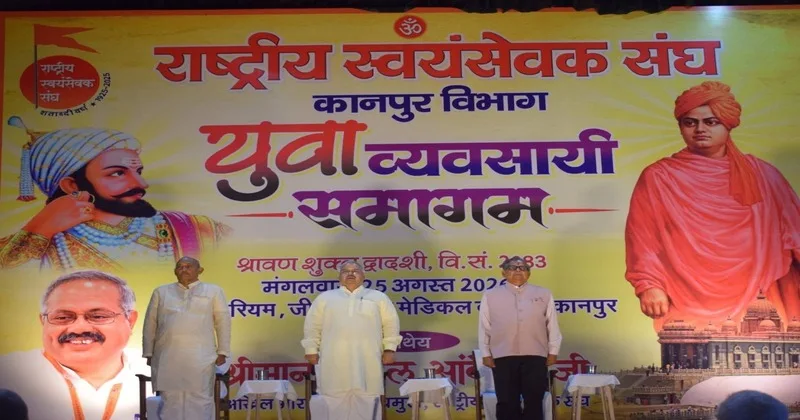
KANPUR: The Rashtriya Swayamsevak Sangh (RSS), Kanpur, organised a ‘Youth Business Conclave’ at the auditorium of Ganesh Shankar Vidyarthi Medical College. Held as part of the RSS centenary celebrations, the programme witnessed the participation of hundreds of prominent young entrepreneurs, businesspersons, industrialists, doctors, professors and intellectuals from the city.
The programme was formally inaugurated by RSS Akhil Bharatiya Prachar Pramukh Sunil Ambekar Ji, Prant Sanghchalak Bhawani Bhik Ji and Vibhag Sanghchalak Dr Shyam Babu Gupta Ji through the lighting of the ceremonial lamp and offering floral tributes to Bharat Mata. This was followed by the singing of the national song, ‘Vande Mataram’.
Addressing the gathering, Sunil Ambekar Ji highlighted the RSS’s 100-year journey and its foundational objectives. He said that the RSS was founded in 1925 on Vijayadashami by Pujaniya Dr Keshav Baliram Hedgewar Ji, and most of the young associates who joined him were barely 20 years old.
Dr Hedgewar Ji himself went to jail during the movement in 1931, and the British government kept a close watch on him. Ambekar Ji said the British had launched not only political and economic attacks but also cultural and religious attacks on India. Dr Hedgewar Ji firmly believed that India needed freedom not merely from political subjugation but also from cultural and mental slavery.
He recalled that in 1936, when Mahatma Gandhi visited an RSS camp at Sevagram and suggested that the Sangh should work under the Congress, Dr Hedgewar Ji respectfully explained that the permanent regeneration of the nation required an independent and selfless organisation dedicated to character-building.
At a time when it was believed that great tasks required only great leaders, Dr Hedgewar Ji changed this approach. He inspired ordinary citizens to participate in nation-building and developed the shakha system as a mechanism for fostering discipline, patriotism and personality development through games and collective activities.
Sunil Ambekar Ji said that throughout its historical journey, the RSS has remained committed to the single objective of creating patriotic and responsible citizens.
Referring to the Partition of 1947, he said that RSS volunteers and Shri Guruji, the second Sarsanghchalak, devoted their entire strength to protecting society during the tragic period, with several workers making the supreme sacrifice. In 1948, the RSS was banned following what he described as false allegations regarding Mahatma Gandhi’s assassination, and the ban was subsequently lifted without any conditions.
He also recalled the Emergency imposed in 1975, when civil liberties were curtailed. RSS volunteers played a significant role in the struggle for the restoration of democracy. After the Emergency, when the government changed, the third Sarsanghchalak, Pujaniya Balasaheb Deoras Ji, called upon society to “forget and move forward” and worked towards rebuilding social unity.
Ambekar Ji also referred to the 1963 Udupi conference in Karnataka, where revered saints were brought together on a common platform and the historic declaration ‘Na Hindu Patito Bhavet’ was made, conveying that no Hindu is fallen or untouchable. He said that when every individual carries a divine presence, there can be no place for untouchability or caste-based discrimination in society.
Discussing contemporary global and national challenges, Sunil Ambekar Ji called upon society to adopt the five resolutions of ‘Panch Parivartan’ proposed by the RSS:
1. Social Harmony: Eliminate discrimination based on caste, sect and class, with every family taking the initiative towards social harmony.
2. Kुटुंब Prabodhan (Family Values): The family is the foundation of Indian culture. He emphasised the need to spend time with children, have meals together as a family and create an environment of values and संस्कार at home.
3. Environmental Protection: Adopt a lifestyle that is in harmony with nature and the environment.
4. Sense of ‘Swa’ (Swadeshi and Self-Respect): Take pride in one’s language, culture and identity, and develop the confidence to use one’s own language, including signing in it, while freeing oneself from a colonial mindset.
5. Civic Duties: Every citizen should sincerely and faithfully fulfil their fundamental duties.
He said the construction of the Ram Temple and the abrogation of Article 370 were not merely the result of government initiatives but became possible when society collectively resolved to achieve these objectives. He said that challenges such as religious conversion, ‘love jihad’ and divisive forces continue to confront society, and people must remain alert and take responsibility for addressing such challenges rather than becoming helpless.
Ambekar Ji said that more than 1.50 lakh service activities are currently being carried out across the country by the RSS and various associated organisations. He highlighted the extensive network of Ekal Vidyalayas and Sewa Bharati working in remote tribal and rural areas to provide education, healthcare and opportunities for self-reliance. He also noted that the relief work undertaken by Hindu society and RSS volunteers during the COVID-19 pandemic provided an example at the global level.
He called upon young businesspersons, professionals, NGOs and members of the intellectual community to visit RSS shakhas, understand its ideology and organisational methodology, and actively contribute to its various service initiatives.
The programme concluded with the collective singing of the national anthem.