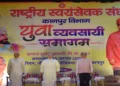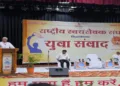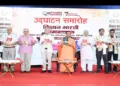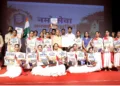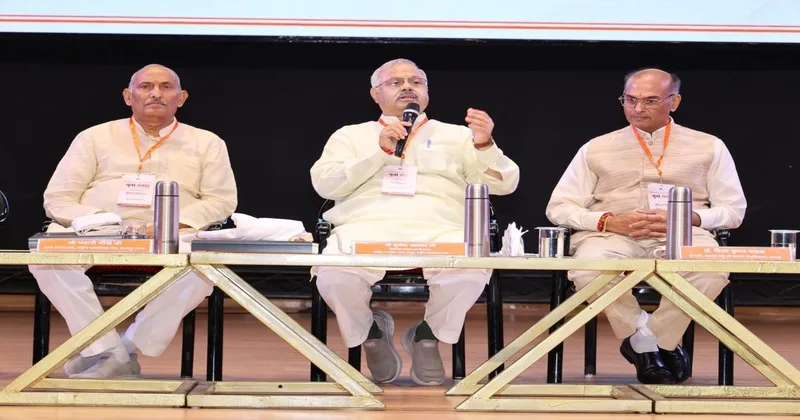
Kanpur: A ‘Yuva Samvad’ programme was held at the Veerangana Rani Lakshmibai Auditorium of Chhatrapati Shahu Ji Maharaj University, Kanpur. RSS Akhil Bharatiya Prachar Pramukh Sunil Ambekar was present as the chief speaker at the special dialogue programme. The programme was presided over by the University Vice-Chancellor, Prof. Vinay Kumar Pathak Ji.
During the programme, while answering questions raised by students on the social and cultural unity of Bharat, Sunil Ambekar said that the diversity of Bharat is its strength. “The fundamental work of the Sangh is to remove that forgetfulness in society which separates us from our roots. Our languages, traditions and forms of worship may be different, but we are all part of the same cultural consciousness.”
He clarified that Bharatiya traditions never become an obstacle to individual freedom; rather, they complement one another. He called upon the youth to move beyond binary thinking. The fundamental elements of Hindutva are ‘unity’, ‘togetherness’ and ‘co-existence’. The values of sacrifice, dedication and service are what connect all Bharatiyas with one another.
Addressing the concerns of the youth regarding artificial intelligence (AI) and employment in the modern era, he said that human ‘discretion’ is its greatest strength, which no machine can replace. In the age of AI, it can provide information and process it quickly. But the ability and discretion to decide what should be said in which situation and which decision would be in the interest of everyone and conducive to the welfare of society rests with human beings. The youth should take decisions according to their discretion and act accordingly.
Society itself decides what the framework of technology should be and what kind of life we should live. The youth must first understand themselves so that they can use technology according to their needs.
Sunil Ambekar mentioned the service projects run by the Sangh. He spoke about ‘Saksham’ for the empowerment of persons with disabilities, ‘Vidya Bharati’ (Shishu Mandir and Vidya Mandir) in the field of education, and ‘Ekal Vidyalaya’ for remote areas. He also discussed the campaign to inspire youth towards self-employment through the ‘Swavalambi Bharat Abhiyan’.
He advised the students not to remain limited to just one degree, but to learn at least 2-3 new skills. In the new education policy, extracurricular activities have now also been made a core part of the curriculum. Researchers and students should always go to primary and original sources instead of depending on secondary sources.
Discussing women’s safety, he said that change must begin with oneself. Efforts should be made to create an environment in one’s university and surroundings where women feel safe. Change is not possible only through rules and laws; for this, an environment of positive thinking and social responsibility must be created beginning from our homes. Every family should discuss safety, respect and good behaviour. From childhood itself, such an environment should be created for children in which they can openly express themselves.
Calling disagreement normal in a democracy, he said that opposition should always remain peaceful. Consensus and dialogue are the greatest means of reaching a decision.
At the beginning of the programme, Vice-Chancellor Prof. Vinay Kumar Pathak Ji welcomed the chief guest and shared his experiences with the Sangh since 1991. He spoke about the work carried out with five people in the initial phase in the field of Ayurveda and discussed the ‘Vedic Book’ prepared by his team.
Prof. Pathak gave the students the example of a ‘laser light and torch’ and conveyed the message of maintaining concentration and a clear direction in life. He shared his experiences of his visit to Japan and concluded his address with lines of former Prime Minister of the country, the late Atal Bihari Vajpayee Ji.
RSS Prant Sanghchalak Bhawani Bhikh Ji, along with a large number of university teachers and students, participated in the programme.