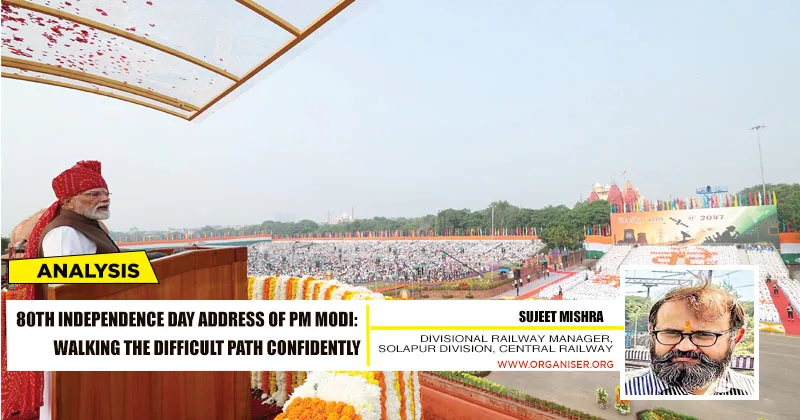
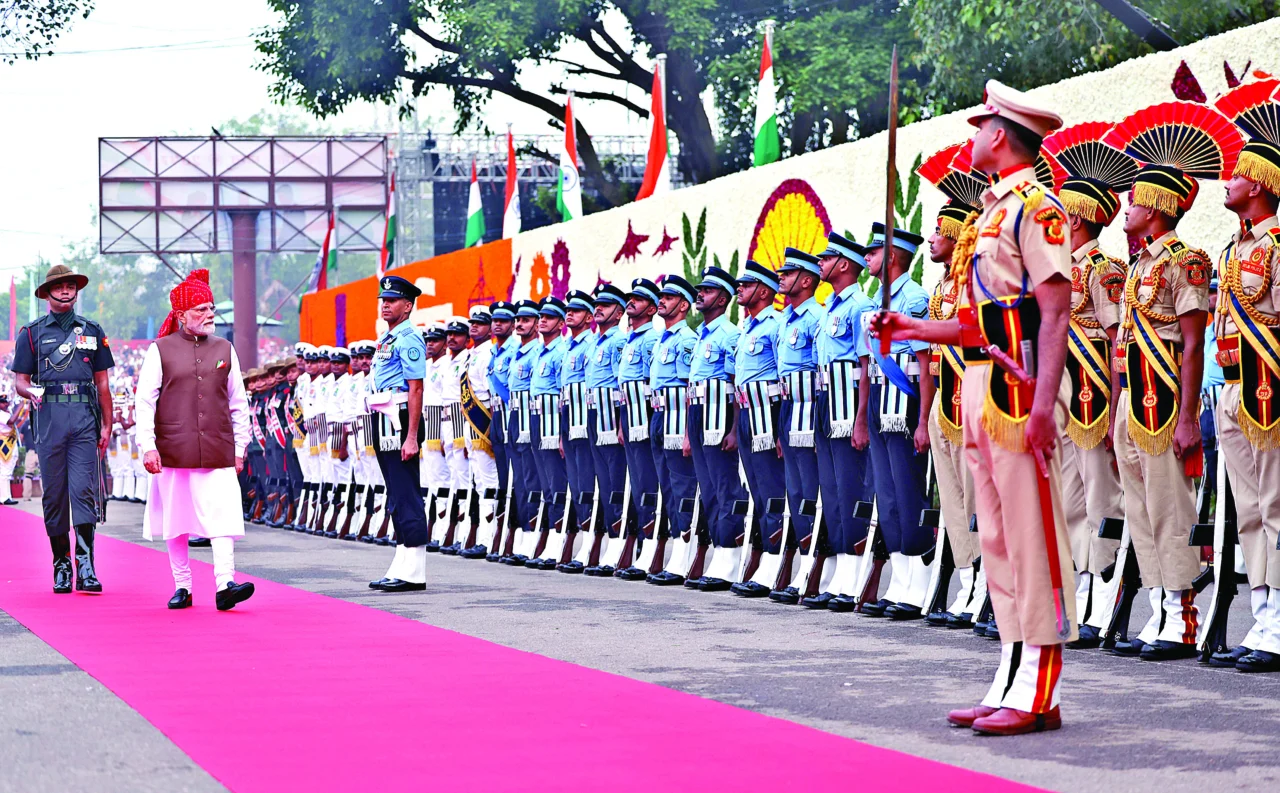
The Prime Minister, from the ramparts of the Red Fort on Independence Day, called for self-confidence, self-pride and self-reliance, but why is a civilisational state marking its eightieth Independence Day found wanting on these? The answer is two centuries long. Colonial rule brought famines, and a condemnation of all that we held dear. Bharat, a major contributor to global GDP, was recast as a burden the sahibs carried. Brutal imperialistic extraction reduced the country to penury. From being counted amongst the fragile five to becoming a major growth engine of the world, Bharat has surely travelled quite some distance, meeting and handling wars, a pandemic and the breakdown of the traditional global order on the way, coming out more resilient.
The rise of civilisational states cannot be fully explained without taking recourse to causality. Nyaya logicians formulate the cause as karya niyata purvavrutti, the invariable antecedent of an effect: that which came before it and cannot otherwise be accounted for. Nothing explains a present state unless it precedes that state. We take this framework to the eightieth Independence Day address. The address makes claims on the future, and a claim on the future is tested by finding what stands behind it. The aviral stream of national consciousness so aptly found expression in the rendition of Vande Mataram from the Red Fort on August 15 for the first time since independence, in the hundred and fiftieth year of the song. That stream might have thinned, but it is roaring now, redeeming the Panch Pran, the five pledges of 2022. So we start a few years back, in the middle of a crisis.
The Vaccine Test
In the spring of 2020 the world rediscovered what a queue is, and it did so in the least dignified way available. Countries argued over the order of a line for a vaccine no laboratory had yet finished making. Advance purchase agreements ran months ahead of the science, and those who signed first were, with few exceptions, those who owned the laboratories. Conditions were attached that no sovereign state would accept in an ordinary year, and several accepted them anyway, because waiting had a body count.
Bharat did two things then, but only one is usually remembered. It built its own, and Covaxin, developed by Bharat Biotech with the Indian Council of Medical Research, was Bharatiya from the design onward and not Bharatiya only at the point of assembly. Then it sent the vaccine out, and from January 2021 the consignments moved under Vaccine Maitri. The second act carries the argument. A country able to make something acquires, along with the thing itself, the option of giving it away. That option is what standing in the world actually consists of. A country that cannot make it has one option, which is to ask, and asking is a posture from which little can be negotiated. It is arithmetic, settled years in advance by decisions that looked purely commercial at the time, and it decides what a foreign ministry can say in a hard week. Dependence is not a cost. It is a lever, and the hand on it is not ours.
Beyond Political Freedom
Political independence was settled in August 1947, and many of the things that political independence was supposed to protect remain unsettled. That is what the Prime Minister called dependence. He named the need to defend our own interests, a clear signal that we will hold out for symmetric relationships.
The Prime Minister carried on from what he had articulated at IIT Delhi barely a week before, where he named three dimensions of the unfinished business — economic self-reliance, technological self-reliance and industrial self-reliance. He offered all three as an achievable ambition and not a mere aspiration or empty dream — Chip se ship tak — all of it here, made by your hands.
The dependence being described is not the work of one government, one party or one decade of bad judgement. It accumulated like silt in a harbour that nobody had dredged. It was laid down by thousands of procurement decisions that appeared entirely reasonable at the time. Each was cheaper on the morning it was taken than the alternative sitting beside it on the table. Silt is nobody’s decision. He said it plainly: the country cannot be run on the policies and rules of a bygone era. Limiting ourselves to what is cheap to buy denudes Bharat’s industrial strength, because the purchase is never seen as part of a larger competence. Employment and growth opportunities slip away to foreign lands, and the dependence that follows is increasingly weaponised. Delay in the supply of specialised tunnelling equipment is a case in point, though we are one of the world’s largest spenders in infrastructure today. Dependence of that kind can choke our ability to create and sustain employment.
For a country whose citizens constitute around 17 per cent of humanity, such dependence erodes self-esteem and self-confidence. That is antithetical to achieving our rightful place in the comity of nations. The address is clear on the remedy. Capturing the entire value chain means design through to manufacturing. This is Make in India rebooted with backward integration. We must own not only the package but also the Intellectual Property (IP) of the product. In short, it is Dream, Design and Make in India.
Facts Against Fear
The address does something no speech of celebration is obliged to do. It stops, at length, on the people who set out to frighten the country, and it repeats what they said. The list he repeats is exact and we can readily relate to it. There would be no vaccine, people would not survive COVID–19, and when West Asia caught fire there would be no petrol at the pump, no gas, no diesel and no fertiliser. All of it was rumour, and he says without softening it that some people took pleasure in keeping Bharatiyas frightened.
Highlights of Prime Minister’s I-Day address
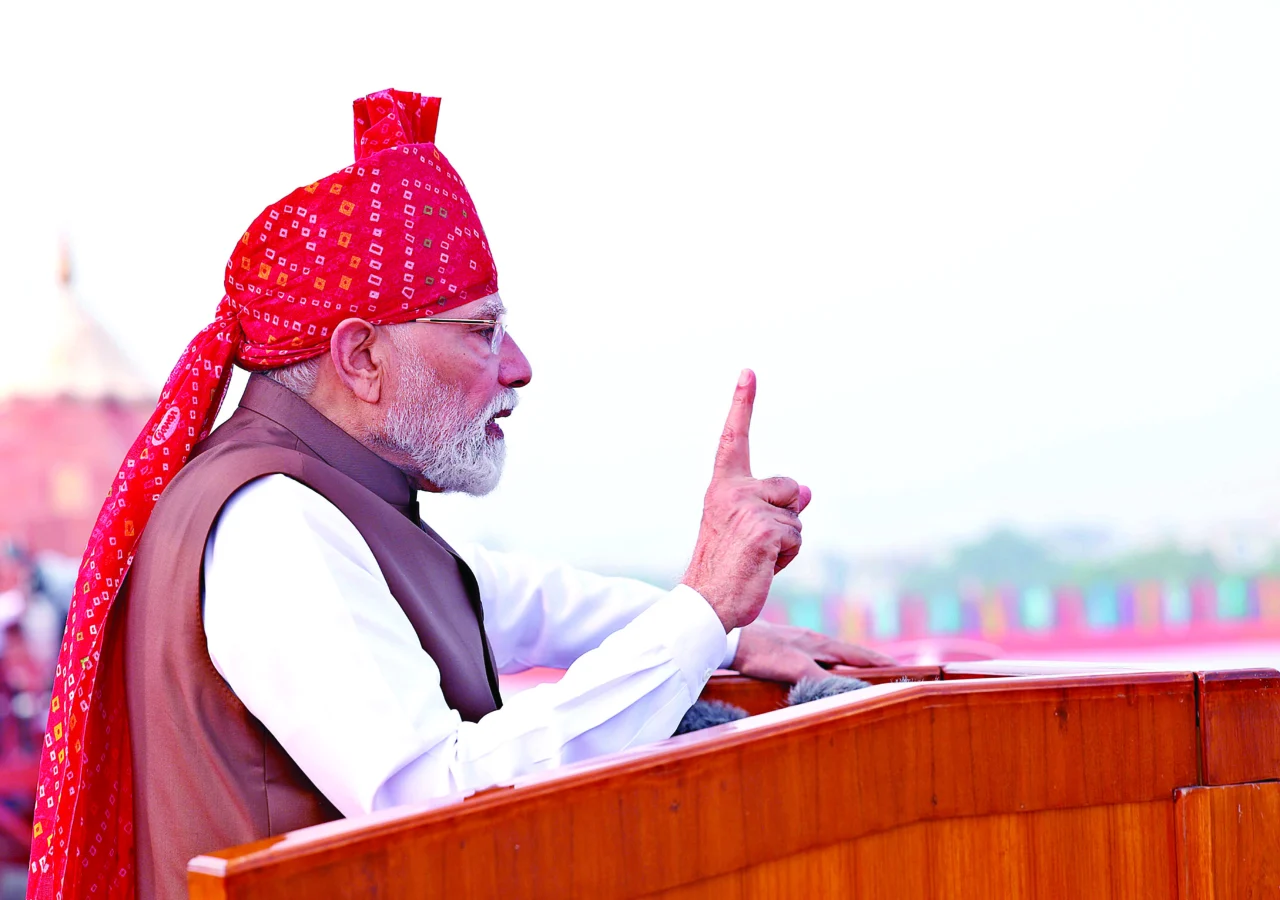
- Today, it is a historic moment for all of us. After 80 years, Vande Mataram was sung at the Red Fort for the first time on the occassion of Independence Day.
- We will strive towards making a ‘Viksit Bharat’ by 2047. This is collective resonance of more than 140 crore nationals.
- Internet users, consumers increased by 4%; digital transactions rose by 100%. Every year, we provided direct water supply and gas connection. We achieved these fiats within the last decade. This tells us that we are on our path to make our country a ‘Viksit Bharat.’
- We should strive towards making (our) country self-reliant. We need to protect our own interests and thereby ‘(therefore the) ‘Make in India’ campaign stands out.
- Critical minerals, energy security, and data centres are evolving demands of our time. By 2047, we aim to generate 100 GW of nuclear power and get 5 new nuclear reactors.
- Before 2014, only 70 cities in Bharat had access to piped gas. Now, more than 700 cities have been connected to piped gas, essentially over 1.45 crore households. Solar energy capacity has been increased to 106 GW.
- In 90 years, just 30% of the rail network was electrified. In a decade, we succeeded in electrifying 100% of the rail network.
- Bharat has maintained the spirit of ‘Nagarik Devo Bhav’ when some people thrived on fear-mongering.
- We have ongoing Free Trade Agreements with more than 40 nations. Bharat’s seafood has an evolving potential.
- Bharat is on its way on ‘Reform Express.’ Next level reforms are needed for 2047 goals. The seven reform Saptadhara goals:
- Reform 1 – Manufacturing power
- Reform 2 – Food production and processing.
- Reform 3- Technology and innovation.
- Reform 4 – Gatishakti seamless fast connectivity, modern highways, inland waterways
- Reform 5 – Defence measures
- Reform 6- Green Economy and Blue Economy
- Reform 7 – Soft Power
To this he answers with an inventory of facts, and not with a condemnation of the doomsday purveyors. The country has gas, petrol and urea today, with the economic strength to absorb the gap between the import cost and the cost to the farmer. The preparations that made that possible were made before this black swan crisis could even be imagined. From 1925 to 2014, only around 30 per cent of the railway network had been electrified. Nearly 99 per cent has now been electrified. Traction diesel consumption by Indian Railways was one of the largest in the country, and it fell with the wires. The fuel bill that was never paid became fiscal space, and the country had it when tariffs arrived and traffic through Hormuz came under threat. A frightened citizen is not defended by silencing whoever frightened her. A frightened citizen is defended by a record she can hold up against the fear.
Report Card Or Promise?
The address separates into two kinds of sentence, and the difference between them is the most useful thing in the speech. Sorted that way, the speech yields nine report cards and thirteen announcements. One kind claims something already delivered. Over twelve years, defence production up about four times, electronics manufacturing about seven times, modern coach production twenty-one times, mobile phone production thirty-five times. Those are report cards, and every one of them can be checked.
The other kind, promises. Five to eight more semiconductor plants over the coming seven to eight years. Six crore Lakhpati Didis. A talent hunt aimed at the Olympic Games of 2036, and at the events Bharat does not contest, which are nearly three-fourths of those on the programme. A promise of that shape is measured against delivery of the same shape. Lakhpati Didi began with a target of three crore women, surpassed it, and had the target doubled. The Bharatiya semiconductor ecosystem has already started to export.
The Seven Streams
The address drops the one genuinely new thing it has to offer. The Prime Minister reached back to the civilisational memory of Sapta Sindhu, the land of the seven rivers, and then called for a Sapt Dhara, seven streams of strength: manufacturing power, agriculture and food production, technology and innovation, Gati Shakti, Raksha Shakti, the green movement and blue economy, and the soft power of Bharat.
The reach backwards is the point, not the decoration. A list of seven industrial priorities imported from a consultancy deck would be a plan and nothing more. Such a plan may not last as long as the government that commissioned it. A civilisational state has something a nation-state does not: a layer of its own record older than any of its institutions. It can name a policy against that layer. So Sapt Dhara does not ask the citizen to accept seven priorities. It asks her to recognise seven, and recognition binds far longer than agreement. That is what a civilisational state is for, and it is the redemption of one.
Every announcement in the address carries a horizon, and one of them is far shorter than the rest. One crore young Bharatiyas are to be trained in artificial intelligence skills over the coming year
Three of the seven already carry numbers. The green stream has solar capacity, which has gone from 2 GW twelve years ago to 160 GW. Technology and innovation has the bioeconomy, which has gone from 60,000 crore rupees before 2014 to 20 lakh crore. The blue stream is the newest and the least settled. The PM referred to the decision that 99 per cent of the coastal area had been opened: from No-Go to Go-Ahead. Samudra Manthan is the mission that follows, with an approved outlay of Rs 84,084 crore.
Set the seven side by side and one asymmetry stands out. Six name ground on which the state can build capacity through an outlay, a mission or a plant. The seventh, soft power, names an asset the state does not own at all. Yoga, film, craft and cuisine belong to citizens and cannot be commissioned by anybody. Set Sapt Dhara beside Panch Pran, which the same address recalls near its close and ties to self-pride rather than to policy. Read together they are one arc across four years. Panch Pran was the resolve declared. Sapt Dhara is the resolve given departments, budgets and dates.
The 2027 Test
Every announcement in the address carries a horizon, and one of them is far shorter than the rest. One crore young Bharatiyas are to be trained in artificial intelligence skills over the coming year. Nothing else in the speech runs on a clock that tight, which makes this the first promise of August 15, 2026 that turns into a report card, in August 2027, whether or not anybody is watching.
It is worth being clear about why that particular promise was made, because the reason is not a fashion for a fashionable technology. Every stable society runs on a quiet bargain: study, work hard, acquire knowledge and skills, and you or your children will stand higher than you began. Bharat has been building the means to keep that bargain cheap. Free coaching for competitive examinations has been announced, and it runs on a capability the country already acquired — Its Digital Public Infrastructure. As every Bharatiya knows in the bone, education and medical care are the two biggest worries. Ayushman Bharat has created the world’s largest safety net, with 44.73 crore cards issued and 12.69 crore hospital admissions till July 22, 2026. Jan Aushadhi kendras bring medicines within the common man’s reach. Free coaching by experts seeks to relieve the citizen in the same spirit, the one the Prime Minister called Nagarik Devo Bhava.
Private startups run by young founders put their own satellites and rockets into orbit and succeeded at the first attempt, which does not happen by accident or by subsidy. At the Sanand semiconductor plant, the Prime Minister highlighted Janajatiya daughters from villages where nobody had previously held a passport, who were working in chip manufacturing after receiving training abroad.
Declarations and Delivery
There remains the question of why any of this checking is possible, and the answer is not obvious until you look at how other countries are read. Scholars who set out to read Chinese intentions have often gone back a thousand years for their material. They did so because they treated public speech as concealment. The real text had to be recovered elsewhere, from planning documents and the testimony of defectors.
A whole discipline grew around that exercise. The Red Fort inverts every one of those conditions, because it is open, it is annual, and it happens at one venue on one date, in the speaker’s own language, naming figures that a citizen can check inside the same week. Bharat needs no defector to read its own statecraft. What a regime of declaration asks of us is not decoding but checking, and checking is work that ordinary citizens are entirely capable of doing.
There is a precedent for taking a declaration from that rampart seriously, and it is twelve years old. On August 15, 2014 a Prime Minister stood there and talked about toilets. He said, in the same breath, that he did not know how the criticism would run, and asked aloud what sort of Prime Minister speaks of sanitation from the Red Fort. The subject he had chosen was neither terrorism nor insurgency. It was a problem that the elites of India, and of the First World, had long treated as permanent: sanitation. It was seen as a burden of the unwashed masses, to be carried as a form of noble suffering. In that first address of 2014, it was not put as a question of sanitation. It was put as a question of the dignity of women, and that reading has been foundational in bridging the gap between India and Bharat from the highest seat of political power.
Swachh Bharat began on October 2, 2014. Bharat was declared free of open defecation on October 2, 2019, on the strength of more than 10 crore individual household toilets. The count stood at 12.54 crore on July 24, 2025. [Swachh Bharat Mission (Grameen) Dashboard] Cities now compete for the rank of being the cleanest. Gandhi Ji, to whom the Prime Minister paid homage, had expressed anguish at the state of sanitation in Bharat. Sri Aurobindo held that the mantra of Bankim Chandra, Vande Mataram, was not appreciated in its own day, and he predicted that a time would come when the whole of Bharat would resound with the singing of it. The Sri Aurobindo Institute of Culture records the prophecy, and the rendition from the Red Fort this year gave striking expression to that vision.
Reform by conviction. Solving problems the world has made peace with. This found clear utterance on May 12, 2020, with the country deep inside a national lockdown, when we were told what the route was, in a single line borrowed from the shastras. This is the path, and the path was self-reliance. The path was named then. Walk it.
(These are the personal opinions of the author)