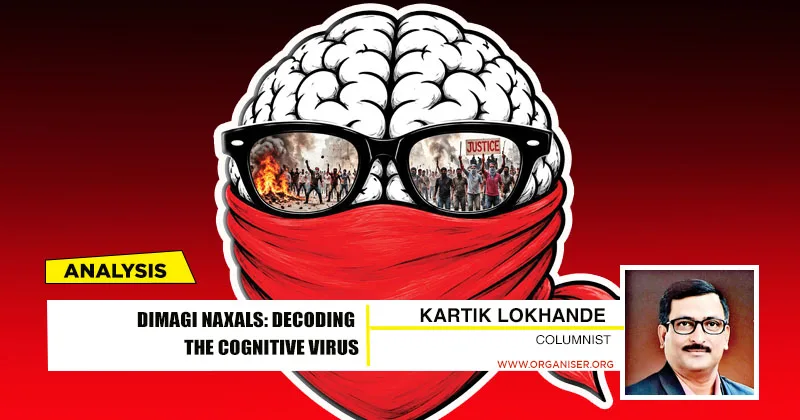
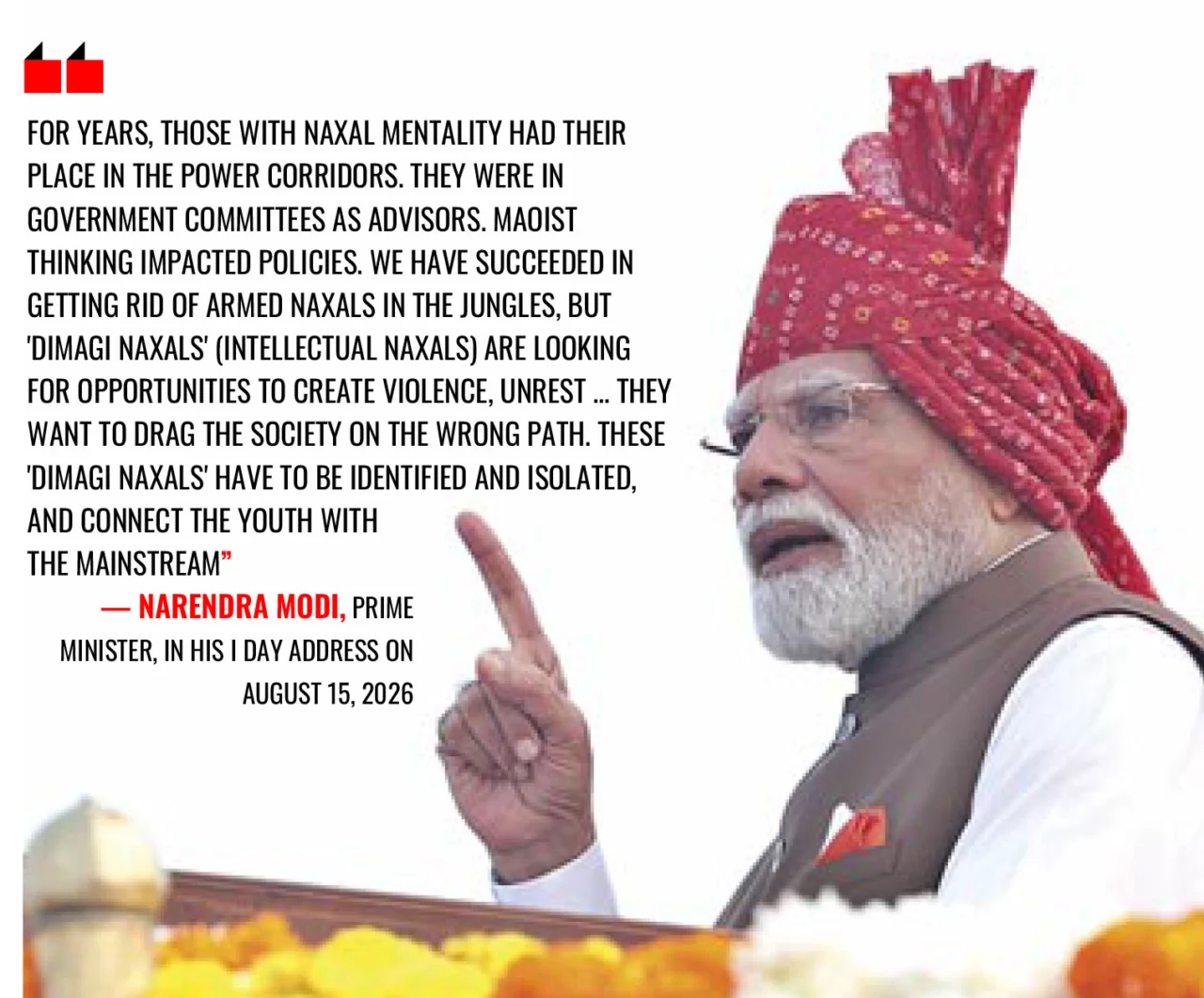
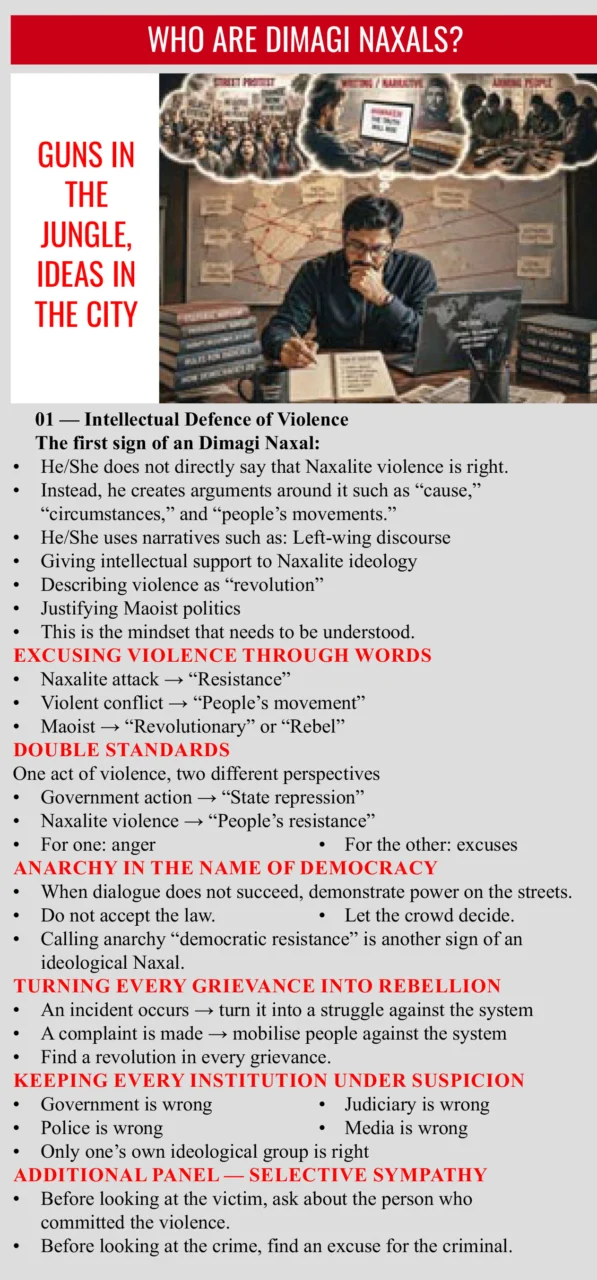
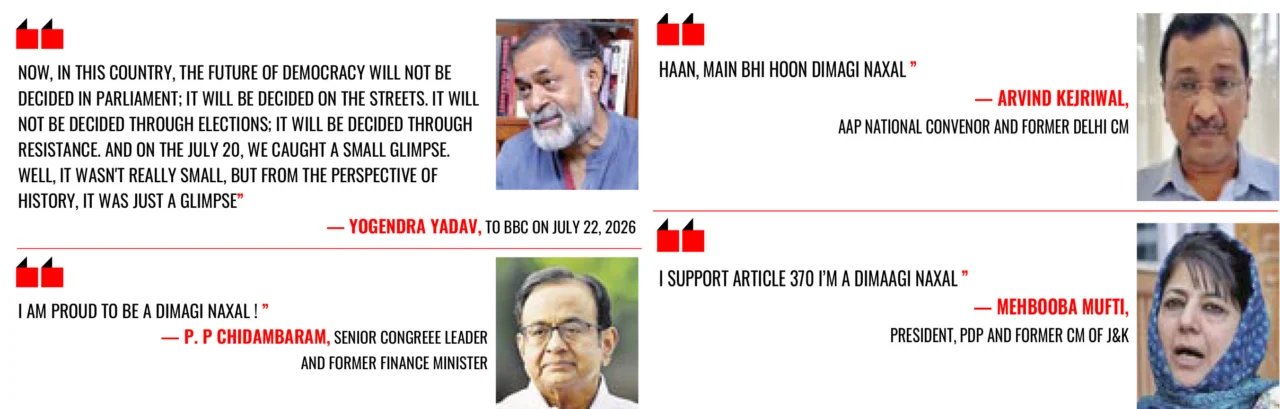
Prime Minister Narendra Modi’s Independence Day address this year has generated a lot of heat across various media formats, mainly because of the term Dimagi Naxal he used. Soon after, a political slugfest began. Senior Congress leader and former Union Home Minister P. Chidambaram described himself as a Dimagi Naxal after interpreting the term as a description of the opposition leaders. The Cockroach Janta Party (CJP) template of alternative politics came into play, with ‘someone’ launching the Dimagi Naxal Party on social media under the same usual names as at the time of CJP, and gaining millions of followers within a couple of days. Union Minister Kiren Rijiju said that Dimagi Naxals were those who supported the Maoists, rejected the Constitution, stood with separatists, and wanted to create anarchy. Within days of PM Modi’s speech, however, the entire country has started discussing and debating who is a Dimagi (intellectual or ideological) Naxal’? So far, everyone is adding a layer or two to the interpretation, with some even trying AI-generated responses. But, in all this heated debate, has someone taken a look at the documents of the Maoists to find out what they reveal about the Dimagi Naxals? Let’s do it.
Formenting Trouble
First, let’s make it clear that the erstwhile Naxalites and now the Maoists (covered under the term Left-Wing Extremism) have always enjoyed the support of the intellectuals, academics, writers, film-makers, and educated persons committed to the destructive and anti-India ideology with foreign roots. For instance, the pioneer figure behind the Naxalbari violence of 1967 – Charu Mazumdar – himself was a highly educated, English-speaking intellectual. Even after his death, we witnessed an orgy of violence and the splits and mergers of major Naxalite factions into CPI (Maoist). He still remains a key ideological and intellectual influence on the Left-Wing Extremists. Thus, from the inception of Naxalism to the present-day Maoism, this violent ideology was always backed by ‘Dimagi Naxals’. The only difference is that nobody has described it as impactfully as PM Modi has recently. Guided by the Dimagi Naxals, who mostly operated from urban centres, the ‘Hathiyari Naxals’ or the armed Maoists wreaked havoc in the forests and unleashed a killing spree on innocent tribals and other civilians.
What Does it Say?
Discussing the Dimagi Naxals’ in the context of the banned CPI (Maoist), especially after the collapse of its leadership and organisational structure owing to the Government’s resolute action over the past few years, one must first discuss the Maoist document titled ‘CPI-Maoist Party Programme’.
It speaks about ‘capture’ of the big cities in the name of ‘New Democratic Revolution’. It states clearly, “…we have to build a vast and well-entrenched underground network of the party and also other mass organisations among the working class and other toiling sections of the people along with students and intellectuals. And we have to build up political movements.”
If one of the founding documents of the Maoists speaks about focusing on ‘intellectuals’ and building up ‘political movements’, what else can be proof enough that Maoists have been working to indoctrinate the ‘Dimagi’ people from the cities, and also to instigate youth to build ‘political movements’?
Glorified Naxalism
But, of course, like Charu Mazumdar, there have been several others who were highly educated intellectuals but wasted their life glorifying or justifying Naxalism/Maoism. In some recent cases, several eminent social workers, writers, and intellectuals were named and accused of having Maoist links. The persons facing such accusations included ‘revolutionary poet’ Varavara Rao (who was arrested when Indira Gandhi was PM, and also when Modi was in his second term as PM), Kobad Ghandy (who has authored the book Fractured Freedom), Sridhar Srinivasan, Father Stan Swamy, Prof. G. N. Saibaba, Gautam Navlakha, Umar Khalid and the list is long. Of these, Sridhar Srinivasan, Swamy, and Saibaba are no more. The Maoists issued condolences upon their death. Does that indicate some emotional or ideological or intellectual connection among them and the Maoists? People today are smart enough to draw their own inferences.
From Protest to Disruption: The Gene Sharp Playbook in Bharat
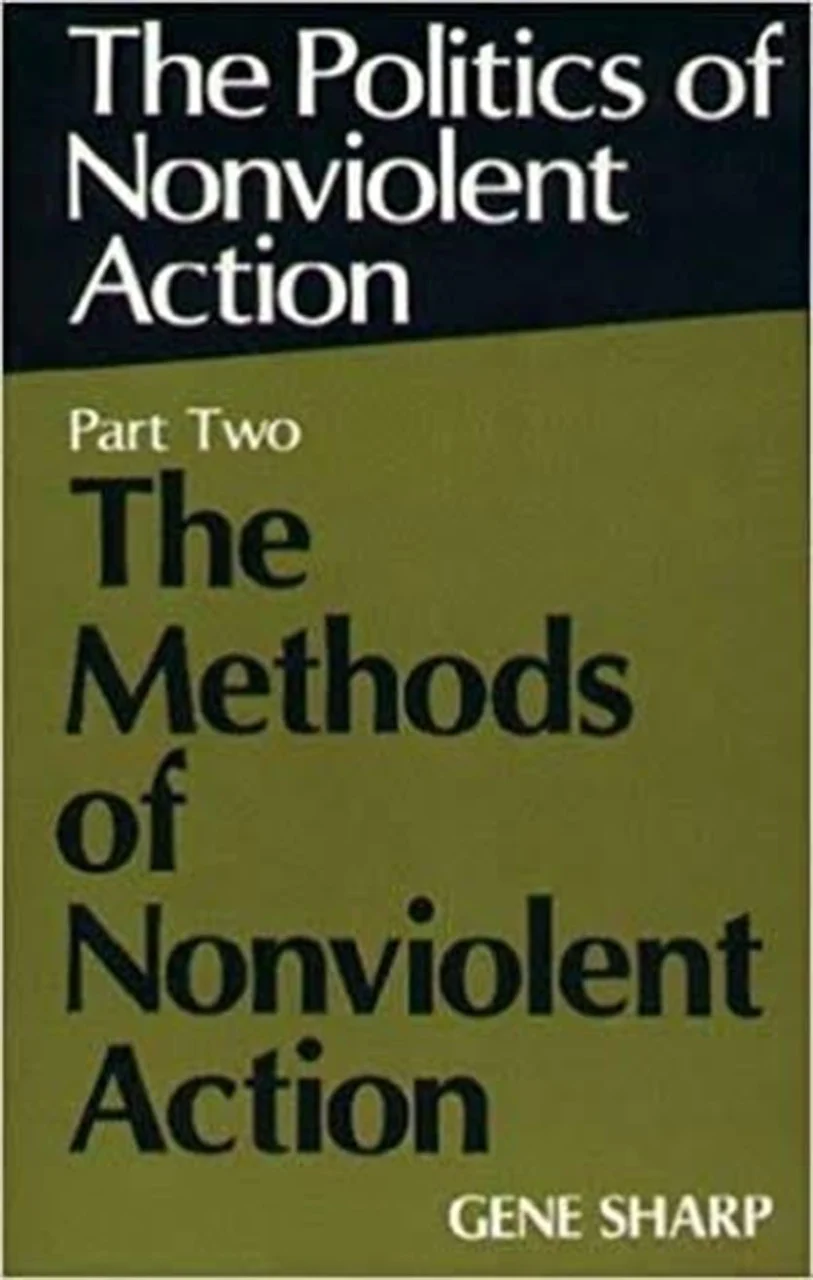
From “I am Cockroach” to “I am Dimagi Naxal too”, in the last few months Bharat is witnessing an unprecedented increase in anti-social voices, which are directly denying the existence of Institutions and challenging the elected Government violently. This tactic may trace back to Gene Sharp’s “198 Methods of Nonviolent Action”, a catalogue of tactics designed to weaken or challenge an existing power structure. It includes methods such as protests, strikes, boycotts, civil disobedience, non-cooperation, parallel institutions, and symbolic demonstrations.
Sharp’s framework can be understood through different stages:
Identify the sources of power
Governments depend on institutions such as the bureaucracy, police, military, courts, businesses, media, and public cooperation.
Identify weaknesses and dependencies
Activists examine where the government depends on public participation, legitimacy, money, labour, information, or institutional cooperation.
Few Sharp methods
Sharp documented 198 methods of so-called non-violent
action, including:
Protests and demonstrations
Strikes
Boycotts
Civil disobedience
Refusal to cooperate
Formation of parallel institutions
Symbolic acts and public displays
Boycott of elections
Hartal
Peasant strike
Blacklisting of traders
Lockout
Student strike
Social boycott
Mock funerals
Humorous skits and pranks
Performances of plays and music
Taunting officials
Rude gestures
Slogans, caricatures, and symbols
Economic shutdown
But Maoists have been cautious about the image of their sympathisers. They often refer to such sympathisers as ‘intellectuals’, ‘public thinkers’, ‘liberal democrats’ etc. Whenever the Maoists faced grave danger from the security forces, they roped in people falling into categories such as ‘mediators’. In their Central Committee meeting held in 2013, the Maoists made an interesting observation: “It would be useful if we do not appoint mediators in this struggle form. If we feel it is necessary, then it would be better not to appoint liberal democrats (such as BD Sharma, Haragopal etc). As they work as mediators from our side, they would be branded with the Maoist seal and they would face some limitations in working with other intellectual and democratic sections…” The Maoists have taken the names in their own document, and so far, no objection has appeared in the public domain.
During the 9th Unity Congress of the CPI (Maoist) held in 2007 (when Congress-led UPA was in power), the Maoists passed a resolution on ‘Prisoners’ Struggles’. According to the resolution, the Naxalite congress resolved to advance the people’s war throughout India by strengthening the People’s Liberation Army (PLA), the military wing of the CPI-Maoist, and mobilising more cadres through militant mass movements against the neo-liberal policies of globalisation, liberalisation, and privatisation. The conclave also decided to expand the armed struggle from ‘guerrilla war’ to ‘urban and mobile warfare’, focusing on industrial areas. The conclave also exhorted Naxalite cadres to use every possible means to free detained activists, including through jailbreaks.
The ‘mediators’ were to be appointed to make an organised effort to secure the release of the arrested key Maoist figures. The Maoists describe their arrested comrades as ‘political parties’ despite the fact that their party CPI (Maoist) and its front organisations are banned and that they do not contest any election conducted under the Constitution of India and in line with the highest democratic principles of the country.
Speaking of these so-called ‘political prisoners’, during the 9th Unity Congress of the CPI (Maoist) held in 2007 (when Congress-led UPA was in power), the Maoists passed a resolution on ‘Prisoners’ Struggles’. That resolution had two important aspects – to make an organised effort to secure the release of ‘political prisoners’ and to turn the prisons into ‘political universities’ by imparting ‘political education’ to other prisoners.
Glorifying Afzal Guru
Soon after, an outfit was floated by the name Committee for the Release of Political Prisoners (CRPP), which was banned in some States as a Maoist front organisation during Congress-led UPA’s rule. In 2010, this CRPP organised ‘Azadi: The Only Way’ convention in Delhi. As the title suggests, it championed the cause of ‘Azadi’ as per the idea of secessionist elements in Kashmir, Punjab, Manipur etc. CRPP, through this convention, tried to further the ‘Tukde Tukde’ agenda. Through its magazine The Arrested, CRPP tried to glorify Parliament attack convict Afzal Guru. Yes, the same Afzal Guru in whose ‘honour’ the ‘Tukde Tukde Gang’ raised the slogan – ‘Tum Kitne Afzal Maroge, Har Ghar Se Afzal Niklega’.
Current Generation of Urban Naxals
Interestingly, a ‘student activist ’, Umar Khalid, was also speaking the same language before he was arrested on charges of being the key conspirator in the Delhi Riots (2020) case. Now, connect the dots. CRPP’s public relations man Rona Wilson was arrested from Delhi. Apart from Umar Khalid, another ‘activist’ Sharjeel Imam was arrested for making a seditious statement of ‘severing the North-East from rest of India’. Since CRPP was banned in some States, and it came under scanner, newer fronts are being launched like CaRWAN, which is campaigning for release of those arrested on charges of instigating worker unrest in Manesar and Gurugram earlier this year. Another new Maoist front Persecuted Prisoners’ Solidarity Committee (PPSC) is working to mobilise lawyers and activists to collect information to challenge the Unlawful Activities Prevention Act (UAPA) and the newly passed Maharashtra Special Public Security Act. ‘Chronology Samajhiye’ is an apt expression for the people to understand the links among all these. Who is holding all these strings together, creating social media posts, printing books, making emotional reels, penning articles? The answer is simple: Dimagi Naxals. There is more to the story.
Modus Operandi Revealed
Two more documents of the Maoists shed even better light on how do they target Dimagi people and indoctrinate them into Dimagi Naxals. In their document ‘Urban Perspective: Our Work in Urban Areas’, the Maoists state, “There is the need to emphasise the necessity of uniting with intellectuals. We need to allot sufficient cadre to work among them and put some special effort to unite and organize them.” Besides intellectuals, they have been focusing on student organisations, writers, cultural activists, environmental groups, teachers and middle-class employees’ associations etc. The Maoists first unite all these into ‘Legal Democratic Organisations’. Some such organisations “may be those catering to a particular section like trade unions, student bodies, women’s fronts, caste abolition organisations, nationality organisations, writers’ associations, lawyers’ organisations, teachers’ associations, cultural bodies, etc,” they add.
To indoctrinate these Dimagi segments of society, the Maoists have a well-laid-out plan. Their ‘Politburo Member in-charge’ is tasked with conducting the ‘ideological and political education of the group’. “While classes and joint study should be conducted, great importance should also be given to other more flexible methods like informal discussion, films, individual reading, etc,” they state in ‘Urban Perspective’ document. It does not stop there, they try to use libraries, ‘street corner reading posts’, and other such means to “disseminate progressive literature among other general books such as lecture series during festivals, debate competitions, elocution competitions, etc. where our comrades express progressive views; public speaking courses, personality development courses, etc. with political topics included in the syllabus; mass organisation training camps, and the like.” Doesn’t all this sound like Dimagi Naxal activity plan? One can’t be too naïve to not understand this. Then, there is another Maoist document, ‘Strategy and Tactics of Indian Revolution’. It clearly acknowledges the existence of what is being described as Dimagi Naxals today. It states, “It was first of all among intellectuals, students and youth that Marxism-Leninism in India had extensively spread and found acceptance.” Apart from reiterating the need for focusing on unemployed youth living in the extensive rural areas and towns and cities, teachers, intellectuals, employees in other fields etc, this particular Maoist foundational document makes the Dimagi Naxal activity amply clear.
“We should try to prepare bulletins, pictorial stories, video films etc., for developing the understanding regarding basic Marxism for new PMs and for the peasantry and the Adivasi peasantry. We should seek help from sympathiser educationists. Bringing out magazines based on local resources and improving them during that course itself should be our policy…
“The CC must set up a Central Publishing House for publishing ideological and political literature in English and Hindi; the local language publishing houses of the State units will publish literature according to requirements in the local languages. The official ideological-political organ of the Party should be brought out regularly to focus on ideological-political issues. It will be published secretly and can be translated into the regional languages. The Central political organ of the Party should be brought out in English and Hindi and in other languages according to the decision of the CC. This magazine must basically take the political stand of the party on current issues and current extensive reports of the movement.” The above extensive quote from the Maoist foundational document answers how social media platforms, especially Instagram, have so much of reel, pictorial content that speaks the language of basic Marxism first, resort to ‘political education’, then deploy subtle radical ideas, and ultimately instigate the followers. Who thinks of devising such ideas of indoctrination and radicalisation?
‘Dimagi Naxals!’
It is very easy to distinguish Dimagi Naxals from genuine dissenters. While the genuine dissenters stick to Constitutional and democratic methods, the Dimagi Naxals aim at creating what ‘Bharat Ratna’ Dr. Babasaheb Ambedkar described as ‘grammar of anarchy’. He must be credited with prescribing the ultimate test of identifying Dimagi Naxals of the future.