New Delhi: Former Union Finance Minister and senior BJP leader Arun Jaitley passed away on August 24, 2019, at the age of 66, after undergoing treatment at the All India Institute of Medical Sciences (AIIMS) in New Delhi. On his death anniversary, his political journey and contribution to India’s economic transformation continue to be remembered by leaders across the political spectrum.
A lawyer by profession and a prominent parliamentarian, Jaitley occupied several important positions during a political career spanning decades. He was known for his sharp parliamentary interventions, legal expertise and significant role in shaping the economic policies of the BJP-led governments.
Jaitley’s political journey began during his student days. He graduated with a BCom (Honours) degree from Shri Ram College of Commerce in 1973 and obtained his LLB degree from the Faculty of Law, University of Delhi, in 1977. At Delhi University, he became an active leader of the Akhil Bharatiya Vidyarthi Parishad (ABVP) and served as president of the Delhi University Students’ Union in 1974.
During the Emergency imposed between 1975 and 1977, Jaitley was detained under preventive detention laws and spent 19 months in jail. After his release, he joined the Jan Sangh and subsequently rose through the BJP’s organisational and political ranks.
Jaitley became a BJP national executive member in 1991 and emerged as a prominent party spokesperson in the period leading up to the 1999 Lok Sabha election. In the Atal Bihari Vajpayee-led government, he handled key portfolios, including Commerce and Industry, Law and Justice, Corporate Affairs and Finance.
He later became one of the BJP’s most influential parliamentary leaders. From 2009 to 2014, he served as the Leader of the Opposition in the Rajya Sabha. He also remained an important strategist and communicator for the party during major political and policy debates.
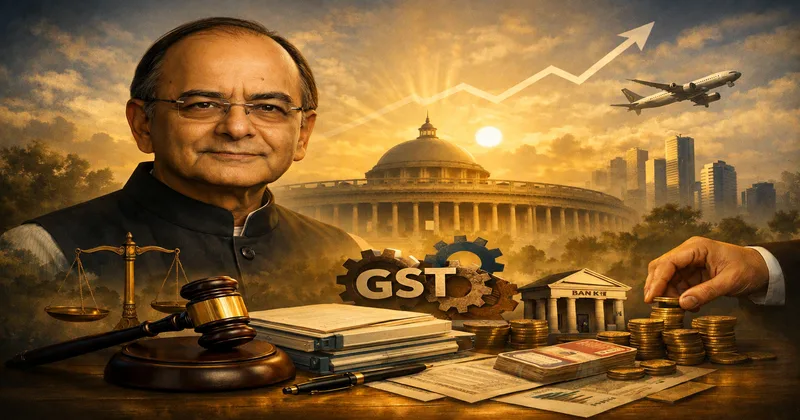
As Finance Minister in the Narendra Modi government, Jaitley was closely associated with several major economic reforms.
Goods and Services Tax: Jaitley played a central role in building political consensus around the Goods and Services Tax (GST), which came into effect in 2017 and replaced a complex web of indirect taxes with a nationwide tax framework.
Insolvency and Bankruptcy Code: The IBC, enacted in 2016, sought to establish a time-bound framework for resolving insolvency and recovering distressed assets, addressing the longstanding problem of bad loans.
Financial inclusion: Jaitley supported initiatives aimed at expanding access to formal banking and financial services, including the Pradhan Mantri Jan Dhan Yojana.
Banking-sector reforms: His tenure saw measures for strengthening public-sector banks, including recapitalisation and consolidation.
Demonetisation: Following the November 2016 decision to withdraw old Rs 500 and Rs 1,000 currency notes, Jaitley played a key role in explaining and implementing the government’s economic response.
Digital economy: His tenure coincided with the rapid expansion of digital payments and the formalisation of the economy.
Corporate tax reforms: Measures reducing corporate tax rates for eligible companies were aimed at encouraging investment and improving the business environment.
Foreign investment: His tenure also witnessed policy measures aimed at liberalising foreign direct investment in several sectors.
Social-sector initiatives: As Finance Minister, Jaitley was involved in budgetary support for flagship welfare programmes, including the Pradhan Mantri Ujjwala Yojana.
Labour and maternity benefits: The extension of statutory maternity leave to 26 weeks was another significant policy change during his tenure.
Beyond economics, Jaitley was also a respected Supreme Court advocate. He practised law before the Supreme Court and various High Courts and was widely regarded for his legal acumen.
Seven years after his death, Arun Jaitley’s legacy remains closely associated with a period of significant economic and institutional change. Whether in Parliament, the courtroom or the Finance Ministry, his influence on India’s political and economic discourse remains an important part of his enduring legacy.