New Delhi: On the occassion of National Space Day, Prime Minister Narendra Modi urged India to build a globally dominant private space ecosystem and reiterated startups to leverage the country’s cost competitiveness, vast talent pool and policy stability as a strategic advantage to attract global talent, companies and investment to accelerate the domestic space paradigm, to greater heights.
Prime Minister also encouraged India’s emerging private space industry to think beyond domestic ambitions and position the country as a global destination for space careers, innovation and investment.
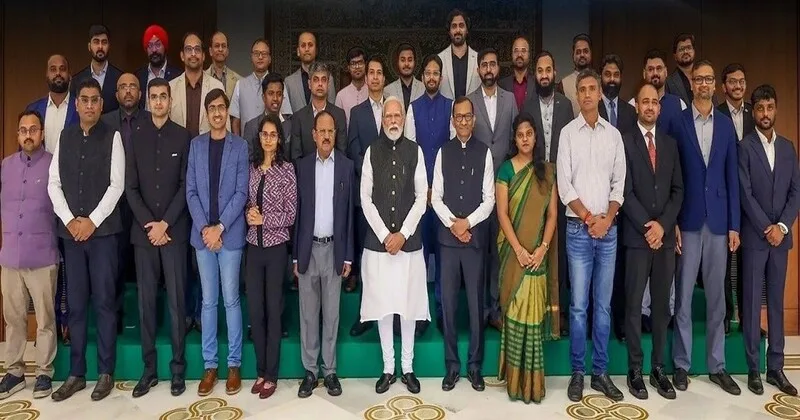
Interacting with the CEOs and founders of 20 space startups in New Delhi on the ocaasion of National Space Day, PM Modi said India should create an “aura” in which people across the world feel that if they want to build a career in space, they should come to India. He also highlighted India’s cost advantage, skilled workforce and willingness to take risks as key factors that could help the country rapidly establish itself as a major global space power.
Met India’s brightest space StartUps.
As always, came away impressed by their energy and ambition.
You would love their insights and optimism.
Do tell me…what excites you most about India’s space journey? #NationalSpaceDay pic.twitter.com/d1pDC0UZ6p
— Narendra Modi (@narendramodi) August 23, 2026
World should look towards India when it thinks about space: PM Modi
PM Modi said that India’s space sector has the potential to become a magnet for global talent, companies and capital. “I believe we should create an aura where people from all over the world feel that if they want to build a life in this field, they should come to India”, he said, stressing that global professionals should aspire to join Indian space startups or the country’s space agency.
The Prime Minister said the private space ecosystem could attract the entire global talent pool “like a magnet”, turning human capital into a major strategic strength for India. His remarks come as the country’s space sector expands rapidly beyond traditional government-led programmes, with private companies increasingly involved in launch vehicles, satellites, earth observation, space intelligence, propulsion, debris management and other emerging technologies.
Happy National Space Day! 🛰️
Here’s to dreaming even bigger, innovating more and pushing newer frontiers…. pic.twitter.com/ZebTBth2bA
— Narendra Modi (@narendramodi) August 23, 2026
Cost advantage, talent, policy stability and risk-taking to drive growth
PM Modi underlined three major advantages that could help India compete globally:
- Cost competitiveness
- Vast akilled talent pool
- Ability to take risks
“We are highly cost-competitive. There is no question regarding the quality of talent,” he said, adding that India’s natural risk-taking capacity could allow the country to “rapidly carve out a niche” in the global space sector.
The Prime Minister also stressed the importance of policy consistency in giving entrepreneurs the confidence to invest in a high-risk industry. He said that entrepreneurs should know that while mistakes arising from their own decisions may have consequences, they would not be abandoned by the government. According to PM Modi, building this trust was central to the decision to open the space sector to private participation.
Private space sector gains investor confidence
While interacting with PM Modi, the space startup founders highlighted the progress made since India opened the space sector to private players. Skyroot Aerospace, India’s first space-tech unicorn, has successfully launched the country’s first privately developed rocket into orbit, while private companies are now looking to dramatically increase launch frequency.
The founders said that facilities are being developed with the capacity to produce one rocket a month, with a target of achieving monthly launches by mid-2027. Their longer-term ambition is to scale up to one launch a week and eventually several launches a day.
The space startup CEOs also pointed to the growing investor confidence following the successful launches. One CEO told PM Modi that investor confidence had increased significantly after Skyroot’s first launch.
Another startup founder said that the company had secured eight launch contracts within a month of a successful launch, with most of them coming from international customers. The developments underline the growing commercial potential of India’s private space ecosystem and its increasing integration with the global market.
India’s space startups eye global expansion
The CEOs also outlined plans to establish a global ground station network over the next 18 months. They said opening the sector to private participation has generated strong enthusiasm and created opportunities for Indian companies to develop technologies domestically and compete internationally.
The founders also highlighted a reverse talent flow, with Indians working in the US and Europe increasingly expressing interest in returning to India and joining the country’s growing space industry. PM Modi said this trend should be expanded into a broader global talent movement towards India.
Space technology must reach everyday life
Beyond launches and satellites, PM Modi called on startups to expand the use of space technology across sectors that directly affect people’s lives. He encouraged greater applications in agriculture, livestock management, dairy, environmental protection and other areas.
The Prime Minister suggested that the companies developing space-based agricultural technologies should work with agricultural universities and government departments to help farmers make better-informed decisions and improve productivity.
Similarly, companies working on space-debris management could collaborate with environmental organisations to scale up solutions. The broader objective, PM Modi indicated, is to ensure that space technology moves beyond specialised applications and becomes an important tool for economic development and everyday problem-solving.
Atal Tinkering Labs to build young space talent
PM Modi also called for closer collaboration between space startups and Atal Tinkering Labs to nurture curiosity about space among children from an early age. Such engagement, he suggested, could create a new generation of students interested in space science, engineering, innovation and entrepreneurship.
The move reflects the government’s broader effort to connect India’s expanding space ecosystem with schools, startups, universities, industries and research institutions.
20 startups at the centre of India’s space ambition
The interaction with the Prime Minister brought together founders and CEOs from 20 space startups working across diverse areas of the space economy. They included Skyroot Aerospace, Agnikul Cosmos, Pixxel, Dhruva Space, GalaxEye, PierSight, Bellatrix Aerospace, Digantara, SatSure, Suhora Technologies, Manastu Space, Astrobase, TakeMe2Space, VyomIC, Cosmoserve Space, OrbitAID Aerospace, SkyServe (Hyspace), Serendipity Space, Vassar Labs and mistEO.
Their work spans designing & launching rockets, reusable launch systems, avionics, satellites, advanced propulsion, space and defence intelligence, space-debris removal, earth observation and AI-powered weather and climate intelligence.
From Chandrayaan-3 to nurturing a world-class private space economy
The push for a globally competitive private space industry comes as India marks National Space Day on August 23, commemorating the historic Chandrayaan-3 landing in 2023.
The Vikram lander’s successful soft landing on the Moon’s south polar region marked a landmark achievement for India and demonstrated the capabilities of its scientists and engineers. The mission also generated scientific data for researchers and inspired a new generation to take an interest in the space exploration.
ISRO Chairman V Narayanan, recalling the organisation’s early years, highlighted the extraordinary transformation of India’s space programme—from an era when rocket components were transported using bicycles to India’s emergence as a major global space power and the next phase increasingly being shaped by private enterprise.